






George Vlachogiannis, Managing Editor of Cancer Control at Sage, shared a post on LinkedIn:
“Passing the Baton: Succession Planning and Mentorship for Cancer Control in Low- and Middle-Income Countries.
Cancer control in low- and middle-income countries (LMICs) depends not only on funding, infrastructure, and technology, but also on the people who lead and sustain these systems over time.
This Perspective article by Prof Nirmala Bhoo Pathy MD PhD and Prof Nazik Hammad, recently published in Cancer Control, makes an important point: when mentorship and succession planning are left informal, cancer programs become vulnerable. Progress in screening, treatment, palliative care, research, and policy can be disrupted when key leaders retire, relocate, or step back.
Mentorship and succession planning in LMICs should not depend on goodwill alone. Rather, they need to be built into cancer systems, with clearer pathways for early- and mid-career professionals, more inclusive leadership opportunities, and better transfer of knowledge across generations. Strengthening cancer control, also means investing in the people who will carry it forward.”
Title: Passing the Baton: Succession Planning and Mentorship for Cancer Control in Low- and Middle-Income Countries
Authors: Nirmala Bhoo-Pathy, Yupei Zhang and Nazik Hammad
Read The Full Article

Nirmala Bhoo Pathy, Professor at the University of Malaya and Adjunct Professor at Kasturba Medical College, Manipal, added:
“Every cancer control programme in a low- or middle-income country has a name attached to it. The person who built the screening initiative, fought for the registry, kept the palliative service alive when the budget said it could not exist. We call them champions. We rarely ask what happens when they leave.
This has been on my mind for a long time, and not only as a public health physician or research lead. I am where I am because powerful mentors passed me the baton. I now spend much of my time trying to pass it on.
Nazik Hammad and I have circled this problem for years from different ends of the world, she across Africa, I across Asia, and arrived at the same conclusion. The continents differ. The fragility does not. When leadership rests on a few individuals with no succession planning behind them, a single departure can stall an entire programme.
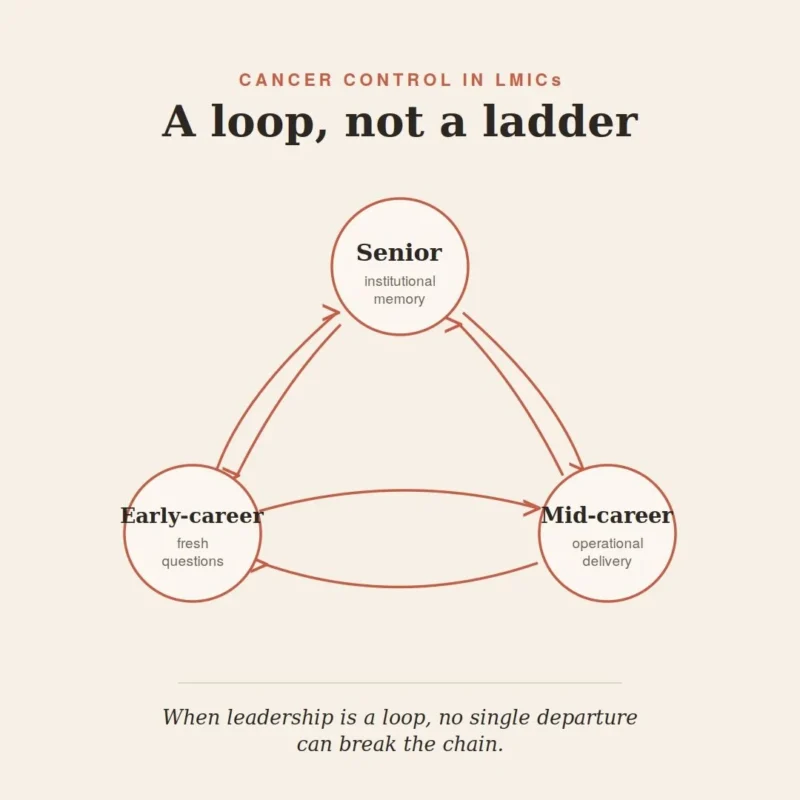
Our paper, out today in Cancer Control and open access, proposes a different model. Not a hierarchy but a continuity system, where senior leaders hold institutional memory, mid-career professionals anchor delivery, and early-career colleagues bring fresh questions. Each stage holds the others. Succession becomes a core function of the system, written into leadership KPIs, not left to chance. And drawing on the Lancet Commission on Women, Power and Cancer, we argue it has to be intentionally inclusive, or it simply reproduces the same exclusions in the next generation.
We wrote it with Yupei Zhang, an early-career colleague from the University of Manchester. After all, a paper about intergenerational continuity should itself be the work of more than one generation. Would love to hear how this lands in your setting.”
Other articles about Cancer Control on OncoDaily.