In a pair of announcements that underscore Gilead Sciences’ intensifying commitment to oncology, two of its collaboration partners, Cartography Biosciences and Kymera Therapeutics, revealed today that Gilead has exercised exclusive licensing options under pre-existing agreements. Taken together, the moves reveal a company not merely building a pipeline on paper, but actively pulling the most promising programs forward into development.
Cartography Bio: First Option Exercised on Novel Tumor-Selective Target
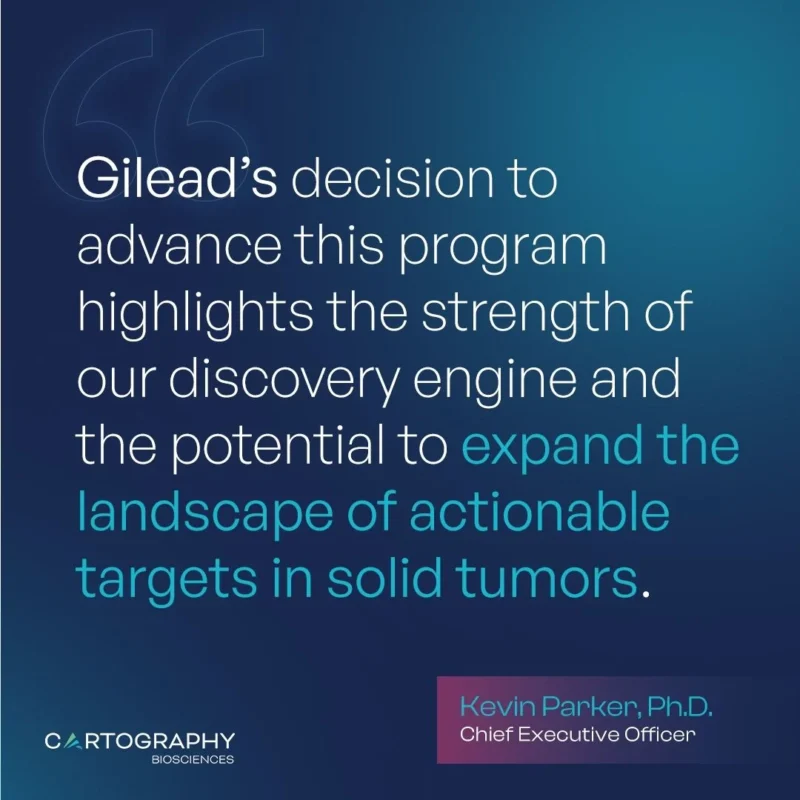
Cartography Biosciences made the following announcement on LinkedIn:
We’re pleased to share that Gilead Sciences has exercised the first of its options to exclusively license an oncology target discovered and validated through our proprietary ATLAS and SUMMIT platforms as part of our collaboration.
This milestone underscores our systematic approach to uncover high-value, tumor-selective targets and target combinations designed to drive potent anti-tumor activity while minimizing off-tumor toxicity.
We look forward to continuing our work with Gilead to advance additional programs and translate these insights into meaningful impact for patients.
Read the full announcement.”
Cartography Biosciences/LinkedIn
The option exercise marks the first concrete milestone under a collaboration the two companies launched in May 2024. Under the original agreement, Cartography received an upfront payment of $20 million, with the collaboration initially focused on identifying tumor-selective target antigens in triple-negative breast cancer (TNBC) and the most common form of non-small cell lung cancer (NSCLC), adenocarcinoma.
The significance of ATLAS and SUMMIT lies in the problem they are designed to solve. The current target landscape in oncology is growing increasingly crowded, and there is an urgent need to provide patients with innovative, targeted medicines, a challenge that computational target discovery platforms are uniquely positioned to address by identifying novel antigens overlooked by conventional approaches. Gilead exercising its first option signals that the platform has delivered a target compelling enough to advance, validating both Cartography’s discovery capabilities and the rationale for the original partnership.
Kymera Therapeutics: Gilead Licenses First-in-Class CDK2 Molecular Glue Degrader
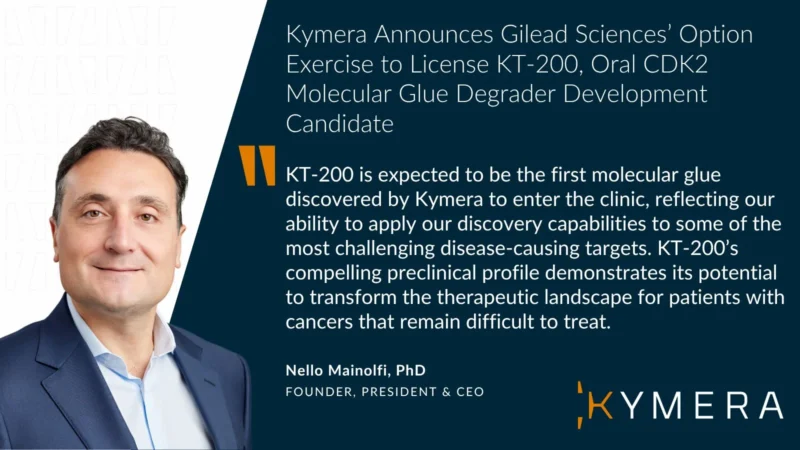
In a separate but strategically resonant announcement, Kymera Therapeutics stated on LinkedIn:
We’re excited to share that Gilead has exercised its option to license KT-200, our first-in-class, oral CDK2 molecular glue degrader, and advance the program into further development.
This milestone marks important progress in our strategic collaboration and further validates the potential of our differentiated discovery engine to deliver a new generation of medicines for patients that remain underserved by the current standard of care.
Read the full press release.
Kymera Therapeutics/LinkedIn
Gilead will progress KT-200 into IND-enabling studies to support an IND filing in 2027.
KT-200 represents a meaningful advance in targeting CDK2, a validated but historically elusive driver of tumor growth. Rather than merely inhibiting CDK2 function, KT-200 degrades the protein through molecular glue mechanisms — a selective approach that could reduce the off-target effects common with traditional CDK inhibitors and offer a safer, more precise treatment option for CCNE1-amplified cancers, including advanced breast cancer.
Preclinical data has been encouraging. KT-200 demonstrated low-nanomolar degradation of CDK2, robust activity in CCNE1-amplified and overexpressed cell lines and in vivo tumor models, brain-penetrant potential, and a favorable safety profile.
Under the terms of the agreement, Kymera is eligible to receive up to $750 million in total payments, with $85 million in upfront and option exercise payments realized to date. Kymera retains eligibility for tiered royalties on net product sales ranging from high single-digit to mid-teens percentages.
A Pattern Worth Noting
Considered in isolation, each of these option exercises is a meaningful milestone. Considered together, they reveal something larger: Gilead is systematically converting its partnership portfolio into active development programs. Both the Cartography and Kymera exercises reflect options built into structured discovery collaborations, a deal architecture that allows large pharma to fund early-stage science without fully committing, then selectively advance winners.
That Gilead is now exercising these options, on top of three acquisitions totaling more than $15 billion in 2026 alone, points to a company executing with notable discipline and speed. Each activated program adds a distinct modality to Gilead’s oncology arsenal: novel tumor-selective antigens from Cartography feeding potential ADC or bispecific applications; a first-in-class degrader from Kymera targeting a CCNE1-driven cancer biology with proven unmet need.
For both Cartography and Kymera, Gilead’s confidence is a meaningful signal, not just financially, but as external validation of platform-level capabilities that both companies are actively marketing to additional partners.
Read more biotech insights on OncoDaily Biotech.
Written by: Semiramida Nina Markosyan, Editor, OncoDaily Canada