The U.S. Food and Drug Administration (FDA) has granted Fast Track designation to FG001, FluoGuide A/S’s investigational fluorescent imaging agent, for use as an intraoperative imaging guide during surgical resection of high-grade glioma (HGG). The March 18, 2026 announcement follows the FDA’s clearance of an investigational new drug (IND) application in February 2026, positioning the Danish biotech to initiate a U.S. Phase 2 registration trial in the second quarter of 2026.
Addressing Critical Unmet Need in Glioblastoma Surgery
High-grade gliomas, particularly glioblastoma (the most aggressive form), remain among oncology’s most challenging malignancies. Despite maximal surgical resection followed by radiation and temozolomide chemotherapy, median overall survival remains approximately 12-15 months, with recurrence nearly universal.
You can read more on the Glioblastoma on OncoDaily.
Donna Haire, Chief Operating Officer of FluoGuide, emphasized the significance of Fast Track designation:
Fast Track designation for FG001 is a meaningful recognition by FDA of the significant unmet need in [high-grade glioma] and the potential of our program to improve intraoperative tumor detection. We greatly value the opportunity to work closely with the FDA and deeply appreciate their engagement as we continue to advance FG001 for patients facing this devastating cancer.

FG001 Mechanism: uPAR-Targeted Fluorescence-Guided Surgery
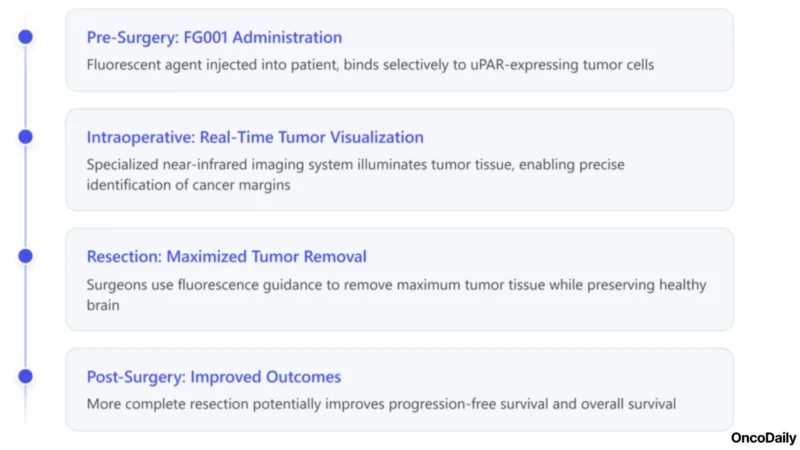
FG001 is a targeted fluorescent imaging agent that binds to the urokinase-type plasminogen activator receptor (uPAR), a protein highly expressed on many aggressive cancer cells. When administered before surgery, FG001 causes tumor tissue to fluoresce under specialized near-infrared imaging systems, enabling surgeons to visualize cancer cells in real-time during resection.
How FG001 Works:
The uPAR-targeting mechanism differentiates FG001 from 5-aminolevulinic acid (5-ALA), the most widely used fluorescence-guided surgery agent, which relies on metabolic conversion to a fluorescent compound within tumor cells.
U.S. Phase 2 Registration Trial: Timeline and Strategy
FluoGuide plans to enroll the first patient in its U.S. Phase 2 registration trial in Q2 2026. The IND was initially submitted to the FDA in January 2026 and cleared the following month.
Investigators anticipate that two U.S. trials will be required to support U.S. regulatory approval of FG001 in patients with HGG89. This dual-study strategy is common for surgical imaging agents, allowing for:
- Dose optimization and safety validation in the first trial
- Confirmatory efficacy data in the second trial
- Support for labeling claims regarding extent of resection and clinical outcomes
Morten Albrechtsen, Chief Executive Officer of FluoGuide, stated:
We are pleased achieving this important milestone in our endeavor to help patients with high-grade glioma.

Clinical Context: Fluorescence-Guided Surgery Landscape
Fluorescence-guided surgery has emerged as a promising adjunct in neuro-oncology, with the goal of maximizing tumor resection while preserving neurological function. The most established agent is 5-aminolevulinic acid (5-ALA), which received FDA approval and has been shown in randomized trials to:
- Improve extent of resection
- Increase progression-free survival
However, 5-ALA has limitations:
- Variability in fluorescence intensity across tumor regions
- Specificity challenges with signal from non-tumor tissue
- Logistical complexities related to administration timing and visualization requirements
FG001’s uPAR-targeting mechanism aims to address some of these limitations by providing more specific tumor visualization through receptor-targeted binding rather than metabolic conversion.
Broader Pipeline: Beyond Glioma
While the Fast Track designation focuses on HGG, FG001 is also being investigated in head and neck cancer and lung cancer, reflecting the broad expression of uPAR across various solid malignancies. This pan-tumor applicability could significantly expand FG001’s commercial potential if clinical trials demonstrate efficacy across multiple cancer types.
Competitive Landscape and Market Opportunity
FluoGuide enters a competitive but underdeveloped market for fluorescence-guided surgery agents:
Current Players:
| Agent | Target/Mechanism | Status | Key Limitation |
| 5-ALA (Gleolan) | Metabolic (protoporphyrin IX) | FDA-approved | Variable fluorescence, specificity issues |
| Fluorescein sodium | Non-specific | Off-label use | Limited tumor specificity |
| Tumor Paint (BLZ-100) | Chlorotoxin peptide | Phase 2 development | Development status unclear |
| FG001 | uPAR-targeted | Fast Track, Phase 2 starting | Requires validation in registration trials |
The market opportunity is substantial given:
- 14,000+ new glioblastoma diagnoses annually in the U.S.
- Maximal safe resection as a key prognostic factor
- Limited approved fluorescence agents with validated clinical benefit
Regulatory Precedent and Approval Pathway
The FDA’s approval of 5-ALA (Gleolan) in 2017 established a regulatory precedent for fluorescence-guided surgery agents in glioma. The approval was based on:
- Randomized Phase III data showing improved extent of resection
- Progression-free survival benefit
- Acceptable safety profile
FluoGuide will likely need to demonstrate similar endpoints in its registration trials:
- Primary endpoint: Proportion of patients achieving gross total resection or extent of resection improvement
- Secondary endpoints: Progression-free survival, overall survival, safety
- Surrogate markers: Correlation between extent of resection and clinical outcomes
Key Takeaways
- FDA grants Fast Track designation to FG001 for high-grade glioma surgery, expediting development timeline.
- FG001 is uPAR-targeted fluorescent imaging agent that causes tumor tissue to fluoresce during surgery.
- U.S. Phase 2 registration trial launching in Q2 2026 following February 2026 IND clearance.
- Fast Track benefits include frequent FDA interactions, rolling review eligibility, and priority review potential.
- Addresses critical unmet need in glioblastoma, where median survival is 12-15 months despite current treatments.
- Two U.S. trials anticipated to support regulatory approval.
- Differentiated from 5-ALA through receptor-targeted mechanism vs. metabolic conversion.
- Broader pipeline includes head and neck and lung cancers, reflecting uPAR’s pan-tumor expression.
- Clinical data published in Neurosurgery journal (June 2025) provides independent validation.
- Competitive with 5-ALA (Gleolan) and other fluorescence-guided surgery approaches.
Read more biotech insights on OncoDaily Biotech.
Written by: Semiramida Nina Markosyan, Editor, OncoDaily Canada