





Curtis Lachowiez, Oncologist and hematologist at the OHSU Knight Cancer Institute, shared on X:
“Happy to share our collaborative work out now in Journal of Clinical Oncology describing risk prognostication in AML following HMA+VEN therapy.
Title: Risk Prognostication After Hypomethylating Agents Combined With Venetoclax in AML: The PRISM Risk Model
Authors: Curtis A. Lachowiez, Joshua F. Zeidner, Jad Othman, Andy Kaempf, Seongseok Yun, Maël Heiblig, Michael Heuser, Rabia Shahswar, Rafael Madero Marroquin, Joseph M. Cannova, Andrius Žučenka, Jennifer Marvin-Peek, Jayastu Senapati, Yasmin Abaza, Alok Swaroop, Irene Zacheo, Federica Monaco, Amine Belhabri, Urbain Tauveron-Jalenques, Emmanuelle Tavernier, Martin Carré, Gaspar Aspas Requena, Rachel J. Cook, Elie Traer, Jennifer N. Saultz, Jenny O’Nions, Faisal Basheer, John Laurie, Shivani Handa, Eytan M. Stein, Maria R. Baer, Rebecca Olin, William Blum, Gary Schiller, Tara Lin, Emily Curran, Ashley Yocum, Ellen Madarang, Naval Daver, Tapan M. Kadia, Giovanni Marconi, Yazan Madanat, Richard Dillon, Courtney D. DiNardo, Ronan Swords, Juan E. Arango Ossa, Justin Watts, Sanam Loghavi, Daniel A. Pollyea, Elsa Bernard
This work was built upon recognition by others that ELN22 doesn’t adequately risk-stratify patients treated with VEN-based regimens. Instead, the 4 gene classifier (evaluating mutations in NRAS, KRAS, FLT3-ITD, and TP53) better stratified OS.
Title: Genetic risk stratification and outcomes among treatment-naive patients with AML treated with venetoclax and azacitidine
Authors: Hartmut Döhner, Keith W. Pratz, Courtney D. DiNardo, Andrew H. Wei, Brian A. Jonas, Vinod A. Pullarkat, Michael J. Thirman, Christian Récher, Andre C. Schuh, Sunil Babu, Xiaotong Li, Grace Ku, Zihuan Liu, Yan Sun, Jalaja Potluri, Monique Dail, Brenda Chyla, Daniel A. Pollyea
However, this foundational model still had room for improvement. We demonstrated adding or reclassifiying certain mutations could improve OS stratification beyond the initial 4-gene classifier, and ELN24 risk categories.
Title: Refined ELN 2024 risk stratification improves survival prognostication following venetoclax-based therapy in AML
Authors: Curtis A. Lachowiez, Vishvaas I. Ravikumar, Jad Othman, Jenny O’Nions, Daniel T. Peters, Christine McMahon, Ronan Swords, Rachel Cook, Jennifer N. Saultz, Jeffrey W. Tyner, Richard Dillon, Joshua F. Zeidner, Daniel A. Pollyea
Additionally, other groups had developed alternative risk models, some inclusive of cytogenetics.
Title: Beat AML genetic risk stratification model in a cohort of older VEN/HMA-treated patients with AML
Authors: Fieke W. Hoff, Ashley O. Yocum, Uma M. Borate, Alice S. Mims, John C. Byrd, Yazan F. Madanat
Title: Prognostic Model Combining Mutational and Cytogenetic Profiles in Acute Myeloid Leukemia Treated with Venetoclax and Hypomethylating Agents
Authors: Dimitrios Drekolias, Fatima Tuz Zahra, Caroline Fileni, David A. Sallman, Qianxing Mo, Onyee Chan, Ling Zhang, Nicole D. Vincelette, Xiaoqing Yu, Rinzine Sammut, Jungwon Moon, Junyoung Park, Sura-Attha Umasangtongkul, Felyschia M. Lledo, Tiffany N. Razabdouski, Chia-Ho Cheng, Dahui Qin, Kathy Mai, Somedeb Ball, Rory M. Shallis, Zhuoer Xie, Andrew T. Kuykendall, Eric Padron, Kendra Sweet, Alison R. Walker, Rami S. Komrokji, Jeffrey E. Lancet, Sandrine Niyongere, Thomas Cluzeau, Seongseok Yun
Title: Mayo Genetic Risk Models for Newly Diagnosed Acute Myeloid Leukemia Treated With Venetoclax + Hypomethylating Agent
Authors: Naseema Gangat, Azeem Elbeih, Nour Ghosoun, Kristen McCullough, Fnu Aperna, Isla M. Johnson, Maymona Abdelmagid, Aref Al-Kali, Hassan B. Alkhateeb, Kebede H. Begna, Michelle Elliott, Abhishek Mangaonkar, Aasiya Matin, Antoine N. Saliba, Mehrdad Hefazi Torghabeh, Mark R. Litzow, William Hogan, Mithun Shah, Mrinal M. Patnaik, Animesh Pardanani, Talha Badar, Hemant Murthy, James Foran, Jeanne Palmer, Lisa Sproat, Nandita Khera, Cecilia Arana Yi, Samuel Yates, Abigail Sneider, Emily Dworkin, Anand A. Patel, Alexandre Bazinet, Jayastu Senapati, Alex Bataller, Courtney DiNardo, Tapan Kadia, Ayalew Tefferi
Limitations of these current models included:
- Limited sized datasets,
- Lack of external validation in some,
- Only molecular characteristics considered in most,
- Genes were dichotomized, thus the relative impact of co-mutations wasn’t accounted for.
With PRISM-AML, we built a large multinational database (N=2,092) to generate a high-fidelity, reproducible prognostic model for OS integrating clinical, cytogenetic, and mutation data. 17 features were retained in the final model (red= adverse, blue= favorable).
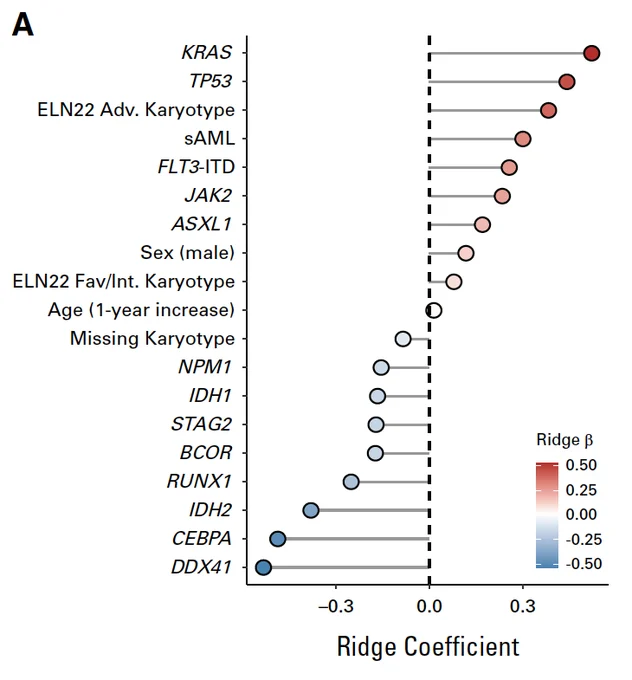
Many of these features are included in prior published models, validating their findings. Others retaining prognostic independence aren’t as well represented or had conflicting effects on OS following VEN-based treatment (i.e., secondary AML, JAK2, BCOR, STAG2, RUNX1, CEPBA).
Each feature was given a weight, and a continuous PRISM score generated, much in the spirit of the IPSSM risk-model utilized in MDS.
Title: Molecular International Prognostic Scoring System for Myelodysplastic Syndromes
Authors: Elsa Bernard, Heinz Tuechler, Peter L. Greenberg, Robert P. Hasserjian, Juan E. Arango Ossa, Yasuhito Nannya, Sean M. Devlin, Maria Creignou, Philippe Pinel, Lily Monnier, Gunes Gundem, Juan S. Medina-Martinez, Dylan Domenico, Martin Jädersten, Ulrich Germing, Guillermo Sanz, Arjan A. van de Loosdrecht, Olivier Kosmider, Matilde Y. Follo, Felicitas Thol, Lurdes Zamora, Ronald F. Pinheiro, Andrea Pellagatti, Harold K. Elias, Detlef Haase, Christina Ganster, Lionel Ades, Magnus Tobiasson, Laura Palomo, Matteo Giovanni Della Porta, Akifumi Takaori-Kondo, Takayuki Ishikawa, Shigeru Chiba, Senji Kasahara, Yasushi Miyazaki, Agnes Viale, Kety Huberman, Pierre Fenaux, Monika Belickova, Michael R. Savona, Virginia M. Klimek, Fabio P. S. Santos, Jacqueline Boultwood, Ioannis Kotsianidis, Valeria Santini, Francesc Solé, Uwe Platzbecker, Michael Heuser, Peter Valent, Kazuma Ohyashiki, Carlo Finelli, Maria Teresa Voso, Lee-Yung Shih, Michaela Fontenay, Joop H. Jansen, José Cervera, Norbert Gattermann, Benjamin L. Ebert, Rafael Bejar, Luca Malcovati, Mario Cazzola, Seishi Ogawa, Eva Hellström-Lindberg, Elli Papaemmanuil
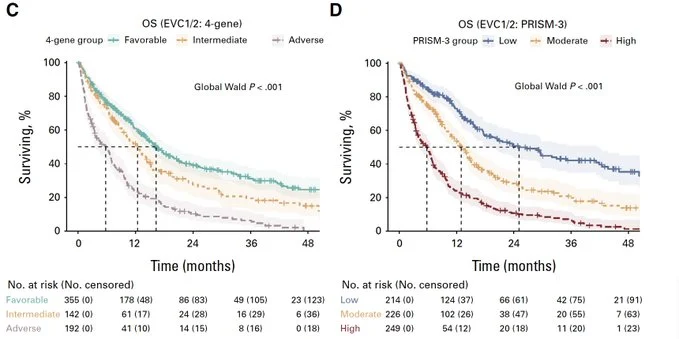
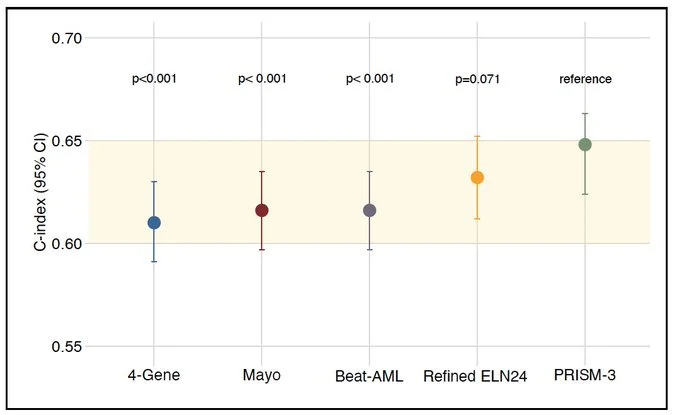
We then separated this score into three risk strata (low, moderate, high-risk), which resulted in clear and improved separation of survival across PRISM risk groups compared to the 4-gene classifier in training, internal, and external validation sets.
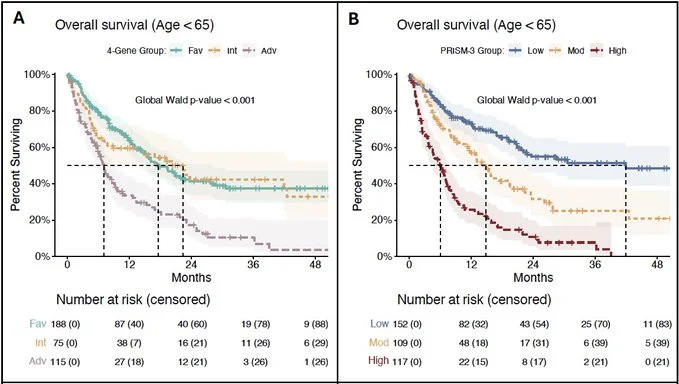
PRISM risk groups also appeared to improve survival stratification in younger patients compared to the 4-gene classifier, where HMA+VEN treatment is currently under investigation.
Title: Results from paradigm – a phase 2 randomized multi-center study comparing azacitidine and venetoclax to conventional induction chemotherapy for newly diagnosed fit adults with acute myeloid leukemia
Authors: Amir Fathi, Alexander Perl, Geoffrey Fell, Brian Jonas, Brittany Ragon, Alice Mims, Uma Borate, Gabriel Mannis, Karen Quillen, Max Stahl, Paul Koller, Andrew Artz, Monzr M. Al Malki, Guido Marcucci, Mary Linton Peters, Timothy Graubert, Peter Westervelt, Philip Amrein, Hanno Hock, Andrew Brunner, Gabriela Hobbs, Rupa Narayan, Michelle Lee, Brandon Aubrey, Alyssa Watson, Richard Hao, Shilton Dhaver, Michael Grunwald, Yi-Bin Chen, Andrew Matthews, Christopher Hourigan, Brent Wood, Donna Neuberg, Areej El-Jawahri, Ibrahim Aldoss
The PRISM risk groups improved OS prognostication compared to currently published models at the time of publication.
We deployed an online calculator at. On the website, one can calculate both the PRISM risk and 4-gene classifier for a patient. A ‘survival discovery’ tab is also available to look at OS based on genetics not included in the final PRISM model.
While the PRISM model informs a more accurate prognosis for patients and providers, it also may inform patient selection/clinical trial design for novel VEN-based triplet regimens and/or de-escalation trials.
While this project was a huge success, there is still much work to be done! Even after including additional features, OS discrimination was modestly improved. Other features such as AML differentiation, still influence OS apart from genetics.
Title: Genetic and Phenotypic Correlates of Clinical Outcomes with Venetoclax in Acute Myeloid Leukemia: The GEN-PHEN-VEN Study
Authors: Curtis A. Lachowiez, Mael Heiblig, Gaspar Aspas Requena, Emmanuelle Tavernier-Tardy, Fangyan Dai, Amenech B. Ashango, Daniel T. Peters, Jacob Fang, Andy Kaempf, Nicola Long, Christopher A. Eide, Stephen E. Kurtz, Wei Xie, Anupriya Agarwal, Aishwarya Sahasrabudhe, Christine M. McMahon, Maria L. Amaya, Gabrielle Meyers, Arpita Gandhi, Jessica Leonard, Brandon Hayes-Lattin, Richard T. Maziarz, Elie Traer, Rachel J. Cook, Ronan Swords, Theodore P. Braun, Jennifer N. Saultz, Ashley M. Eckel, Michael R. Loken, Joshua F. Zeidner, Jeffrey W. Tyner, Daniel A. Pollyea
Looking forward, newer models will need to account for
- Additional targeted therapies combined with VEN
- Effect of AML differentiation state and/or BCL2 family protein levels
- Edditional patient factors.
Other articles about AML on OncoDaily.