The week after ESTRO 2026 brought a strong selection of LinkedIn updates across radiotherapy, highlighting new clinical data, technology development, patient-centered innovation, and ongoing debates around the future of radiotherapy.
This week’s selection reflects major activity following ESTRO 2026, from new evidence in rectal cancer and discussions around pelvic radiotherapy in high-risk prostate cancer to evolving strategies in stage IV NSCLC. Several posts focused on how radiotherapy is being refined in daily practice, including dose-escalated treatment approaches, organ preservation, smarter patient selection, and the need to continue recruiting patients into clinical trials.
Important advances were also seen in radiotherapy technology and workflow. Posts highlighted the growing role of upright proton therapy, compact proton systems designed for LINAC vaults, same-room CBCT workflows in brachytherapy, and new approaches to immobilization and patient positioning. These updates show how innovation in radiation oncology is increasingly focused not only on precision, but also on efficiency, accessibility, and patient comfort.
At the same time, several posts captured the broader human and professional side of the field. From patient advocates shaping research design to international representation within ESTRO committees and reflections on the energy of the congress, this week’s discussions emphasized collaboration, inclusivity, and the importance of keeping patients at the center of progress.
Together, these 10 LinkedIn posts capture a meaningful post-ESTRO 2026 week in radiation oncology, from clinical trial results and technical innovation to workflow improvement, global collaboration, and patient-centered cancer care.
Andrada Turcas – Radiation Oncologist | Institute of Advanced Studies in Science and Technology-Babeș-Bolyai University of Cluj-Napoca
While everybody is hopefully getting some rest after #ESTRO26, here is a nice post-conference read: our European Society for Radiotherapy and Oncology (ESTRO). CNS FG systematic review on regional brain radiosensitivity & neurocognition is finally published in Radiotherapy and Oncology
Big thanks to all co-authors and collaborators involved!
Aoife Williamson
Nils Gleim
Tomáš Kazda
Sharon Fernandez
Harat Maciej
Maximilian Niyazi
giuseppe minniti
Clemens SeidelHopefully a useful contribution toward safer brain radiotherapy
Xenofon Vakalis – Radiation Oncologist | Medical center of Athens
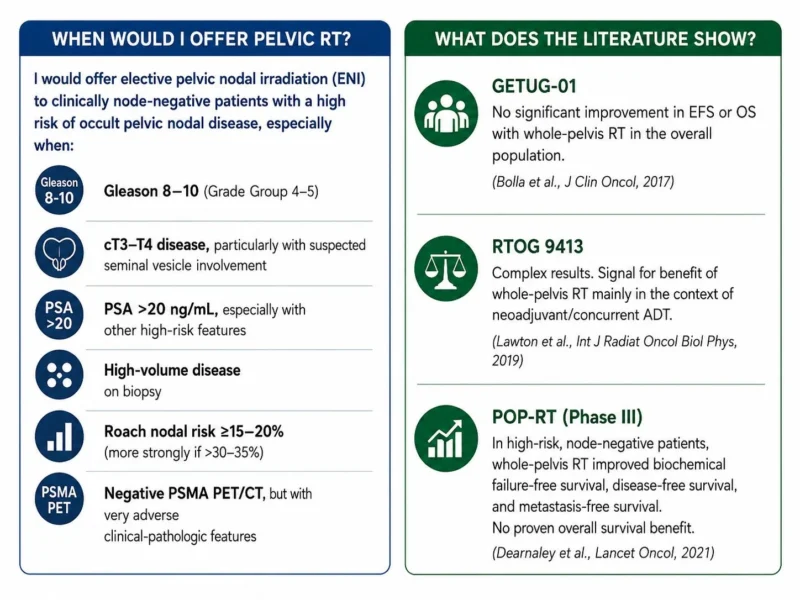
Pelvic Radiotherapy in High/Very High-Risk Prostate Cancer After PEACE-2
As presented so far, PEACE-2 does not yet answer the key question of whether elective pelvic nodal irradiation should routinely be used in clinically node-negative high/very high-risk prostate cancer.
The currently available data mainly concern cabazitaxel, which did not improve cPFS, bPFS, or MFS. Results comparing prostate-only RT versus whole-pelvis RT are still awaited.When would I offer pelvic RT?
I would consider elective pelvic nodal irradiation (ENI) in clinically N0 patients with a high probability of occult pelvic nodal disease, especially in:
▪️ Gleason 8–10 / Grade Group 4–5
▪️ cT3–T4 disease, particularly with seminal vesicle involvement
▪️ PSA >20 ng/mL combined with other high-risk features
▪️ High-volume disease on biopsy
▪️ Roach nodal risk ≥15–20% (more convincing if >30–35%)
▪️ Negative PSMA PET/CT but highly adverse clinicopathologic features
Read full post here.
Julie McCrossin – Broadcaster | MC | Cancer Patient Advocate
The History of the Linear Accelerator #LINAC
The modern medical linear accelerator, commonly known as the LINAC, is now considered the backbone of external beam radiotherapy. Every day, thousands of cancer patients around the world receive treatment using machines capable of delivering radiation with extraordinary precision. However, the story of the LINAC began long before its use in medicine.The foundations of linear acceleration date back to the early twentieth century, during a period of rapid development in particle physics. Scientists were searching for methods to accelerate charged particles to very high energies in order to study the structure of matter.
One of the major breakthroughs came from Norwegian engineer and physicist Rolf Widerøe, who proposed the concept of linear particle acceleration in 1928.
In the following decades, particle accelerators became increasingly important in physics laboratories. However, early radiotherapy machines mainly relied on orthovoltage X-ray units and later cobalt-60 teletherapy systems. While these technologies were valuable, they had limitations in beam penetration and dose distribution, especially for deep-seated tumors.
Read full post here.
Shinobu Kumagai – Medical Physicist | Teikyo University Hospital
【Presented the Clinical Impact of ImagingRing at the JASTRO Brachytherapy Meeting】
Today, I gave a presentation at the Brachytherapy Division Meeting of Japanese Society for Radiation Oncology.I evaluated how much the workflow improved after introducing Elekta Studio with ImagingRing, which was installed in our institution last year.
A retrospective time analysis was performed comparing 83 treatments before the system upgrade and 22 treatments after the upgrade.The total workflow from patient entry to exit from the treatment room was divided into the following phases:
A. From applicator insertion to completion of treatment-planning imaging
B. From completion of treatment-planning imaging to treatment start
C. From treatment completion to patient exitBecause irradiation time depends strongly on source strength, we also separately analyzed:
D. Total non-irradiation workflow time
E. Total treatment room timePreviously, our CT room and brachytherapy treatment room were physically separated, requiring patient transfer between rooms.
After the upgrade, the workflow was redesigned into a same-room CBCT workflow, while treatment planning using MIM and Oncentra was performed in parallel.
As shown in the thumbnail, substantial reductions in workflow time were achieved particularly in phases A and B.These results demonstrated that same-room CBCT workflow can support faster and more efficient brachytherapy while maintaining a highly advanced treatment environment.
David Sebag-Montefiore –Professor of Clinical Oncology and Health Research | University of Leeds
📣Exciting news from ESTRO📣
Dose- escalated radiotherapy significantly improves clinical complete response in low and intermediate‑risk rectal cancer.
Huge congratulations to Ane Appelt, who brilliantly presented the primary endpoint results of the APHRODITE trial today, co-led with Simon Gollins.The team were awarded the prestigious Donal Hollywood Award for the highest abstract ranked out of >4,000 submitted to European Society for Radiotherapy and Oncology (ESTRO).
Key findings:
Clinical complete response increaed from 33% (50 Gy) to 49% (60 Gy) OR 2.27, p=0.038
Very low toxicity, using a novel mesorectal radiotherapy volume developed in Leeds and Leiden
Similar quality of life across both treatment groups.The results represent a major step towards smarter, kinder, organ‑preserving treatment options for rectal cancer.
A huge thank you to Yorkshire Cancer Research for funding us, the brilliant Leeds Clinical Trials Research Unit (Leeds CTRU) team, the APHRODITE Trial Management Group, all recruiting sites, and most importantly the patients without whom none of this would have been possible.
Lionel Bouchet – SVP, Commercial Development at Mevion | Building the Proton Therapy Market | Health System Strategy & Partnerships | Mevion Medical Systems
Proton therapy in a LINAC vault is no longer a concept. It is installed, validated, and expanding.
At ESTRO 2026, Stanford University School of Medicine presented independent commissioning data: submillimeter precision, 97–99.8% gamma pass rates, and diagnostic-quality upright CT.
The MEVION S250-FIT is now both FDA-cleared and CE-marked, supporting the full clinical scope across major anatomical sites for both adult and pediatric indications.
69% of the ESTRO audience believes upright proton therapy will be mainstream by 2035.
Dana-Farber Cancer Institute. Fondazione Pascale in Naples, Italy. And a growing number of institutions adopting this architecture.
The integration of Mevion Medical Systems’ compact proton technology with Leo Cancer Care’s upright positioning has changed the equation. There is no turning back.
Full article below.
Article link
Corinne Faivre-Fin – Professor of Thoracic Radiation Oncology at The University of Manchester
Delighted to have moderated a fantastic joint European Society for Radiotherapy and Oncology (ESTRO) 2026 – IASLC session:
Clinical Panel Discussion
Revisiting the role of radiotherapy in stage IV NSCLCA truly engaging multidisciplinary panel bringing together perspectives across the full lung cancer ecosystem:
David Woolf
Zeno Gouw
Thomas Newsom-Davis
Janette RawlinsonThe discussion highlighted how rapidly the treatment landscape is evolving in stage IV NSCLC, and the continuing need to integrate systemic therapy advances, radiotherapy strategies, and patient-centred outcomes in a truly personalised approach.
Key message: please recruit to clinical trials including TOURISTGrateful to all speakers and to the audience for such thoughtful questions and contributions to a lively and important debate. #ESTRO26
Nejla Fourati – Radiation Oncologist | CHU Habib Bourguiba
ESTRO 2026 – Stockholm 🇸🇪 ✨
Beyond the scientific and organizational excellence that ESTRO consistently delivers, this year’s congress was an exceptional opportunity for inspiring discussions, meaningful collaborations, and the presentation of scientific work from our Sfax team 🇹🇳, reflecting the daily reality of radiation oncology in a resource-limited setting driven by unlimited commitment to patients and innovation.
I am particularly proud and honored that my application was selected to join the 𝐍𝐚𝐭𝐢𝐨𝐧𝐚𝐥 𝐒𝐨𝐜𝐢𝐞𝐭𝐢𝐞𝐬 𝐂𝐨𝐦𝐦𝐢𝐭𝐭𝐞𝐞 of ESTRO as a 𝐅𝐮𝐥𝐥 𝐌𝐞𝐦𝐛𝐞𝐫 and the 𝐟𝐢𝐫𝐬𝐭 𝐫𝐞𝐩𝐫𝐞𝐬𝐞𝐧𝐭𝐚𝐭𝐢𝐯𝐞 𝐨𝐟 𝐧𝐨𝐧-𝐄𝐮𝐫𝐨𝐩𝐞𝐚𝐧 𝐬𝐨𝐜𝐢𝐞𝐭𝐢𝐞𝐬. A meaningful recognition that I embrace with great gratitude, responsibility, and commitment.
Proud to contribute to European Society for Radiotherapy and Oncology (ESTRO) vision ✨
“Radiation Oncology. Optimal Health for All, Together.”
Tracy Underwood – Head of Translational Research Leo Cancer Care | UKRI Future Leaders Fellow |
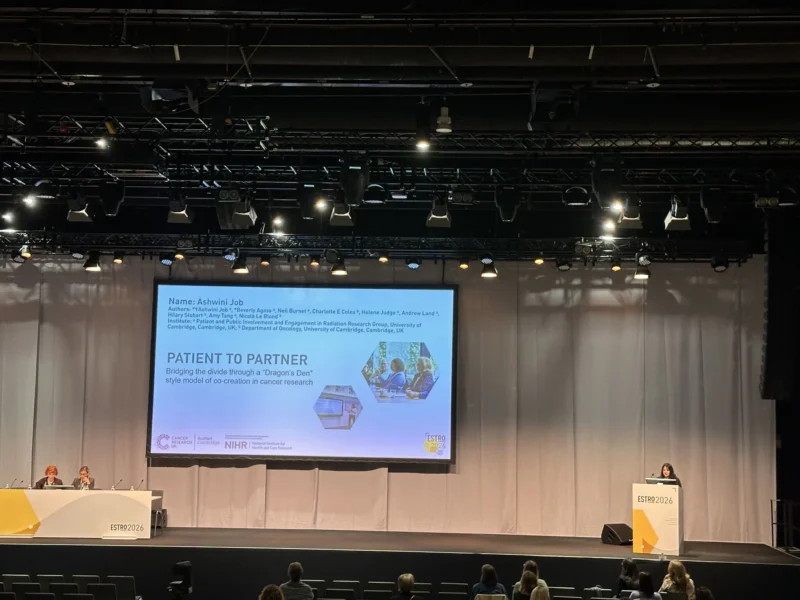
A particularly welcome theme at ESTRO this year has been the emphasis on patient-centred radiotherapy.
This morning, Ashwini Job, a patient advocate, described the importance of embedding patient perspectives at every stage of cancer research – so that it is conducted not just for patients, but with patients.
Ashwini represented a team in Cambridge who implemented a novel and powerful “Dragon’s Den” model, creating a platform for patient voices to provide early-stage input into the design of radiotherapy research.
Ashwini’s powerful presentation was followed by one from my talented colleague Simon Ingram, who presented our project on “Patient-centred development of arms-up support for upright radiotherapy of the thorax.”
Simon highlighted how upright positioning gives us an opportunity to do things differently, placing human-centred design at the heart of radiotherapy immobilisation.
Through a huge collaborative effort involving Jemma Nunn, Ross Tierney, SUSMITHA C L, Tanmoy Das, Sophie Boisbouvier, Mike Fray, Janet Ulman, Heidi Probst, Sarah Smizz, Kat Tunnicliffe, Hannah Sanderson, Heather Lysiak-Wright, Macmillan Cancer Support, HER Breast Friends and many others, we drew on insights from five co-design workshops involving clinicians, physiotherapists, and – most importantly – women with lived experience of breast radiotherapy.
Simon’s extraordinary dedication – 17 prototypes, 31 design iterations, and input from more than 80 voices – has helped bring us to an upright arms-up support design that we’re really proud of. We’re grateful to UKRI and Leo Cancer Care for supporting this work.
Well done to Simon, Ashwini, and everyone involved in these inspiring examples of patient-centred innovation in radiotherapy.
Sasa Mutic – President of Radiation Oncology Solutions at Varian Medical Systems
#ESTRO2026 doesn’t end quietly.
It ends with something harder to name. A kind of electricity. The feeling of walking out of a room knowing something shifted. In the science, in the conversation, in what you now believe is possible.That feeling is worth paying attention to.
Because you’re about to walk back into your clinic, your department, your team. And what you bring with you from this week matters more than any abstract discussion about the future of oncology. You were here. You heard it firsthand. You saw what’s coming.
The energy around the 𝗛𝗮𝗹𝗰𝘆𝗼𝗻 𝟱 solution this week said something important. It wasn’t polite conference interest. It was recognition. Clinicians encountering something that spoke directly to a problem they have been carrying for years and realizing, maybe for the first time, that the answer had arrived.
What I kept hearing was a version of the same sentence: 𝙩𝙝𝙞𝙨 𝙘𝙝𝙖𝙣𝙜𝙚𝙨 𝙬𝙝𝙖𝙩’𝙨 𝙥𝙤𝙨𝙨𝙞𝙗𝙡𝙚 𝙞𝙣 𝙢𝙮 𝙙𝙚𝙥𝙖𝙧𝙩𝙢𝙚𝙣𝙩.
Not someday. Now.
That phrase carries more weight than it appears to. It isn’t about a feature. It’s about what your team can now attempt. What your patients can now receive. What centers that couldn’t justify the infrastructure before can now seriously consider.
The Halcyon 5 solution doesn’t just raise the ceiling for the centers already at the frontier. It raises the floor for everyone else.
And that is the story worth telling when you get home. Not a summary of sessions. Not a list of announcements. The story of a field that is moving with urgency, with precision, with the patient at the center of every decision.
Go back and tell it.The work that started in Stockholm continues in every clinic, every department, every conversation that begins with: 𝙄 𝙬𝙖𝙨 𝙖𝙩 𝙀𝙎𝙏𝙍𝙊 𝙖𝙣𝙙 𝙄 𝙣𝙚𝙚𝙙 𝙩𝙤 𝙩𝙚𝙡𝙡 𝙮𝙤𝙪 𝙬𝙝𝙖𝙩 𝙄 𝙨𝙖𝙬.
#SiemensHealthineers #RadiationOncology #RadOnc #CancerCare #Radiotherapy