Original Study Title: AI-Assisted Clinical Trial Matching in Oncology Using a Neuro-Symbolic Multi-Agent System
Authors: A. Loaiza-Bonilla, C. Yost, S. Kurnaz2, E. Tuysuz2, N. G. Thaker D. Giritlioglu, J. P. Noel M
Can artificial intelligence help overcome one of oncology’s most persistent challenges efficient and accurate clinical trial matching? A new prospective study evaluating a neuro-symbolic, multi-agent AI system suggests that it can significantly improve both the speed and quality of patient screening in real-world clinical settings.
Clinical trial matching remains a complex and time-intensive process. It requires careful interpretation of detailed eligibility criteria alongside large volumes of patient data, including clinical notes, imaging reports, pathology, and treatment history. In routine practice, this often translates into delays, missed opportunities for enrollment, and substantial workload for clinicians.
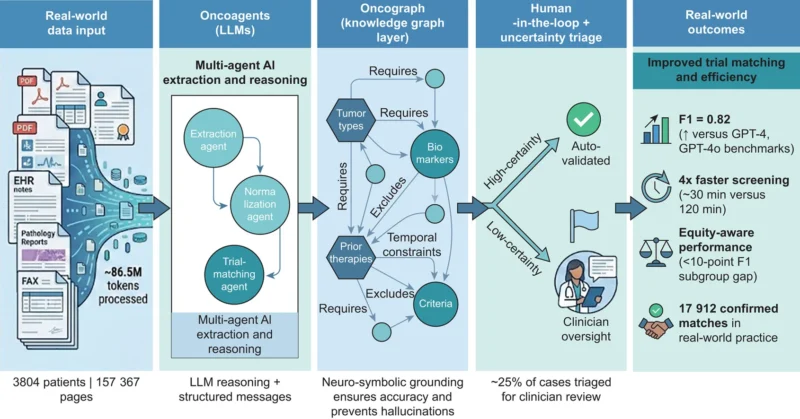
In this study, conducted in a cohort of 3,804 oncology patients, the AI platform demonstrated strong performance. It achieved an F1 score of 0.82, outperforming standard large language model approaches, while also reducing screening time from approximately 120 minutes to just 30 minutes per patient. Overall, the system processed more than 157,000 pages of clinical documentation and generated 17,912 trial matches that were subsequently confirmed by oncologists, highlighting both scalability and clinical relevance.
Hybrid AI Approach Enables More Reliable Decision-Making
A key strength of the system lies in its hybrid, neuro-symbolic architecture. Rather than relying solely on large language models, the platform integrates LLM-based information extraction with oncology-specific knowledge graphs and rule-based reasoning. This design allows the system to more accurately interpret complex and nuanced eligibility criteria, including biomarker requirements, prior lines of therapy, comorbidities, and time-dependent conditions.
Importantly, clinician oversight remains part of the workflow, ensuring that AI-generated matches are validated before clinical use. This combination of automated processing and human verification helps mitigate risks such as hallucinations or misinterpretation of clinical data, which remain key concerns in standalone AI applications.
Addressing a Critical Gap in Oncology Care
Low clinical trial enrollment continues to be a major limitation in oncology, with many eligible patients never identified or referred in time. The findings from this study suggest that AI-assisted platforms could help bridge this gap by standardizing and accelerating the screening process, improving consistency across institutions, and reducing the burden on clinical teams.
Beyond efficiency, such systems may also support more equitable access to trials by ensuring that eligibility is assessed systematically rather than opportunistically. This has important implications for both patient outcomes and the broader development of new cancer therapies.
Clinical Takeaway
This prospective study provides real-world evidence that AI can play a meaningful and practical role in clinical trial matching. Systems that combine language models with structured medical knowledge and clinician oversight appear to offer a safe and scalable approach to improving trial identification in oncology.
As AI continues to integrate into clinical workflows, its role in optimizing trial access may become one of its most immediate and impactful applications.
You Can Read Full Article here
Written By Aren Karapetyan, MD