
Early-stage non-small cell lung cancer is usually managed according to clinical stage, imaging findings, operability, and postoperative pathology. Yet patients with the same apparent stage can have very different outcomes after surgery. This is especially important in clinical stage I lung adenocarcinoma, where many patients undergo surgery alone, while a smaller biologically aggressive subgroup may already carry a higher risk of recurrence.
A study by Hong, Hwang, Dasgupta, Abbosh, and colleagues evaluated whether tumor-naïve presurgical circulating tumor DNA detection could help identify high-risk patients before surgery, without requiring tumor tissue sequencing. The investigators analyzed presurgical plasma from 895 patients with EGFR/ALK wild-type clinical stage I or II NSCLC using a targeted methylation-based cell-free DNA assay (Hong et al., 2024).
Why Tumor-Naïve ctDNA Testing Matters
Tumor-informed ctDNA assays are powerful but often require tumor tissue, sequencing, and longer turnaround times. In early-stage NSCLC, this can be difficult because small tumors may provide limited tissue, and treatment decisions before surgery often need to be made quickly.
A tumor-naïve methylation-based assay offers a different approach. It does not need prior tumor profiling and may be easier to integrate into presurgical workflows. In this study, the assay was used before surgery to determine whether ctDNA detection could identify patients with biologically higher-risk disease.
Study Design And Population
The study included patients recruited prospectively at Samsung Medical Center between 2014 and 2020. All patients had clinical stage I or II NSCLC, underwent surgery, had available presurgical plasma, and had EGFR/ALK wild-type disease.
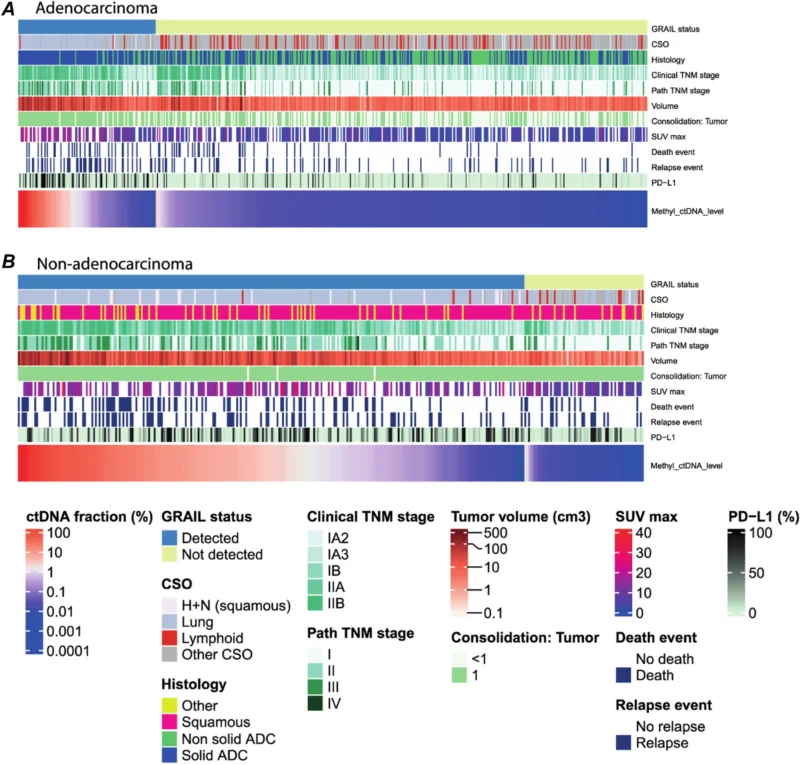
Among the 895 evaluable patients, ctDNA detection varied strongly by both stage and histology. In clinical stage I NSCLC, ctDNA was detected in 188 of 602 patients (31%), while in clinical stage II NSCLC it was detected in 209 of 293 patients (71%).
Histology made a major difference. In lung adenocarcinoma, presurgical ctDNA detection was less frequent: 13% in clinical stage I LUAD and 47% in clinical stage II LUAD. In non-LUAD tumors, ctDNA detection was much more common, occurring in 71% of clinical stage I cases and 93% of clinical stage II cases (Hong et al., 2024).
The Strongest Signal Was In Stage I Lung Adenocarcinoma
The most clinically relevant finding was that presurgical ctDNA detection was prognostic in clinical stage I lung adenocarcinoma.
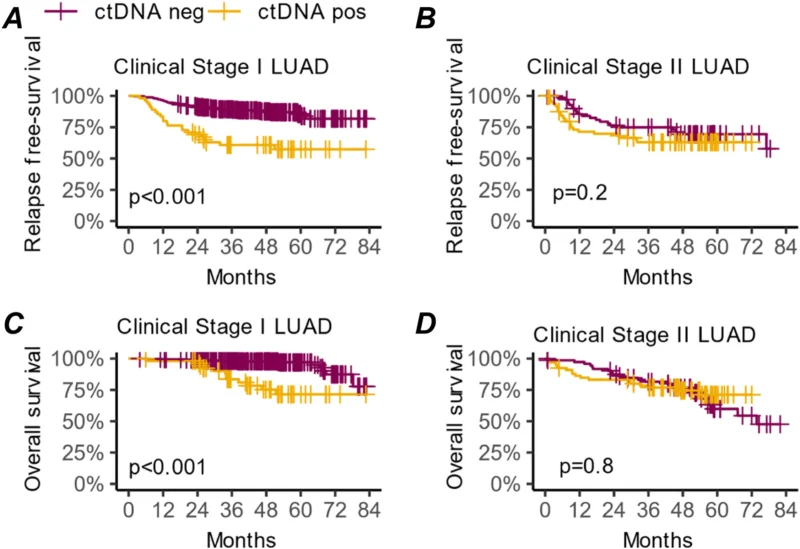
Among 414 patients with clinical stage I LUAD, 55 patients (13%) were ctDNA-positive before surgery. These patients had significantly worse recurrence-free survival than ctDNA-negative patients. The 2-year recurrence-free survival was 69% in ctDNA-positive patients compared with 91% in ctDNA-negative patients, with a log-rank p < 0.001 (Hong et al., 2024).
This is important because ctDNA-positive clinical stage I LUAD behaved more like stage II disease. The study reported that 2-year RFS in ctDNA-positive stage I LUAD was similar to that of the broader clinical stage II LUAD population.
By contrast, presurgical ctDNA detection was not prognostic in clinical stage II LUAD or in non-LUAD NSCLC. This suggests that the clinical value of tumor-naïve presurgical ctDNA testing is not uniform across all early-stage NSCLC, but may be strongest in the stage I adenocarcinoma setting.
ctDNA Detection Was Linked To Tumor Biology And Imaging Features
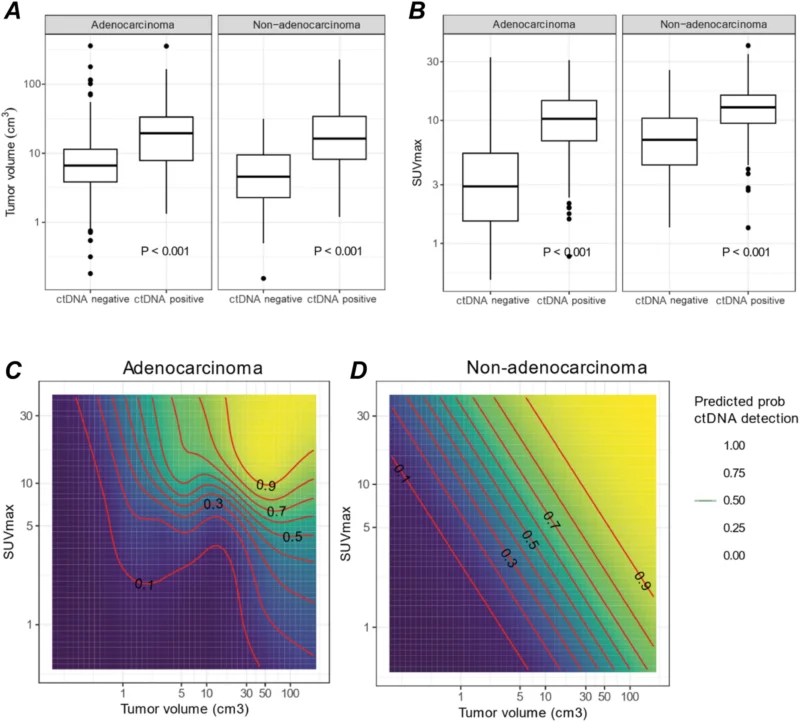
The study also explored why some tumors shed detectable ctDNA before surgery. Tumor volume and PET avidity were both associated with ctDNA detection.
In LUAD, ctDNA-positive tumors had a median tumor volume of 19.46 cm³, compared with 6.64 cm³ in ctDNA-negative tumors. PET avidity also differed, with median SUVmax of 10.32 in ctDNA-positive LUAD versus 2.91 in ctDNA-negative LUAD (Hong et al., 2024).
The investigators found that tumor volume, PET SUVmax, and histologic subtype were independent predictors of presurgical ctDNA detection. In LUAD, metabolic activity appeared especially important at lower tumor volumes, suggesting that both tumor burden and biological activity influence whether ctDNA becomes detectable in the blood.
Presurgical ctDNA Predicted Pathologic Upstaging
Another important finding was the relationship between ctDNA detection and clinical-to-pathologic upstaging. In clinical stage I LUAD, presurgical ctDNA positivity was associated with a higher risk that surgery would reveal more advanced pathologic disease than imaging had suggested.
The background upstaging risk in clinical stage I LUAD was 15.5%, but among ctDNA-positive patients, the positive predictive value for upstaging was 36.4%. This represented a 2.3-fold lift over the baseline risk (Hong et al., 2024).
This matters clinically because presurgical ctDNA positivity may identify patients whose disease is underestimated by imaging alone. Such patients may be candidates for closer staging evaluation, more intensive multidisciplinary review, or future trials of neoadjuvant treatment escalation.
ctDNA Also Correlated With High-Grade Histology
The investigators further found that presurgical ctDNA detection was associated with postoperative discovery of IASLC grade 3 lung adenocarcinoma, a histologic pattern linked with more aggressive disease.
Among patients with clinical stage I LUAD and available histologic grading, ctDNA positivity was enriched in grade 3 tumors. Presurgical ctDNA detection had a positive predictive value of 72% and a negative predictive value of 80% for grade 3 histologic patterns in the resection specimen (Hong et al., 2024).
This suggests that ctDNA may serve as a presurgical signal of aggressive histology before definitive pathology is available.
The PD-L1 Link May Be Clinically Important
Presurgical ctDNA positivity was also associated with higher PD-L1 expression in resected LUAD specimens. In clinical stage I LUAD, PD-L1 positivity was more frequent among ctDNA-positive patients than ctDNA-negative patients.
For example, 24% of ctDNA-positive stage I LUAD cases had PD-L1 expression of 50% or greater, compared with 8% of ctDNA-negative cases. Overall, PD-L1-positive tumors were more common in the ctDNA-positive group (Hong et al., 2024).
This finding is potentially important because ctDNA-positive stage I LUAD may represent a subgroup with both higher recurrence risk and greater biological rationale for immune checkpoint inhibition. The authors suggest that this could support future neoadjuvant immunotherapy trials in ctDNA-positive early-stage LUAD.
Clinical Meaning
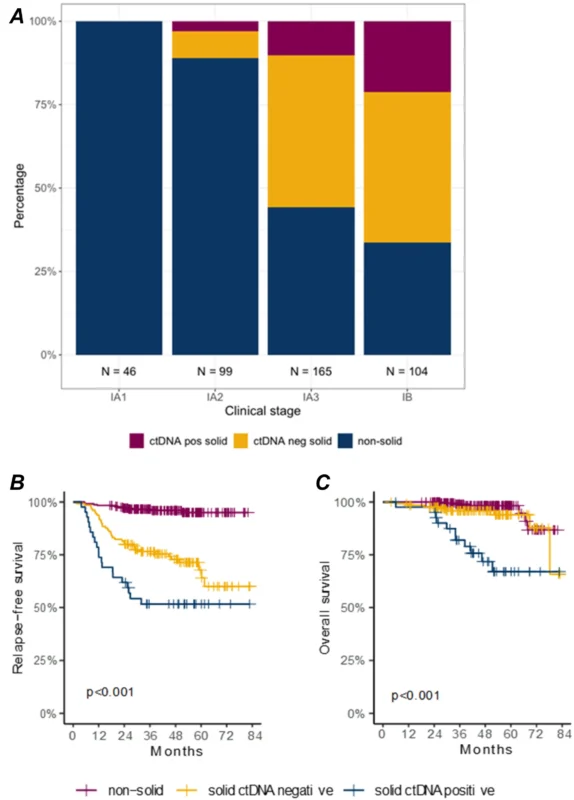
The study supports the idea that presurgical ctDNA testing could add a blood-based risk layer to standard TNM staging. In stage I LUAD, a positive tumor-naïve ctDNA result may identify patients with a recurrence risk closer to stage II disease, a higher chance of pathologic upstaging, higher-grade histology, and greater PD-L1 expression.
This does not mean ctDNA should replace imaging, pathology, or standard staging. Instead, it may complement them. A practical future model could integrate clinical stage, CT solidity, PET avidity, histologic suspicion, and tumor-naïve ctDNA status to identify patients who need more than surgery alone.
The study also shows that the same ctDNA result does not carry the same meaning across histologies. Non-LUAD tumors frequently shed ctDNA even in early-stage disease, which may limit the prognostic discrimination of a simple positive-versus-negative result in that group.
Limitations
The study was large and clinically meaningful, but several limitations remain. It was conducted at a single major center, and the cohort included EGFR/ALK wild-type patients, which means findings may not fully apply to all molecular subgroups. The assay was tumor-naïve and methylation-based, which improves presurgical feasibility, but tumor-informed approaches may offer higher sensitivity in some settings.
Most importantly, this was not an interventional study. It shows that ctDNA positivity identifies higher-risk patients, but it does not prove that changing treatment based on ctDNA status improves survival. Prospective trials are needed to determine whether ctDNA-positive stage I LUAD patients benefit from neoadjuvant or adjuvant treatment escalation.
Conclusion
The study by Hong and colleagues provides strong evidence that tumor-naïve presurgical ctDNA detection has clinical utility in clinical stage I lung adenocarcinoma. A positive ctDNA result identified patients with worse recurrence-free survival, higher risk of pathologic upstaging, enrichment for grade 3 histology, and higher PD-L1 expression.
For early-stage NSCLC, this supports a future in which blood-based biomarkers help refine surgical risk before the operation takes place. The most immediate implication is not routine treatment change, but better risk identification and stronger rationale for ctDNA-guided perioperative trials.