
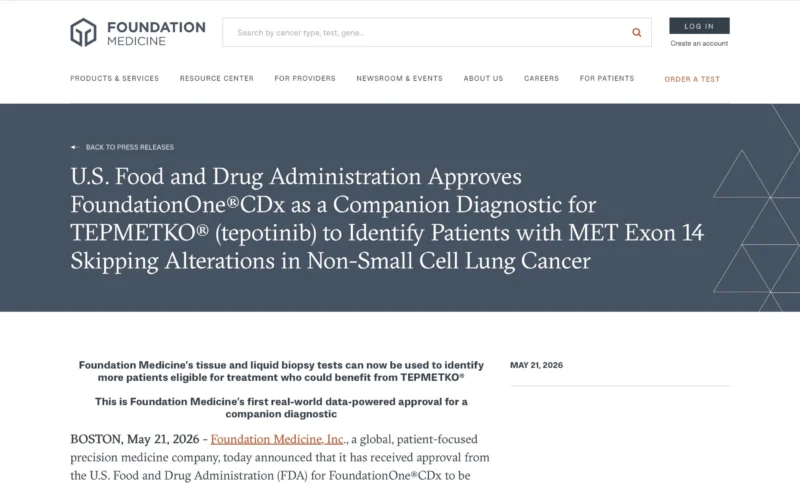
The U.S. Food and Drug Administration has approved FoundationOne CDx as a companion diagnostic for TEPMETKO (tepotinib) to identify patients with metastatic non-small cell lung cancer harboring MET exon 14 skipping alterations. The approval expands testing options for patients with METex14-positive NSCLC by allowing Foundation Medicine’s tissue-based comprehensive genomic profiling test to support treatment selection for tepotinib.
This decision follows the earlier FDA approval of FoundationOne Liquid CDx as a blood-based companion diagnostic for TEPMETKO in November 2024. Together, the two approvals mean that both tissue and liquid biopsy approaches from Foundation Medicine can now be used to identify patients who may be eligible for tepotinib treatment when MET exon 14 skipping alterations are detected (Foundation Medicine, 2026).
Why This Approval Matters
MET exon 14 skipping alterations are found in approximately 3–4% of NSCLC cases and are associated with advanced disease and poor prognosis. For patients with metastatic NSCLC, timely and accurate molecular testing is essential because METex14 is a targetable alteration with an approved treatment option.
TEPMETKO received accelerated FDA approval in February 2021 and traditional FDA approval in February 2024 for adults with metastatic NSCLC harboring MET exon 14 skipping alterations. The new companion diagnostic approval strengthens the testing pathway by adding a tissue-based FDA-approved option to identify eligible patients (Foundation Medicine, 2026).
Tissue and Liquid Biopsy Testing Now Support TEPMETKO Selection
FoundationOne CDx is a next-generation sequencing-based tissue test that analyzes 324 cancer-related genes using DNA from formalin-fixed, paraffin-embedded tumor tissue. It detects substitutions, insertions and deletions, copy number alterations, selected rearrangements, and genomic signatures including microsatellite instability and tumor mutational burden.
FoundationOne Liquid CDx, the company’s blood-based comprehensive genomic profiling test, had already received FDA approval as a companion diagnostic for TEPMETKO. This is particularly relevant when tumor tissue is limited, unavailable, or difficult to obtain. However, a negative liquid biopsy result does not rule out the presence of an alteration, and tissue testing may still be needed when feasible.
A Real-World Data-Powered Companion Diagnostic Approval
A notable aspect of this announcement is that it represents Foundation Medicine’s first real-world data-powered companion diagnostic approval. According to the company, the approval leveraged its real-world data-powered CDx offering, which supports diagnostic label expansion by supplementing clinical trial evidence with curated real-world evidence and regulatory support.
The company highlighted the role of the Flatiron Health–Foundation Medicine Clinico-Genomic Database, which includes data from more than 150,000 patients. This resource can help generate regulatory-grade real-world data cohorts, potentially reducing the need for additional patient enrollment while maintaining evidence standards for companion diagnostic projects (Foundation Medicine, 2026).
Clinical Meaning for NSCLC Care
For clinicians treating metastatic NSCLC, this approval reinforces the importance of comprehensive genomic profiling at diagnosis and during treatment planning. MET exon 14 skipping is uncommon but actionable, and missing this alteration can mean missing an approved targeted therapy option.
The availability of both tissue and liquid biopsy companion diagnostics may help improve patient identification across real-world clinical scenarios. Tissue testing remains important when adequate tumor material is available, while liquid biopsy can be useful when tissue is insufficient or when faster, less invasive testing is needed.
Conclusion
The FDA approval of FoundationOne CDx as a companion diagnostic for TEPMETKO expands the precision oncology testing pathway for patients with metastatic NSCLC harboring MET exon 14 skipping alterations. Together with the prior FoundationOne Liquid CDx approval, this decision provides clinicians with both tissue- and blood-based FDA-approved testing options to help identify patients who may benefit from tepotinib.
The approval also marks an important regulatory milestone for real-world data-powered companion diagnostic development, showing how curated clinical-genomic datasets may support diagnostic label expansion in oncology.