






Key takeaways
- Liquid biopsy uses blood to analyze tumor-derived DNA.
- ctDNA can reveal mutations, resistance, and residual disease.
- ctDNA may detect recurrence before imaging in some cancers.
- Positive ctDNA usually means a higher recurrence risk.
- Negative ctDNA does not fully rule out residual cancer.
Liquid biopsy and circulating tumor DNA (ctDNA) testing are becoming increasingly important tools for monitoring cancer after treatment. By analyzing fragments of tumor-derived DNA circulating in the bloodstream, ctDNA testing can provide molecular information about residual disease, treatment response, emerging resistance, and the risk of cancer recurrence.
One of the most promising applications is the detection of molecular residual disease (MRD) after surgery, radiation therapy, or systemic treatment. In some cancers, ctDNA can become detectable months before recurrent disease is visible on CT, MRI, PET, or other conventional imaging. This raises the possibility of identifying relapse at a much earlier molecular stage.
However, detecting recurrence earlier does not automatically mean that starting treatment earlier improves outcomes. Tumors differ substantially in how much DNA they release into the bloodstream, negative tests can occur despite residual cancer, and the clinical value of changing treatment solely because ctDNA becomes positive remains uncertain in many settings.
The 2026 ASCO guideline therefore recognizes ctDNA as an important clinical tool, particularly for tumor genotyping when tissue testing is difficult or unavailable, but cautions against using it as a universal replacement for established diagnostic and surveillance methods.
What Is ctDNA and How Does a Liquid Biopsy Work?
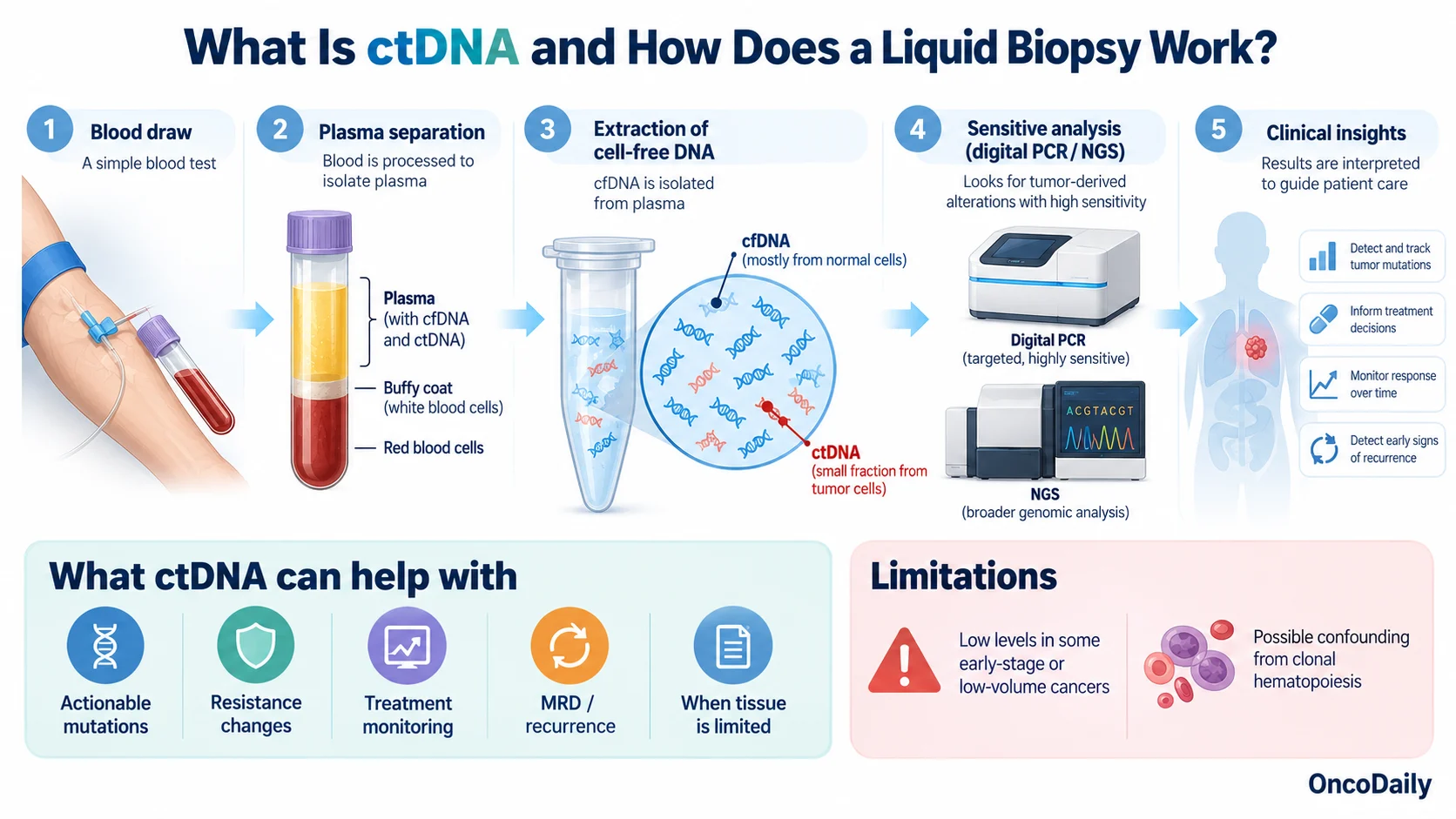
Circulating tumor DNA (ctDNA) consists of DNA fragments released by cancer cells into the bloodstream. It represents only a fraction of total cell-free DNA (cfDNA), most of which originates from normal cells undergoing routine turnover. A liquid biopsy analyzes these circulating tumor-derived fragments, usually from plasma, to obtain molecular information about a cancer without requiring repeated tissue sampling.
After a blood sample is collected, plasma is separated from blood cells and cfDNA is extracted. Sensitive molecular methods such as digital PCR and next-generation sequencing (NGS) can then identify tumor-associated genetic alterations. Some assays search for a small number of predefined mutations, while others analyze much broader genomic panels (Wan et al., 2017; Ma et al., 2024).
ctDNA testing can be used for several different purposes:
- identifying actionable mutations that may guide targeted treatment
- detecting genomic mechanisms of treatment resistance
- monitoring molecular changes during therapy
- investigating molecular residual disease after treatment
- obtaining molecular information when tissue is unavailable or insufficient
One advantage of ctDNA is that it may contain DNA released from different tumor sites and metastases. A single tissue biopsy samples only one area of a tumor at one point in time, whereas plasma testing may sometimes capture broader tumor heterogeneity.
There are important limitations. The concentration of ctDNA is influenced by tumor burden, biological subtype, treatment status, and anatomical location. Small-volume and early-stage cancers often release very little tumor DNA, while tumors confined to certain sites including the central nervous system may be particularly difficult to detect in plasma (Pascual et al., 2022).
Interpretation may also be complicated by clonal hematopoiesis, in which age-related mutations arising in blood-forming cells appear in plasma sequencing and can potentially be mistaken for tumor-derived alterations. For these reasons, a negative or discordant liquid-biopsy result may still require tissue testing.
What Is Minimal Residual Disease (MRD) After Cancer Treatment?
Minimal residual disease, also called measurable residual disease, describes cancer that persists after treatment at levels below the detection threshold of conventional clinical methods.
The terminology differs somewhat between hematologic malignancies and solid tumors. In leukemia and multiple myeloma, MRD traditionally refers to small populations of malignant cells detected using highly sensitive flow cytometry, PCR, or sequencing. In solid tumors, the term molecular residual disease is increasingly used when residual cancer is identified through molecular biomarkers such as ctDNA.
MRD can be present even when a patient has no symptoms and imaging shows no evidence of disease. In this situation, ctDNA provides a molecular signal that microscopic tumor cells may remain somewhere in the body.
A positive MRD result after potentially curative treatment is generally associated with a substantially greater risk of future recurrence. Conversely, patients with repeatedly negative ctDNA tests often have a lower risk of relapse, although a negative result cannot establish that every malignant cell has been eliminated (Abdo et al., 2026).
Two broad approaches are used for ctDNA-based MRD testing:
Tumor-informed assays first analyze the patient’s tumor and then create an individualized panel to track mutations specific to that cancer.
Tumor-agnostic or plasma-only assays search for predefined genomic or epigenomic features without requiring prior tumor sequencing.
Each approach has different advantages in sensitivity, turnaround time, cost, and applicability. The optimal assay also depends on the cancer type and clinical setting.
Importantly, MRD is already deeply integrated into management of several hematologic malignancies. Its use in solid tumors is advancing rapidly, but the evidence supporting treatment decisions based on ctDNA remains uneven across different cancers.

Can ctDNA Detect Cancer Recurrence Before Imaging?
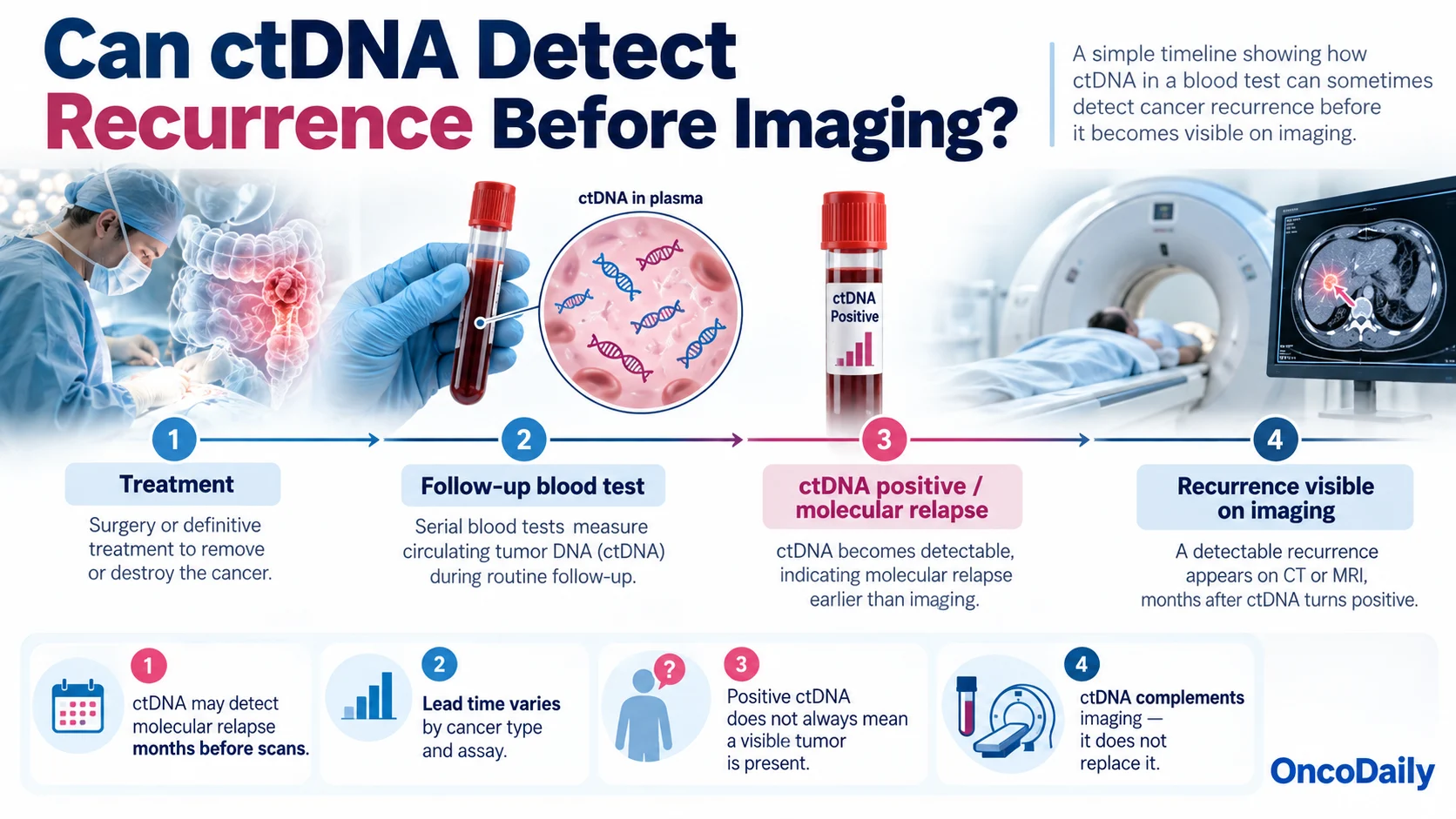
In some cancers, ctDNA can detect molecular evidence of recurrence before a tumor becomes visible on conventional imaging.
After surgery or other definitive treatment, ctDNA can be measured repeatedly over time. Persistent ctDNA shortly after treatment may indicate residual disease, while ctDNA that disappears and subsequently reappears can signal molecular relapse.
This has been demonstrated across several malignancies.
In stage II colorectal cancer, postoperative ctDNA strongly predicted subsequent recurrence (Tie et al., 2016). In early breast cancer, mutation tracking detected molecular relapse before clinical recurrence in a substantial proportion of patients, with reported lead times measured in months (Garcia-Murillas et al., 2015).
Similar findings have been reported in early-stage lung cancer. In TRACERx and related studies, ctDNA was detectable before or at radiographic recurrence in many patients, with molecular relapse sometimes preceding imaging by several months. PubMed Central (PMC)
In diffuse large B-cell lymphoma, serial ctDNA monitoring has also identified molecular recurrence before clinically apparent disease.
The exact lead time varies substantially according to cancer type, assay, sampling schedule, tumor biology, and site of recurrence. It therefore does not make sense to describe ctDNA as uniformly detecting recurrence a fixed number of months before imaging.
A positive ctDNA result also does not necessarily mean that a measurable tumor is already present. The signal may reflect a very small burden of residual cancer below the resolution of current imaging.
This distinction is clinically important. The ability to predict recurrence is known as clinical validity. Demonstrating that treatment based on that earlier signal improves survival or other meaningful outcomes is clinical utility—and that second question remains unresolved in many cancers.
ESMO previously concluded that ctDNA MRD has strong evidence of clinical validity in several early-stage cancers but insufficient evidence for routine MRD-directed treatment outside appropriate clinical studies. The newer 2026 ASCO guideline similarly emphasizes that prognostic association alone does not establish that clinicians should change treatment based on every positive ctDNA result.
What Does a Positive or Negative ctDNA Test Mean?
The meaning of a ctDNA result depends strongly on why the test was performed.
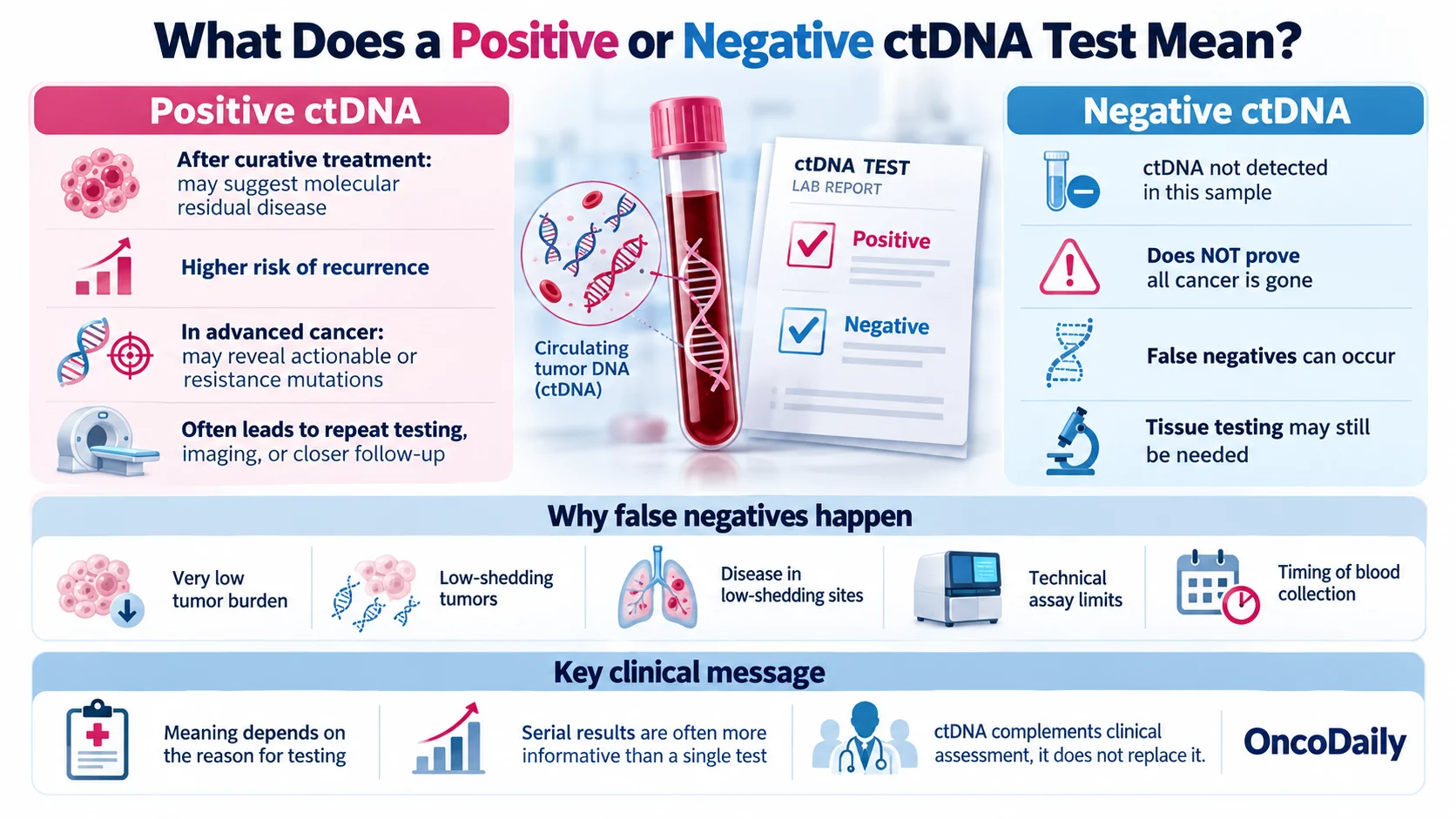
After potentially curative treatment, a positive ctDNA result may indicate molecular residual disease and is usually associated with a higher risk of recurrence. Serial conversion from negative to positive can also raise concern for molecular relapse.
In advanced cancer, however, a positive ctDNA test may serve a different purpose. Rather than detecting MRD, it may identify an actionable genomic alteration that helps guide targeted therapy or reveal a resistance mutation emerging during treatment.
A negative ctDNA result requires more caution. It means that tumor-derived DNA was not detected above the assay’s threshold in that particular sample—it does not necessarily mean that no cancer remains.
False-negative results may occur when:
- tumor burden is extremely low
- the tumor releases little DNA into circulation
- disease is confined to a low-shedding anatomical site
- the relevant alteration is technically difficult for the assay to detect
- blood is collected when ctDNA concentration is particularly low
This is why negative plasma genotyping may need to be followed by tissue testing when the clinical situation still strongly suggests a potentially actionable alteration. Both ESMO and ASCO emphasize this limitation.
Serial measurements can sometimes provide more information than a single test. Persistently negative results, persistent positivity, ctDNA clearance during therapy, or conversion from negative to positive may each carry different prognostic implications.
However, ctDNA concentration itself should not automatically be interpreted as a direct measurement of tumor burden. The 2026 ASCO guideline specifically cautions against using fractional or concentration-based ctDNA measurements as surrogate measures of disease unless there is evidence supporting that application.
Which Cancers Can Be Monitored With ctDNA?
ctDNA has been investigated in almost every major solid tumor, but its clinical maturity varies substantially.
Colorectal cancer currently has one of the strongest evidence bases. Postoperative ctDNA is strongly prognostic for recurrence, and prospective trials have begun testing whether it can guide adjuvant therapy.
In non-small cell lung cancer, plasma ctDNA has an established role in molecular profiling, particularly when tissue is unavailable, inadequate, or would delay treatment. It can identify alterations such as EGFR mutations and other clinically actionable genomic abnormalities. Molecular residual disease surveillance after curative-intent treatment is also being actively studied.
In breast cancer, ctDNA can detect genomic alterations in metastatic disease and is being extensively investigated for monitoring treatment response and detecting molecular relapse after treatment for early-stage disease.
ctDNA is also being investigated in:
- bladder and urothelial cancer
- melanoma
- pancreatic cancer
- gastroesophageal cancer
- ovarian cancer
- prostate cancer
- biliary tract cancer
- head and neck cancer
In lymphoma, plasma ctDNA can reflect tumor burden, molecular response, and clonal evolution. In leukemias and multiple myeloma, however, MRD is more commonly assessed using specialized bone marrow or peripheral-blood methods rather than relying primarily on plasma ctDNA.
The ability to monitor these cancers is not equivalent across disease types. Tumor shedding matters considerably. Larger tumors and cancers involving the liver, for example, may release substantial ctDNA, while small-volume disease or tumors in certain anatomical compartments may be much harder to detect.
This variability is one reason why a single ctDNA assay or threshold cannot yet be applied uniformly across oncology.

Can ctDNA Results Change Cancer Treatment or Follow-Up?
In selected situations, yes.
The clearest randomized evidence comes from stage II colon cancer. In the DYNAMIC trial, patients were assigned to either ctDNA-guided adjuvant therapy or conventional management based on clinicopathological features.
Only 15% of patients in the ctDNA-guided group received chemotherapy compared with 28% in the standard-management group, while 2-year recurrence-free survival remained noninferior at 93.5% versus 92.4% (Tie et al., 2022). New England Journal of Medicine
Longer follow-up has strengthened those results. At approximately five years, recurrence-free survival remained similar at 88% with ctDNA-guided management and 87% with standard management, while overall survival was also comparable between the two groups (Tie et al., 2025).
The trial is important because it moves beyond simply showing that ctDNA predicts recurrence. It demonstrates that ctDNA can, in a defined clinical setting, be incorporated into treatment decision-making while reducing chemotherapy exposure.
This finding should not be generalized automatically to every stage of colorectal cancer or to other malignancies.
In advanced cancer, ctDNA may already directly affect treatment when plasma sequencing identifies an alteration linked to an approved targeted therapy. The 2026 ASCO guideline supports ctDNA genotyping when tissue biopsy is difficult or unsafe, when tissue results would not be available quickly enough to guide management, or when regulatory approval specifically permits or requires plasma testing.
The more uncertain area is post-treatment surveillance.
A newly positive ctDNA result may justify repeat molecular testing, earlier imaging, or evaluation within an MRD-directed clinical trial. But routine treatment escalation solely because ctDNA becomes detectable is not yet supported across most solid cancers.
Similarly, persistently negative ctDNA may provide reassuring prognostic information, but it should not currently be used to eliminate established follow-up imaging unless supported by disease-specific evidence.
The most important question in the field is therefore no longer simply whether ctDNA can detect recurrence earlier. Evidence increasingly shows that it can.
The question now is whether acting on molecular recurrence before radiographic recurrence leads to better survival, less toxicity, or more effective use of treatment. Ongoing randomized MRD-directed trials will determine how broadly ctDNA moves from prognostic biomarker to routine treatment-guiding tool.
FAQ
What is a liquid biopsy?
A liquid biopsy is a blood-based test that analyzes tumor-derived material such as ctDNA.
What is ctDNA?
ctDNA is DNA released by cancer cells into the bloodstream.
Can ctDNA detect cancer recurrence before scans?
In some cancers, ctDNA can become detectable months before recurrence appears on imaging.
Does a negative ctDNA test mean the cancer is gone?
No. Some tumors release very little ctDNA, so residual disease may still be present.
Can ctDNA replace imaging or tissue biopsy?
Not usually. ctDNA is mainly used alongside imaging, pathology, and clinical follow-up.