
A patient with a hematologic cancer can be in complete remission and still have measurable residual disease (MRD). The two findings describe different depths of response. Complete remission rests on disease-specific clinical, laboratory, morphologic, and sometimes imaging criteria. MRD testing searches for malignant cells or disease-associated molecular markers at levels conventional response assessment can’t detect.
MRD positivity is not the same as clinical relapse. It usually identifies residual disease associated with a higher probability of recurrence, though the strength of that association varies by disease, test, timing, and treatment setting. Undetectable MRD, conversely, doesn’t prove every malignant cell has been eliminated.
What Does Complete Remission Mean?
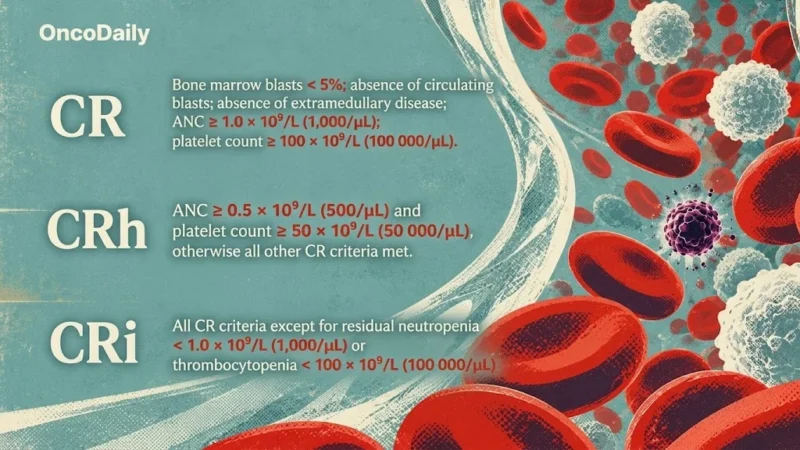
What counts as complete remission changes with the hematologic malignancy being treated. In AML, it requires bone marrow blasts below 5%, absence of circulating blasts and extramedullary disease, and recovery of neutrophils and platelets. Related categories recognize patients who have cleared morphologic leukemia but have incomplete or partial blood count recovery.
These criteria are clinically useful, but morphology has limited sensitivity: a marrow that looks clear under the microscope may still contain a small leukemic population. The European LeukemiaNet (ELN) response framework now incorporates MRD into response assessment, allowing complete remission, CR with incomplete hematologic recovery, and CR with partial hematologic recovery to each be further characterized by MRD status, capturing a deeper remission, refining post-remission relapse risk, flagging emerging recurrence, and serving as a trial endpoint.
The same principle extends beyond AML, though conventional response criteria differ. A patient with myeloma, for instance, may meet complete response criteria even as sensitive marrow testing still identifies clonal plasma cells.
How Sensitive Is MRD Testing?
The term measurable residual disease points to an important limitation: MRD describes disease that can be measured by a particular assay, not the absolute amount of malignant disease remaining in the body.
Multiparameter flow cytometry identifies cells with abnormal immunophenotypic patterns. In AML, flow cytometry can track the leukemia-associated immunophenotype identified at diagnosis (LAIP) while also searching for cell populations that differ from normal or regenerating marrow (DfN). It is also widely used in ALL, CLL, and multiple myeloma.
Quantitative PCR and digital PCR can track specific molecular abnormalities with high sensitivity. In AML, well-established molecular targets include mutated NPM1 and fusion transcripts such as RUNX1::RUNX1T1 and CBFB::MYH11. Molecular monitoring is most informative when the abnormality being measured reliably represents the leukemic clone.
Next-generation sequencing (NGS) can detect residual disease through leukemia-associated mutations or patient-specific sequences. Sensitivity may reach 10⁻⁵ to 10⁻⁶, approximately one malignant cell among 100,000 to 1 million cells, but its role and standardization differ across diseases.
Does MRD Positivity Mean the Cancer Has Relapsed?
No, MRD positivity and overt relapse are separate states. A patient in complete remission with detectable MRD still meets the conventional criteria for remission, the residual population has simply been identified because a more sensitive method was used. Overt relapse requires disease to again meet established relapse criteria.
MRD can precede that event. A patient who previously had undetectable MRD may develop molecular or flow-detectable disease without leaving morphologic remission, sometimes described as MRD relapse or molecular relapse. Some patients with detectable MRD never develop overt relapse and relapse still occurs, too, in a minority of patients whose testing was negative.
It is not established that changing treatment whenever MRD is detected improves outcome. That’s why it can directly guide therapy in some hematologic cancers and stay mostly a prognostic or investigational marker in others.
Detectable MRD During AML Remission
ELN recommends MRD assessment using flow cytometry or molecular methods according to the characteristics of the leukemia. Molecular monitoring is especially well validated in NPM1-mutated AML and core-binding factor AML. For patients without an appropriate molecular marker, multiparameter flow cytometry is commonly used.
Detectable MRD after treatment is associated with increased relapse risk and poorer survival. In a meta-analysis of 81 studies including 11,151 patients with AML, estimated 5-year disease-free survival was 64% in patients with undetectable MRD versus 25% in those with detectable MRD. Before allogeneic transplantation, MRD positivity was associated with a more than threefold higher risk of post-transplant relapse (HR 3.65).
A positive-versus-negative label oversimplifies interpretation, though. Low-level molecular signals can persist in some patients without carrying the same prognostic weight, and ELN recognizes persistent molecular MRD at low levels in specific settings. DNMT3A, TET2, and ASXL1 mutations can persist as part of clonal hematopoiesis after the leukemia has been treated.
In ALL, Residual Disease Can Guide Treatment
MRD has an especially established treatment role in ALL. The depth of response after induction and consolidation is strongly associated with subsequent relapse risk and is incorporated into modern risk stratification.
In a prospective study of 580 adults with Philadelphia chromosome-negative ALL who had achieved cytologic complete remission, 5-year OS was 80% among patients who achieved molecular MRD remission after consolidation vs 42% in those who didn’t.
Persistent MRD can influence the intensity, the use of immunotherapy and decisions surrounding allogeneic transplantation. It has also created a treatment state: a patient in hematologic CR receives additional leukemia-directed therapy specifically because residual disease is measurable.
In the BLAST study, adults with hematologic complete remission but persistent or recurrent MRD received blinatumomab, 78% achieved a complete MRD response after the first treatment cycle, establishing residual molecular disease during remission as a clinically actionable target.
Multiple Myeloma: MRD Gains Regulatory Ground
The depth of response achievable with contemporary myeloma therapy has made conventional complete response insufficient. MRD has moved from a prognostic curiosity to a real regulatory endpoint: in 2026, the FDA issued draft guidance supporting MRD-negative complete response as a potential primary endpoint for accelerated approval in multiple myeloma trials.
The accelerated approval of iberdomide plus daratumumab and dexamethasone made that concrete. Based on EXCALIBER-RRMM, where MRD-negative complete response at a sensitivity of 10⁻⁵ was the major efficacy endpoint, 41% of patients on the iberdomide combination reached it versus 21% on DVd.
Myeloma also spreads unevenly through the skeleton, so a marrow aspirate from one site can look clean while disease persists elsewhere, which is why marrow testing increasingly gets paired with imaging. Whether treatment should routinely be intensified, prolonged, or discontinued according to MRD remains an active area of study.
You can also read:

CLL: MRD Informs Prognosis, Not Treatment Decisions
MRD has become particularly informative in CLL with fixed-duration targeted therapy. In CLL14, nearly three-quarters of patients treated with one year of venetoclax-obinutuzumab achieved undetectable MRD in peripheral blood at the end of treatment, and deeper MRD responses were associated with longer progression-free survival. Despite this strong prognostic association, detectable MRD alone is not an indication to restart treatment in CLL.
CML: Deep Molecular Response Has a Specific Clinical Role
In CML, molecular monitoring is part of routine care. BCR::ABL1 transcripts are measured in peripheral blood and reported on the International Scale. Achieving a major molecular response, corresponding to BCR::ABL1^IS ≤0.1%, is an important treatment milestone.
BCR::ABL1 does not need to become undetectable for treatment to be successful. Patients can remain in MMR for years with low-level detectable transcripts and continue to have excellent disease control. Deep molecular response becomes particularly relevant when treatment-free remission is considered, as a sustained response of MR^4 (≤0.01%) or deeper is generally required before TKI discontinuation.
After TKI discontinuation, frequent molecular monitoring can detect rising BCR::ABL1 before clinical recurrence. If the increase reaches the threshold for restarting TKI therapy, most patients regain their previous molecular response.
You can also read:

What About Lymphoma?
MRD is less standardized in lymphoma. Response assessment in many lymphomas still relies heavily on clinical evaluation and imaging, particularly PET/CT in FDG-avid disease.
Circulating tumor DNA is emerging as a way to detect residual lymphoma. In the prospective HOVON-902 cohort, after first-line therapy for large B-cell lymphoma, 3-year progression-free survival was 85% in MRD-negative patients vs 17%. MRD remained prognostic even after accounting for PET/CT findings.
This is not yet at the point where a positive ctDNA result routinely determines treatment. Assays, thresholds, timing, and MRD-guided interventions still vary across lymphoma subtypes, and prospective trials are evaluating how ctDNA can be combined with imaging and used to guide therapy.
MRD Is Not a Fixed Disease State
A substantial residual population and a signal near the assay’s detection limit don’t carry the same risk. A small signal that remains stable is different from one that is increasing after a previous response. The 2025 ELN-DAVID recommendations now incorporate this: in patients with persistent low-level molecular MRD, a ≥1-log increase from the previous nadir is considered MRD relapse.
MRD status is dynamic. Residual disease detected after one phase of treatment can disappear after subsequent consolidation, immunotherapy, targeted therapy, transplantation, or maintenance, so a patient who is initially MRD positive can still achieve a deeper response without ever experiencing overt relapse in between.
The opposite transition is also possible: disease that was previously undetectable may become measurable again before morphologic or clinical recurrence. In settings where serial MRD monitoring is validated, that interval can become a window for earlier assessment and, in selected diseases, intervention.
How Should MRD Negativity Be Interpreted?
An MRD-undetectable result describes the limits of the test: no disease was identified in the tested specimen above the assay’s detection threshold at that time. Residual malignant cells may exist below that threshold, outside the sampled compartment, or in sites the specimen didn’t represent, and clonal evolution can later produce a population the original marker no longer captures the same way. Sustained MRD negativity is more informative than a single result, but even that cannot guarantee against future relapse.
Complete remission is a major treatment milestone, but modern assays can now separate patients whose disease burden differs at greater depth. How much that additional information should change treatment depends on the malignancy, method, timing and the evidence supporting MRD-directed intervention in that specific setting.
You can also read:

FAQ
Can two patients with the same MRD level have different relapse risks?
Yes. The same numerical MRD level can have different implications depending on the malignancy, treatment received, timing of testing, marker being followed, and whether MRD is falling, stable, or rising. MRD is therefore not a universal risk scale that can be interpreted independently of clinical context.
Can MRD become negative without changing treatment?
Yes. MRD status can change as the effect of ongoing or previously administered therapy continues. A patient who is MRD-positive after an early treatment phase may become MRD-negative after consolidation, maintenance, transplantation, or another planned component of therapy. This is one reason MRD is best interpreted at defined time points and in the context of the treatment course.
Why can MRD be negative in the bone marrow but disease still be present?
A bone marrow aspirate samples only a small anatomical area. This is particularly relevant in multiple myeloma, where disease can be patchy and may persist in focal skeletal or extramedullary sites despite an MRD-negative marrow. Imaging and marrow-based MRD can therefore provide complementary information.
Can MRD disappear and then become detectable again?
Yes. MRD can move in both directions. Reappearance after previous negativity may precede morphologic or clinical relapse, while low-level MRD detected earlier in treatment may subsequently clear. The trajectory can therefore provide information that a single positive or negative result cannot.
Why is MRD used differently in AML, ALL, CLL, and CML?
The evidence supporting MRD is different across hematologic malignancies. In ALL, persistent MRD can influence subsequent treatment, including immunotherapy and transplantation decisions. In CLL, MRD is strongly prognostic but detectable MRD alone is not currently an indication to restart therapy. In CML, serial BCR::ABL1 measurement is already embedded in routine disease monitoring. Pasted markdown
Could MRD eventually replace bone marrow morphology?
Probably not completely. MRD measures disease at a depth that morphology cannot reach, but morphology provides information about marrow architecture, blast burden, hematopoietic recovery, and other abnormalities. The two assessments answer different questions and are increasingly used together.
Is MRD becoming an endpoint for drug approval?
Yes, particularly in multiple myeloma. Your article describes the growing regulatory role of MRD-negative complete response, including the 2026 FDA draft guidance and its use as a major efficacy endpoint in EXCALIBER-RRMM. This development could allow very deep responses to contribute to earlier evaluation of new therapies, although the relationship between MRD endpoints and long-term clinical benefit remains important.