Gastrointestinal cancers are one of the clearest examples of the global cancer implementation gap. The WHO Global status report on cancer 2026: The Future We Choose Together describes a cancer burden that is rising, unequal, and increasingly shaped by whether health systems can deliver proven interventions at scale.
In 2024, there were 20.6 million new cancer cases worldwide, including non-melanoma skin cancers, and an estimated 9.7 million cancer deaths. By 2050, new cancer diagnoses are projected to reach 35 million per year.
Several GI cancers appear prominently in this burden, including colorectal, liver, stomach, esophageal, and pancreatic cancers. These diseases show different biological patterns, but they share the same central problem: many outcomes are shaped not only by tumour biology, but by delayed prevention, incomplete screening where screening is recommended, late diagnosis, limited surgical capacity, unequal access to medicines, and financial hardship.
The message for GI oncology is direct: many of the tools already exist, but delivery remains unequal.
Colorectal Cancer
Colorectal cancer was one of the clearest GI signals in the WHO 2026 report. In 2024, it was the third most common cancer in both men and women, with 1,138,656 cases in men and 902,351 cases in women. This placed colorectal cancer behind lung and prostate cancer in men, and behind breast and lung cancer in women.
Mortality followed the same pattern. In 2024, colorectal cancer caused 504,807 deaths in men and 413,088 deaths in women, making it one of the leading causes of cancer death globally. Among men, WHO reported that lung cancer was followed by colorectal cancer and liver/intrahepatic bile duct cancer, each causing approximately 0.5 million deaths. Among women, colorectal cancer ranked after breast and lung cancer, with approximately 0.4 million deaths.
Rising Colorectal Cancer In Young Adults
The report also flags colorectal cancer within the growing early-onset cancer concern. Global cancer incidence among adults under 50 increased by 79.1% between 1990 and 2019, and people younger than 50 were the only age group with a sustained increase in cancer incidence from 1995 through 2021. For colorectal cancer, the causes of rising rates in younger adults remain less well understood. Possible contributors include gut microbiome-related factors, obesity, physical inactivity, and unhealthy diet, reinforcing the need for stronger cancer registry monitoring and prevention strategies for younger adults.
Screening Works, But Implementation Remains Weak
Colorectal cancer is also the GI malignancy where the report provides the strongest screening message. WHO states that screening for colon cancer has demonstrated mortality reduction when delivered through quality-assured, organized, population-based programmes in high-income countries.
The gap is implementation. In the CanScreen5 dataset covering 130 countries, colorectal and lung cancer screening had the lowest level of global implementation. Seventy-eight countries reported no colorectal cancer screening programme, and only five countries reported pilot programmes. Screening coverage ranged from below 5–10% in early or pilot programmes to approximately 60–70% in mature organized programmes.
Financing remains a major barrier. Compared with other screening interventions, colorectal cancer screening was less likely to be included in health benefit packages. Only 44% of respondents in the low-income country group reported colorectal screening coverage in benefit packages, compared with 89% in high-income countries.
Survival Depends On System Strength
The report highlights colorectal cancer survival as a marker of broader cancer system performance. CONCORD survival trends showed improvement over time, but survival remained unequal by income group. In the 2010–2014 period, five-year net survival for colorectal cancer was 63% in high-income countries, 54% in upper-middle-income countries, and 39% in lower-middle-income countries. This gap reflects differences in early detection, diagnostic capacity, treatment access, surgical quality, and health financing.
Surgery, Biomarkers And Medicines Are Still Not Equally Accessible
Surgery is central to curative treatment for localized colorectal cancer, but surgical outcomes remain unequal. WHO reports that 80% of people diagnosed with cancer are estimated to require surgical care. In GlobalSurg3, a multicentre prospective cohort study across 82 countries, 30-day postoperative mortality after colorectal cancer surgery was approximately two times higher in lower-middle- and low-income settings than in high-income countries, despite similar major complication rates. The report links this to failure to rescue from complications and less specialist surgical support.
Precision oncology also shows a gap even in high-resource settings. WHO cites metastatic colorectal cancer as an example of incomplete diagnostic characterization: guideline-aligned biomarker testing for KRAS, NRAS, BRAF, and MSI was performed in only 40–51% of eligible patients across US community and academic practices between 2013 and 2017. This is especially important because biomarker testing determines access to evidence-based systemic therapy decisions in metastatic disease.
Prevention Is Part Of Colorectal Cancer Control
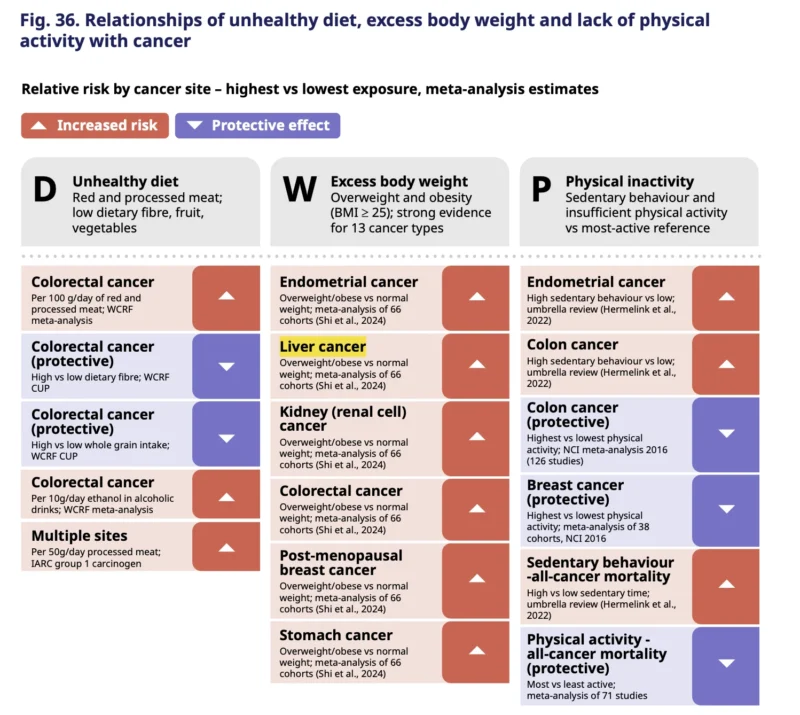
Colorectal cancer also appears prominently in the report’s prevention section. In 2022, 38% of all new cancer cases worldwide were attributable to 30 modifiable risk factors, with tobacco, infections, alcohol, and high BMI the leading contributors globally. Colorectal cancer was among the cancer types with a measurable burden attributable to modifiable risk factors in both women and men.
Diet-related risk is discussed carefully. WHO notes that tobacco and processed meat are both classified as group 1 carcinogens, but the magnitude of risk differs. Compared with eating none, daily consumption of 50 g of processed meatwould result in one additional colorectal cancer case among approximately 100 to 200 people.
Stomach Cancer: Prevention Progress With an Unfinished Chapter
Stomach cancer remained one of the leading cancers among men in 2024, with 638,780 cases, representing 6.4% of male cancer cases. It also carried a substantial mortality burden, causing 418,996 deaths in men, or 7.7% of male cancer deaths.
H. pylori Is The Key Prevention Signal
The most actionable message for gastric cancer is H. pylori control. Infection-associated cancers accounted for 2.3 million new cancer cases in 2022, or 10% of the global cancer burden, and gastric cancer is one of the clearest examples of a malignancy linked to an infectious driver.
Eradication therapy has shown meaningful cancer-prevention potential. Among healthy H. pylori–positive individuals without gastric cancer at baseline, pooled randomized trial data showed a 36% relative risk reduction for future gastric cancer and a 22% relative risk reduction in gastric cancer mortality. Despite this, no country had yet implemented a national population-based programme to screen for and treat H. pylori, although regional programmes exist.
Lifestyle And Prevention
Gastric cancer also sits within the broader prevention landscape. Reductions in salted food consumption and reductions in H. pylori infection have contributed to premature cancer mortality progress, while obesity, unhealthy diet, and physical inactivity remain relevant prevention targets across GI cancers.
Liver And Intrahepatic Bile Duct Cancer
Liver and intrahepatic bile duct cancer was one of the leading cancers in men in 2024. The incidence figure included 586,676 liver cancer cases in men, representing 5.9% of male cancer cases. Mortality was similarly high, with approximately 0.5 million male deaths, placing it among the top causes of cancer death in men.
Viral Hepatitis Prevention Remains Central
The prevention pathway is clear: viral hepatitis control remains one of the most important liver cancer interventions. Meeting hepatitis B vaccination targets by 2030 — reducing new chronic infections by 95% and deaths by 65% — could avert 2.1 million cancer cases. As of May 2026, 115 countries provided universal hepatitis B birth-dose vaccination, but only 45% of infants globally received it within 24 hours of birth.
Progress has been slower for infection-related liver cancer because vaccination and access to viral hepatitis treatment remain suboptimal in many settings. This is especially important for regions carrying a high HBV/HCV burden.
Alcohol And Obesity Add To The Risk Landscape
Alcohol, high BMI, and other modifiable exposures add to the liver cancer burden. Alcohol-attributable cancers remain a major global issue, and liver cancer is one of the malignancies directly linked to alcohol consumption. Excess body weight also contributes to cancer incidence, with obesity increasing fastest in many lower-resource settings.
Pancreatic Cancer: Late Diagnosis Remains the Challenge
Pancreatic cancer appears most clearly in the mortality profile. In 2024, it caused 232,106 deaths in women, accounting for 5.5% of female cancer deaths.
Pancreatic cancer is also included among cancers attributable to modifiable risk factors. In the 2022 risk-factor figure, pancreatic cancer accounted for 2.6% of new cancer cases attributable to modifiable risks in women and 2.8% in men.
Diagnosis And Treatment Access Are The Core System Issues
For pancreatic cancer, the major message is not population screening but access to diagnosis and treatment. Nearly 47%of the world’s population has little to no access to basic diagnostic services, including pathology and diagnostic imaging. Inadequate diagnostic capacity delays diagnosis, staging, referral, and treatment initiation — all critical for pancreatic cancer, where timely imaging, pathology, surgical assessment, and systemic therapy are essential.
Treatment access remains highly unequal. Availability of priority cancer medicines ranged from only 9–54% in low-income and lower-middle-income settings, compared with 68–94% in high-income countries. For pancreatic cancer, this translates into delayed or absent access to systemic therapy for many patients.
Esophageal Cancer: A Risk-Driven GI Malignancy
Esophageal cancer is discussed mainly through prevention and modifiable risk. In the 2022 modifiable-risk figure, esophageal cancer accounted for 1.6% of new cancer cases attributable to modifiable risks in women and 3.8% in men.
Alcohol is one of the key drivers. The report links alcohol consumption to cancers of the oesophagus, liver, colon, and rectum, and emphasizes that public awareness of the alcohol-cancer link remains low. Reducing or stopping alcohol use lowers cancer risk, particularly for cancers of the oral cavity and oesophagus.
Excess body weight and physical inactivity also matter. Physical activity is associated with reduced incidence, and in some cases reduced recurrence, for cancers including colon, stomach, and oesophageal adenocarcinoma. Yet 31.3% of adults were insufficiently active in 2022, and 80% of adolescents were insufficiently active.
Gall Bladder, Anal Cancer And Other GI Tract Malignancies
The report does not provide detailed disease-specific sections for gall bladder cancer, anal cancer, small intestine cancer, or extrahepatic bile duct cancers. However, gall bladder and anal cancers appear in the modifiable-risk figure.
In women, gall bladder cancer accounted for 0.9% and anal cancer for 0.3% of new cancer cases attributable to modifiable risks. In men, gall bladder cancer accounted for 0.5% and anal cancer for 0.3%.
For anal cancer, the broader HPV prevention context is relevant. As of March 2026, 165 countries, or 85% of WHO Member States, had integrated HPV vaccination for girls aged 9–14 into national schedules.
What This Means For Practice
Grouped by cancer type, the message is clear. Colorectal cancer needs organized screening, timely diagnosis, surgical quality, biomarker testing, and medicine access. Stomach cancer has a major missed prevention opportunity in national-scale H. pylori detection and eradication. Liver and intrahepatic bile duct cancer requires stronger HBV vaccination, viral hepatitis control, and alcohol-risk reduction.
Pancreatic cancer depends on faster diagnostics, staging, surgical assessment, and systemic therapy access. Esophageal, gall bladder, and anal cancers reinforce the need for risk-factor control, infection prevention, and better cancer surveillance.
For oncology systems, GI cancer outcomes will improve only when prevention, screening, diagnostics, surgery, pathology, molecular testing, systemic therapy, palliative care, and financial protection are treated as one connected cancer-control continuum.
Takeaway message
The WHO Global status report on cancer 2026 shows that GI cancer control is not only about new drugs or new technology.
It is about whether countries can implement what already works: prevention, vaccination, screening, timely diagnosis, pathology, surgery, systemic therapy, financial protection, and cancer registries.
For GI oncology, the gap is no longer only between what we know and what we do not know. It is between what we know and what health systems are able to deliver.
The full report is available on the official WHO website.