
The ESMO GI Cancers Congress 2026 will take place from July 1 to 4 in Munich, Germany, bringing together major updates across the full spectrum of gastrointestinal oncology.
This year’s programme includes several highly anticipated presentations in colorectal, hepatobiliary, pancreatic, and upper gastrointestinal cancers. Key studies include CAPRI-2 GOIM, KRYSTAL-10, ATOMIC, EMERALD-3, EMERALD-1, TRIPP-FFX, STAR-221, HERIZON-GEA-01, and early-phase studies exploring futibatinib-based combinations in biliary tract cancer and dual RAS(ON) inhibition in KRAS G12D-mutant pancreatic cancer.
Together, these presentations reflect the continued movement of GI oncology toward molecular selection, serial biomarker testing, treatment intensification, local-systemic combinations, and patient-centered endpoints.
CAPRI-2 GOIM: Cetuximab in Molecularly Selected Metastatic Colorectal Cancer
Presentation Number: 2RO
Presenter: Giulia Martini (Naples, Italy)
Trial Type: Phase 2, open-label, biomarker-driven study
Session: Rapid Oral Session
ClinicalTrials.gov: NCT05312398
CAPRI-2 GOIM is evaluating biomarker-driven cetuximab-based treatment across sequential lines of therapy in patients with RAS/BRAF wild-type metastatic colorectal cancer.
The strategy uses serial plasma ctDNA assessment to guide anti-EGFR treatment decisions, including whether cetuximab can be continued with chemotherapy rotation or reintroduced later in the disease course.
Why It Matters?
CAPRI-2 GOIM may help define how plasma ctDNA profiling can guide cetuximab continuation or reintroduction across the continuum of care in RAS/BRAF wild-type metastatic colorectal cancer.
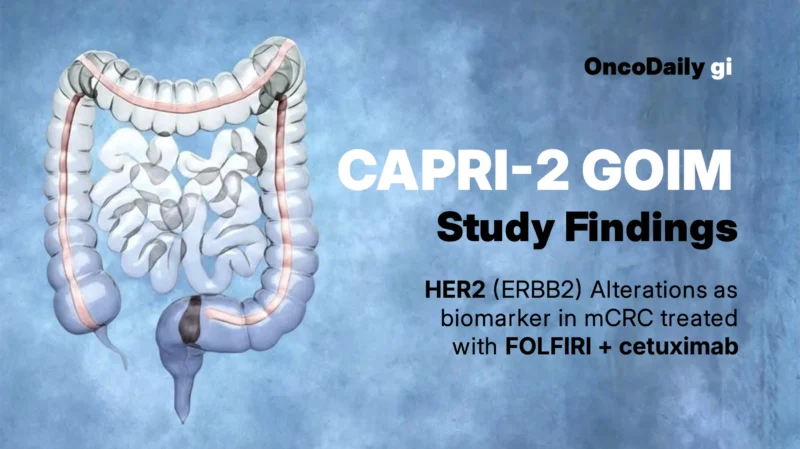
Read more about CAPRI-2 GOIM Study Findings on OncoDaily.
KRYSTAL-10: Adagrasib Plus Cetuximab in 2L KRAS G12C mCRC
Presentation Number: LBA1
Presenter: Josep Tabernero (Barcelona, Spain)
Trial Type: Phase 3 randomized study
ClinicalTrials.gov: NCT04793958
KRYSTAL-10 is evaluating adagrasib plus cetuximab versus chemotherapy-based standard treatment as second-line therapy for patients with KRAS G12C-mutated metastatic colorectal cancer.
The study enrolled patients who had progressed after first-line fluoropyrimidine-based doublet chemotherapy with oxaliplatin or irinotecan. The dual primary endpoints are progression-free survival and overall survival.
Why It Matters?
KRYSTAL-10 could help define the role of KRAS G12C inhibition plus EGFR blockade as a chemotherapy-free targeted strategy in second-line KRAS G12C-mutated metastatic colorectal cancer.
ATOMIC: Does Duration of Adjuvant Chemotherapy or Immunotherapy Matter in Stage III dMMR Colon Cancer?
Presentation Number: 1O
Presenter: Anke Reinacher-Schick (Bochum, Germany)
Trial Type: Phase 3 randomized study
Clinical Trial ID: A021502/AIO-KRK-0317
ATOMIC is evaluating atezolizumab plus mFOLFOX6 versus mFOLFOX6 alone in patients with stage III deficient mismatch repair colon cancer. This secondary analysis examines whether disease-free survival is associated with the number of mFOLFOX6 cycles or atezolizumab cycles received.
Why It Matters?
This analysis may help clarify how treatment exposure to adjuvant chemotherapy and immunotherapy relates to disease-free survival in stage III dMMR colon cancer.

Read more about Phase 3 ATOMIC trial Updates on OncoDaily.
EMERALD-3: Tumour Response With STRIDE ± Lenvatinib Plus TACE in eeHCC
Presentation Number: LBA2
Presenter: Joseph P. Erinjeri (New York, United States)
Trial Type: Phase 3, randomized, open-label, sponsor-blinded study
Session: Proffered Paper Session
ClinicalTrials.gov: NCT05301842
EMERALD-3 is evaluating STRIDE, which includes single-dose tremelimumab plus regular-interval durvalumab, with or without lenvatinib, combined with TACE in patients with unresectable embolisation-eligible hepatocellular carcinoma. This ESMO GI 2026 presentation focuses on tumour response analyses assessed by RECIST v1.1 and mRECIST.
Why It Matters?
EMERALD-3 may help define how dual immunotherapy, VEGFR-targeted therapy, and TACE affect radiologic response in unresectable embolisation-eligible HCC.

Read more about EMERALD-3 Trial on OncoDaily.
EMERALD-1: Final Overall Survival With Durvalumab ± Bevacizumab Plus TACE in eeHCC
Presentation Number: 183O
Presenter: Bruno Sangro (Pamplona, Spain)
Trial Type: Phase 3, randomized, double-blind, placebo-controlled study
Session: Proffered Paper Session
ClinicalTrials.gov: NCT03778957
EMERALD-1 evaluated durvalumab with or without bevacizumab plus TACE in patients with unresectable embolisation-eligible hepatocellular carcinoma. This ESMO GI 2026 presentation reports the final overall survival analysis for durvalumab with or without bevacizumab plus TACE versus TACE alone.
Why It Matters?
EMERALD-1 may help clarify whether adding immunotherapy, with or without anti-VEGF therapy, to TACE can extend benefit beyond disease control in unresectable embolisation-eligible HCC.
Futibatinib, Zimberelimab, and Chemotherapy in 1L Advanced BTC
Presentation Number: 344RO
Presenter: Kazuyoshi Ohkawa (Osaka, Japan)
Trial Type: Phase 1 platform study
ClinicalTrials.gov: NCT04999761
This phase 1 study is evaluating futibatinib, an FGFR1-4 inhibitor, plus zimberelimab, an anti-PD-1 antibody, and gemcitabine/cisplatin chemotherapy in patients with first-line unresectable advanced or metastatic biliary tract cancer in Japan.
Patients were enrolled regardless of FGFR or PD-L1 status. The primary endpoint is dose-limiting toxicity, with secondary endpoints including adverse events and antitumor activity.
Why It Matters?
This study could clarify whether FGFR inhibition can be safely combined with PD-1 blockade and chemotherapy in first-line advanced biliary tract cancer, regardless of FGFR alteration status.
TRIPP-FFX: Phosphorus-32 Microparticles Plus FOLFIRINOX in uLAPC
Presentation Number: LBA4
Presenter: Michele Milella (Verona, Italy)
Trial Type: Open-label, multicentre, randomized study
ClinicalTrials.gov: NCT05466799
TRIPP-FFX is evaluating targeted intratumoural placement of phosphorus-32 microparticles, also known as OncoSil, added to FOLFIRINOX versus FOLFIRINOX alone in patients with unresectable locally advanced pancreatic cancer.
Phosphorus-32 microparticles are implanted into pancreatic tumours under endoscopic ultrasound guidance to deliver local beta radiation. The study is assessing whether this approach can be safely combined with FOLFIRINOX and improve treatment outcomes.
Why It Matters?
TRIPP-FFX could clarify whether adding targeted intratumoural phosphorus-32 microparticles to FOLFIRINOX is feasible and clinically relevant for patients with unresectable locally advanced pancreatic cancer.
Zoldonrasib Plus Daraxonrasib in 2L+ KRAS G12D mPDAC
Presentation Number: 341O
Presenter: Nilofer S. Azad (Baltimore, United States)
Trial Type: Phase 1 dose-escalation and dose-expansion study
ClinicalTrials.gov: NCT06040541
This phase 1 study is evaluating zoldonrasib, a KRAS G12D-selective oral RAS(ON) inhibitor, plus daraxonrasib, a multi-selective oral RAS(ON) inhibitor, in patients with second-line or later KRAS G12D metastatic pancreatic adenocarcinoma.
The study assesses safety, tolerability, and preliminary efficacy. Dose expansion is evaluating zoldonrasib 1200 mg once daily plus daraxonrasib 300 mg once daily as the selected RP2D.
Why It Matters?
This study explores whether dual RAS(ON) inhibition can deepen pathway suppression and address resistance in KRAS G12D-mutant metastatic pancreatic cancer, a setting with no approved targeted therapy.
STAR-221: Domvanalimab, Zimberelimab, and Chemotherapy in 1L Advanced HER2-Negative GC/GEJC/EAC
Presentation Number: 493O
Presenter: Sun Young Rha (Seoul, Republic of Korea)
Trial Type: Phase 3 randomized study
ClinicalTrials.gov: NCT05568095
STAR-221 was designed to evaluate first-line domvanalimab, an Fc-silent anti-TIGIT antibody, plus zimberelimab, an anti-PD-1 antibody, and chemotherapy versus nivolumab plus chemotherapy in patients with advanced HER2-negative gastric, gastroesophageal junction, or esophageal adenocarcinoma.
The primary endpoint is overall survival, tested hierarchically in the ITT, TAP ≥5%, and TAP ≥1% populations. Secondary endpoints include progression-free survival, objective response rate, and safety.
Why It Matters?
STAR-221 tested whether adding TIGIT blockade to PD-1 inhibition and chemotherapy could improve first-line outcomes in advanced HER2-negative gastroesophageal adenocarcinoma, compared with a nivolumab-based standard.

You can also read about EDGE Gastric Study at ESMO 2025 on OncoDaily.
HERIZON-GEA-01: HRQoL With Zanidatamab Plus Chemotherapy ± Tislelizumab in HER2+ mGEA
Presentation Number: 494O
Presenter: Kohei Shitara (Kashiwa, Japan)
Trial Type: Phase 3 randomized study
ClinicalTrials.gov: NCT05152147
HERIZON-GEA-01 is evaluating zanidatamab plus chemotherapy, with or without tislelizumab, versus trastuzumab plus chemotherapy as first-line treatment for HER2-positive advanced or metastatic gastroesophageal adenocarcinoma.
This presentation reports health-related quality-of-life results, a prespecified secondary endpoint assessed with the EORTC QLQ-C30.
Why It Matters?
HERIZON-GEA-01 is important because it evaluates patient-reported quality of life alongside a zanidatamab-based first-line treatment strategy in HER2-positive metastatic gastroesophageal adenocarcinoma.
Read more about HERIZON-GEA-01 Updates on OncoDaily.
More details are available in the official ESMO Gastrointestinal Cancers Congress 2026 programme.