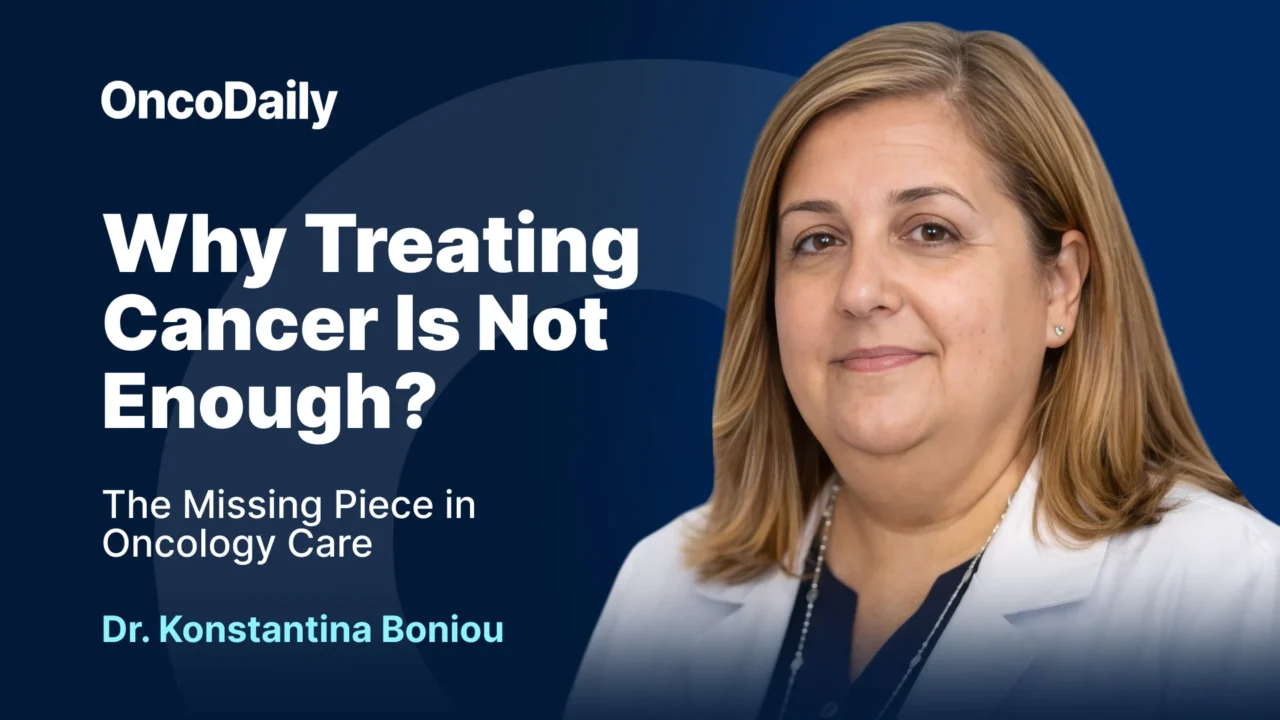
Following our previous discussion on survival and quality of life, we continue our conversation with Dr. Konstantina Boniou, Director of Radiation Oncology at Theagenio Cancer Hospital.
In this second part, we explore a critical but often overlooked dimension of oncology: what it truly means for patients to live with cancer while undergoing treatment.
Cancer care is often structured around treatment delivery. What do we overlook in daily practice?
Oncology is highly structured—and necessarily so. We focus on delivering treatment safely and effectively, following protocols, monitoring toxicity, and evaluating response. However, patients are not only receiving treatment. They are living through it.
They continue to function within their personal, social, and professional environments. They remain parents, partners, and individuals with ongoing responsibilities and concerns that extend far beyond the disease itself. These dimensions are rarely captured in clinical documentation, yet they are central to the patient experience.
Why is this distinction between “treating cancer” and “living with cancer” clinically relevant?
Because quality of life is not a post-treatment concept—it is present from the very beginning. Every therapeutic decision we make has an impact not only on disease control, but also on the patient’s daily functioning, emotional state, and overall well-being. If we approach quality of life as something to be evaluated only after treatment completion, we risk overlooking its progressive decline during therapy. This can affect adherence, patient resilience, and ultimately clinical outcomes.
Many patients report that they are “fine” during treatment. How should clinicians interpret this?
This is a very common and important observation. Patients often underreport symptoms, either because they wish to appear cooperative, or because they perceive their difficulties as insignificant compared to the seriousness of their diagnosis.
However, when explored further, many patients describe persistent fatigue, cognitive difficulties, emotional distress, or a sense of internal pressure to cope without expressing vulnerability.
These experiences are not complications of treatment they are intrinsic to living with cancer.
Is quality of life still underestimated in oncology practice?
In many cases, yes.
Modern oncology is highly effective at quantifying disease. We have precise imaging, biomarkers, and response criteria.
But we are less effective at quantifying disruption. The disruption of daily routines, the loss of confidence in physical or cognitive abilities, and the gradual shift in a patient’s sense of identity are often subtle, cumulative, and not easily captured in standard clinical endpoints. Yet these are the aspects patients experience most intensely.
How does cancer affect patients beyond the physical dimension?
Cancer often leads to a redefinition of self.
Even in cases where treatment is successful, patients frequently report feeling different from their previous selves. Their perception of their body, their independence, and their role within their social environment may change.
These changes are not always visible, but they are deeply meaningful. They highlight the need for a more comprehensive approach to care—one that acknowledges both the biological and the existential dimensions of illness.
What practical changes can clinicians make to maddress this gap?
The first step is awareness. We do not necessarily need more time—we need a shift in perspective. Incorporating simple but targeted questions into clinical encounters can significantly improve communication.
For example:
- Not only asking, “Are you tolerating treatment?”
- But also asking, “How is this treatment affecting your daily life?”
- Not only focusing on side effects
- But also asking, “What has been most difficult for you during this period?”
These questions create space for patients to express aspects of their experience that might otherwise remain unspoken.
Does acknowledging the patient experience actually impact care?
Absolutely.
When patients feel that their experience is recognized, they are more likely to communicate openly. This allows for earlier identification of symptoms, more timely interventions, and improved adherence to treatment. It also strengthens the therapeutic relationship, which is fundamental in oncology. Trust is not a secondary element of care it is central to it.
Cancer treatment can be technically optimal and still feel overwhelming for the patient. Recognizing this does not diminish the success of treatment it completes it.
As highlighted in this discussion, oncology must evolve from a model focused solely on treating disease to one that fully acknowledges the experience of living with it. Because treating cancer is necessary. But understanding how patients live through it is essential.
Written By Eftychia Tataridou, MD