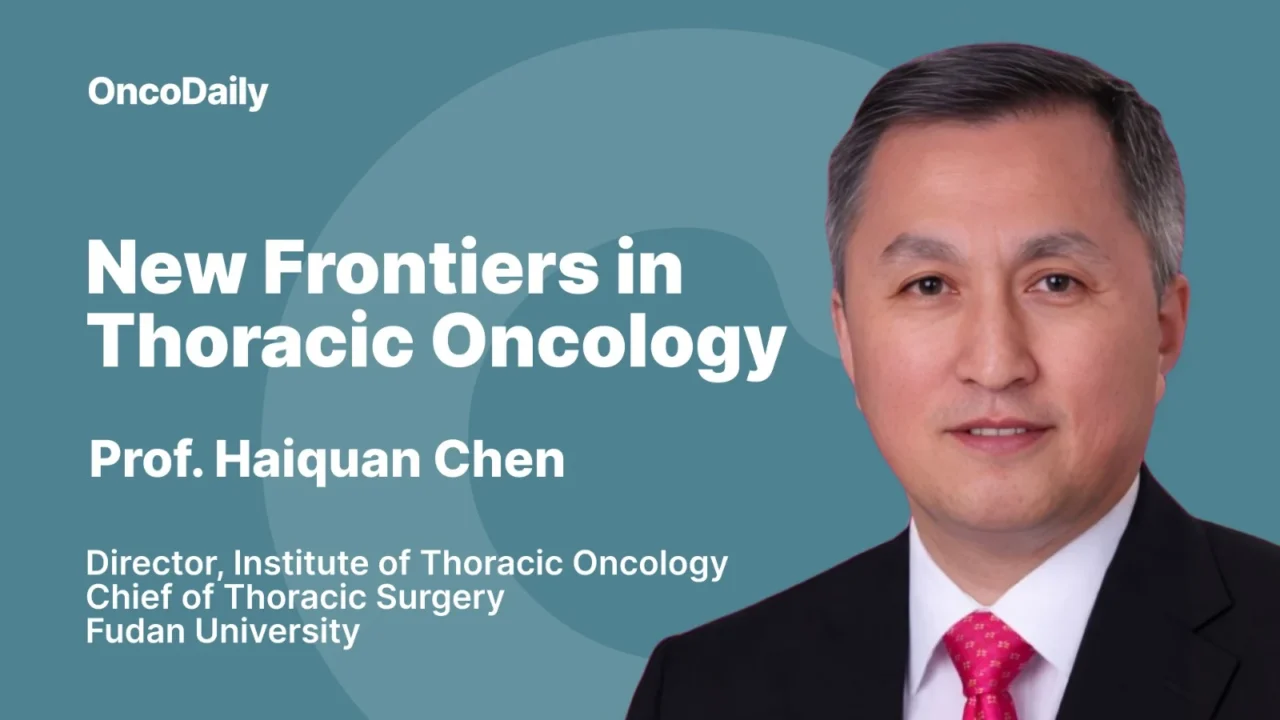
Advances in lung cancer research over the past two decades have dramatically reshaped the clinical management of non–small cell lung cancer (NSCLC). During a recent media interview with OncoDaily Dr. Haiquan Chen, Director of the Institute of Thoracic Oncology at Fudan University and Chief of Thoracic Surgery at the Fudan University Shanghai Cancer Center, discussed how precision surgery, molecular oncology, and immunotherapy are transforming outcomes for patients with lung cancer.
From Uniform Treatment to Precision Oncology
According to Dr. Chen, one of the most important changes in thoracic oncology has been the shift from treating lung cancer as a single disease toward recognizing its biological heterogeneity.Historically, lung cancer treatment strategies were largely determined by anatomical staging alone. However, advances in imaging, pathology, and molecular biology have revealed that lung cancer encompasses a wide spectrum of disease states with distinct biological characteristics.
This improved understanding has enabled clinicians to identify early-stage disease more precisely and to tailor treatment accordingly. In patients with early-stage NSCLC, surgical approaches have evolved toward more individualized strategies, integrating tumor characteristics, radiologic findings, and molecular features to guide decisions about resection and local therapies.
These developments have also improved clinicians’ ability to determine which patients are most likely to achieve cure through surgery or other local treatment modalities.
Targeted Therapy and Immunotherapy Redefining Outcomes
Beyond surgical innovation, systemic therapies have also undergone major transformation. The discovery of oncogenic driver mutations—such as EGFR and ALK alterations—has enabled the development of targeted therapies that dramatically improve outcomes in selected patient populations.
More recently, the emergence of immune checkpoint inhibitors has further changed the treatment landscape for NSCLC. Therapies targeting the PD-1/PD-L1 pathway have demonstrated meaningful improvements in survival across multiple disease settings, including advanced and resectable lung cancer. Building on this progress, next-generation approaches such as bispecific antibodies and antibody-drug conjugates (ADC), including Henlius’ HLX43, a pan-tumor ADC candidate targeting PD-L1, are now being investigated to further enhance antitumor activity for lung cancer beyond checkpoint inhibitors.
Dr. Chen emphasized that these therapies are beginning to transform lung cancer from an acutely fatal disease into a longer-term manageable condition for certain patients, with survival outcomes improving significantly compared with historical standards.
China’s Growing Role in Global Lung Cancer Research
China has increasingly become a major contributor to global lung cancer research and innovation. Over the past four decades, the country has expanded its clinical research infrastructure and oncology capabilities substantially.
With its large patient population and rapidly developing biomedical industry, China has been able to conduct large-scale clinical trials efficiently and generate valuable clinical evidence. In addition, domestic pharmaceutical companies have introduced several novel targeted agents and immunotherapies that are now being studied in international research programs. Dr. Chen noted that in some therapeutic areas, Chinese researchers and biotechnology companies are now contributing leading innovations that help shape global oncology practice.
Multidisciplinary Care in Thoracic Oncology
Another key driver of progress has been the adoption of multidisciplinary team (MDT) approaches in lung cancer care. At the Fudan University Shanghai Cancer Center, complex cases are routinely discussed by teams that include thoracic surgeons, medical oncologists, radiation oncologists, radiologists, pathologists, and other specialists.
This collaborative model ensures that treatment decisions reflect the most current evidence and consider the full range of available therapeutic options. According to Dr. Chen, MDT care has become a routine component of daily clinical practice at leading cancer centers in China.
CheckMate-816 Trial: Serplulimab Plus Chemotherapy
Dr. Chen is currently leading a head-to-head clinical study evaluating serplulimab plus chemotherapy versus nivolumab plus chemotherapy as neoadjuvant therapy for patients with resectable stage II–IIIA squamous NSCLC. The trial builds on the treatment strategy explored in the landmark CheckMate-816 study, which demonstrated the potential of neoadjuvant immunotherapy to improve surgical outcomes.
The goal of the study is to evaluate whether different PD-1 inhibitors combined with chemotherapy can further enhance pathological responses and long-term outcomes in patients undergoing surgery for lung cancer.
Preliminary observations from the study have shown encouraging signals, with major pathological response rates approaching 77% and pathological complete response rates around 50%, suggesting substantial antitumor activity in the neoadjuvant setting.
If confirmed in larger analyses, these results could further refine treatment strategies for patients with resectable NSCLC and help define the optimal immunotherapy-based regimens before surgery.
The Future of Thoracic Oncology
Looking ahead, Dr. Chen emphasized that continued progress in lung cancer care will depend on close collaboration between academic institutions, industry partners, and multidisciplinary clinical teams. Such partnerships will be essential to accelerate drug development, optimize treatment selection, and integrate emerging technologies such as molecular diagnostics and precision imaging into routine clinical practice.
As these advances continue, the combination of personalized surgery, targeted therapies, and immunotherapy is expected to further improve outcomes for patients with lung cancer worldwide.