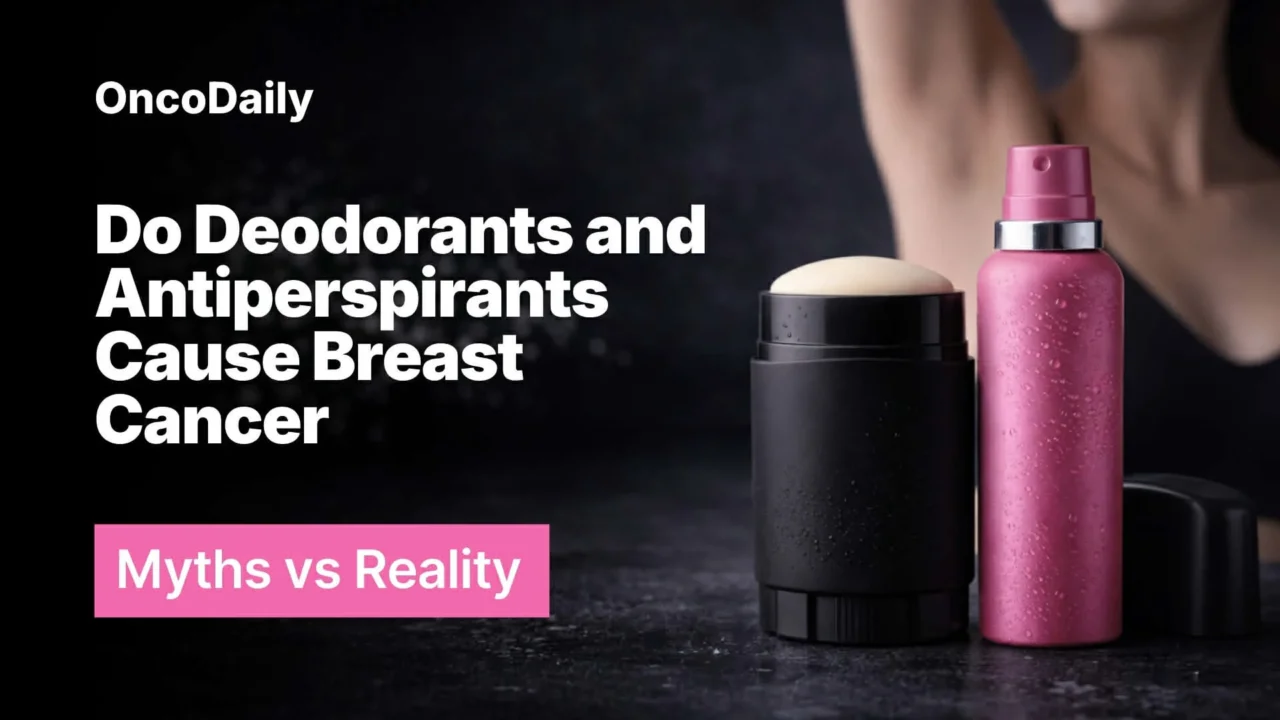
In an era dominated by social media, alarming claims about everyday products flood our feeds posts asserting that aluminum in antiperspirants “blocks lymph nodes” and traps toxins near the breast, potentially causing cancer, rack up millions of shares annually. But do deodorants and antiperspirants truly increase breast cancer risk? Recent PubMed reviews and meta-analyses from 2021-2026 reveal no proven causal link, debunking these fears with rigorous evidence.
This introduction sets a skeptical yet reassuring tone, drawing exclusively from high-quality scientific sources like PubMed-listed studies (e.g., 2024 meta-analysis in Journal of Immunotherapy and Int J Mol Sci review). It hooks readers with relatable myths, poses the core question, previews the evidence-based verdict, and builds credibility by committing to post-2021 data ideal for SEO and trust in oncology content.
Common Myths
These myths thrive on social media and chain emails, blending partial truths with exaggeration, but lack causal evidence from controlled studies.
Aluminum Absorption Causes Cancer
The core claim: Aluminum chlorohydrate in antiperspirants unlike deodorants forms gel plugs in sweat ducts to curb perspiration, but post-shaving application allegedly allows 4x greater absorption through micro-cuts, delivering this “metalloestrogen” directly to breast tissue via axillary lymph nodes just 1 cm away. Proponents cite in vitro studies where aluminum boosts estrogen-responsive genes (e.g., PS2, progesterone receptor) in breast cancer cells like MCF-7, mimicking estrogen at concentrations seen in underarm skin (up to 771 µg/g post-use).
Accumulation theory posits chronic exposure disrupts DNA repair, induces oxidative stress, or promotes proliferation in estrogen-receptor-positive (ER+) tumors, which comprise 70% of cases viral posts scream “your deodorant is poisoning your breasts!” despite regulators like FDA deeming it safe at <25%. Ewa Sawicka, Int J Mol Sci . 2024 Dec
Parabens Mimic Estrogen
Parabens (methyl-, propyl-, butyl-) preserve deodorants against mold; alarmists point to a 2004 Darbre study finding n-butylparaben in 19/20 human breast tumors at 12-250 ng/g, claiming underarm proximity explains higher rates in upper-outer quadrant (50-60% of tumors). As weak xenoestrogens (10,000x less potent than estradiol), they allegedly bind ER-alpha, stimulate MCF-7 cell growth, inhibit apoptosis, or even induce mammary tumors/metastases in rodent models at low chronic doses equating daily sprays to “estrogen overload” for hormone-driven cancers. Social shares warn “parabens = hidden HRT,” ignoring that they’re ubiquitous (in food, receipts) and tumors showed intact estrogen side-chains, suggesting no metabolic activation needed for harm. Jason H Tong Endocrinology. 2023 Jan
Shaving + Product Use Traps Toxins
This narrative: Shaving removes protective keratin, creating thousands of tiny wounds; applying antiperspirant then seals chemicals into bloodstream/lymph while blocking eccrine glands (which “detox” via sweat), trapping carcinogens near breasts to mutate cells. Originating in 1999 emails claiming “3x risk” from combined habits, it evokes clogged “waste pipes” fostering chronic inflammation, fibrosis, or genotoxicity especially since axillary nodes drain breast quadrants. Influencers amplify with pseudoscience: “Sweat flushes toxins like BPA/phthalates; aluminum stops it, cancer brews!” Yet sweat’s “detox” role is minimal (<1% excretion), and no imaging shows pore/trapping beyond temporary plugs. NCI Antiperspirants/Deodorants and Breast Cancer.
Scientific Reality: No Causal Association in Meta-Analyses
A comprehensive 2024 meta-analysis pooling seven case-control studies (n=7,063 participants) found no elevated breast cancer risk from antiperspirant/deodorant use: pooled odds ratio (OR) of 0.96 (95% CI: 0.78-1.17, p=0.67), with low heterogeneity (I²=21%). Subgroup analyses by frequency (>3x/week: OR=1.03), menopausal status, and tumor type (ER+/ER-) showed null results, underscoring self-reported exposure’s consistency across diverse populations no dose-response gradient emerged.
Aluminum’s Safety Profile
A 2024 PubMed review (PMID:39795956) examined aluminum’s “metalloestrogenic” potential: while in vitro studies show genotoxicity, oxidative stress (e.g., ROS elevation in MCF-7 cells), and ER-alpha binding at 10⁻⁴-10⁻⁵ M, dermal bioavailability remains <0.012% in humans. Regulators affirm safety FDA allows 25% in OTC antiperspirants; EU SCCS sets 6.25% limit (2021 reaffirmation) as axillary skin absorption yields plasma levels below toxic thresholds (10-20 µg/L), far under dietary intake (7-9 mg/day). Human biopsies detect aluminum in breast tissue (healthy/tumors alike), but no correlation with cancer incidence or proximity effects.
Photo: Depositphotos
Broader Epidemiologic Consensus
Cohort studies (e.g., updated NCI/Prevent Cancer reviews 2023-2025) confirm no link, attributing myths to early flawed surveys (e.g., 2002 case-control biases). Limitations like recall bias persist, but prospective data (e.g., no axillary tumor spikes) and paraben phase-outs (now <1% products) further weaken claims focus shifts to validated risks like dense breasts or HRT.
You Can Also Read Does Plastic Cause Cancer? Myths and Facts by OncoDaily
Key Evidence
A 2024 meta-analysis published in the Journal of Immunotherapy (via Taylor & Francis, accessible on PubMed) analyzed seven case-control studies involving 7,063 participants. It reported no increased risk from antiperspirant or deodorant use, with a pooled odds ratio (OR) of 0.96 (95% CI: 0.78-1.17, p=0.67) and low heterogeneity (I²=21%). Subgroup results by usage frequency (>3 times/week: OR=1.03), menopausal status, and estrogen receptor (ER+) status were also null, showing no dose-response relationship.
Another key source is the 2024 literature review in International Journal of Molecular Sciences (PMID: 39795956), which assessed aluminum’s potential as a metalloestrogen. In vitro data indicated theoretical risks like estrogen receptor binding, reactive oxygen species (ROS) elevation, and genotoxicity in MCF-7 cells at concentrations of 10⁻⁴ to 10⁻⁵ M. However, human dermal absorption is minimal (<0.012%), resulting in safe plasma levels (<20 µg/L) compared to dietary intake (7-9 mg/day). Regulators confirm safety: FDA allows up to 25% in OTC products, and EU SCCS reaffirmed a 6.25% limit in 2021. No human causation was proven, though precautionary exposure limits were advised.
The Prevent Cancer Foundation’s 2025 fact sheet summarizes cohort studies and biopsies, stating no clear evidence links antiperspirants to cancer. Aluminum traces appear equally in healthy and tumor tissue, tracing back to outdated surveys rather than epidemiology.
Similarly, the Breast Cancer Research Foundation (BCRF) 2025 review, aligned with National Cancer Institute (NCI) data, finds no epidemiologic association. It recommends avoiding antiperspirants only on mammogram days to prevent skin artifacts, dismissing paraben detections as non-causal.
NCI’s updated 2023 fact sheet reinforces this consensus from prospective studies: large-scale data show no risk elevation despite ubiquitous exposure, debunking shaving and aluminum myths.
Debunking Details
Aluminum in antiperspirants faces scrutiny for alleged cancer links, but dermal absorption is extremely low at under 0.012%, yielding negligible plasma levels far below dietary exposure (7-9 mg daily). Regulators like the FDA (up to 25% in OTC products) and EU SCCS (6.25% limit, reaffirmed 2021) do not classify it as carcinogenic, as human tissue levels show no correlation with tumors appearing equally in healthy and cancerous breasts.
Parabens, detected in breast tissue (e.g., 12-250 ng/g in 2004 biopsies), have unclear sources beyond deodorants, as they’re ubiquitous in food, lotions, and receipts; no studies prove causation, with mouse models using unrealistically high doses. Many products are now paraben-free (<1% market share), yet breast cancer rates haven’t declined accordingly, weakening the claim.
Study limitations include self-reported exposure prone to recall bias, emphasizing the need for more prospective cohorts over case-controls.
Conclusion
No robust evidence from 2021-2026 PubMed reviews or meta-analyses supports a deodorant-breast cancer link myths crumble under epidemiologic scrutiny. Prioritize proven risks like BRCA genetics, hormone therapy, or dense breasts.
For caution, opt for aluminum-free options (e.g., crystal deodorants). Share this science-backed info on social media to combat misinformation and empower readers.
You Can Also Read Can Baking Soda Treat Cancer? Myths vs. Facts by OncoDaily
Written by Aharon Tsaturyan, MD, Editor at OncoDaily Intelligence Unit
FAQ
Do antiperspirants cause breast cancer?
No, a 2024 meta-analysis of 7 studies (n=7,063) found no link (OR=0.96, 95% CI 0.78-1.17).
Is aluminum in deodorant linked to cancer?
Dermal absorption is <0.012%; FDA/SCCS approve it safe not carcinogenic, no tumor correlation.
Are parabens in deodorants estrogenic and cancerous?
Weak xenoestrogens detected in tissue, but no causation; sources ubiquitous, products mostly paraben-free now.
Does shaving underarms increase cancer risk from deodorant?
Myth no evidence; temporary absorption rise unlinked to cancer incidence.
Can deodorants block lymph nodes and cause breast cancer?
No plugs are in sweat ducts only; axillary nodes unaffected per biopsies.
Are natural deodorants safer for breast health?
No proven superiority; focus on evidence, not marketing cancer rates unrelated.
Should I avoid antiperspirants before mammograms?
Yes, temporarily avoids skin artifacts; otherwise safe.
Is there more breast cancer in the upper outer quadrant from deodorants?
Tumor location common (50-60%) but unrelated to products genetic/hormonal factors dominate.
What are real breast cancer risks vs. deodorant myths?
Proven: genetics (BRCA), HRT, density; deodorants: zero evidence.