
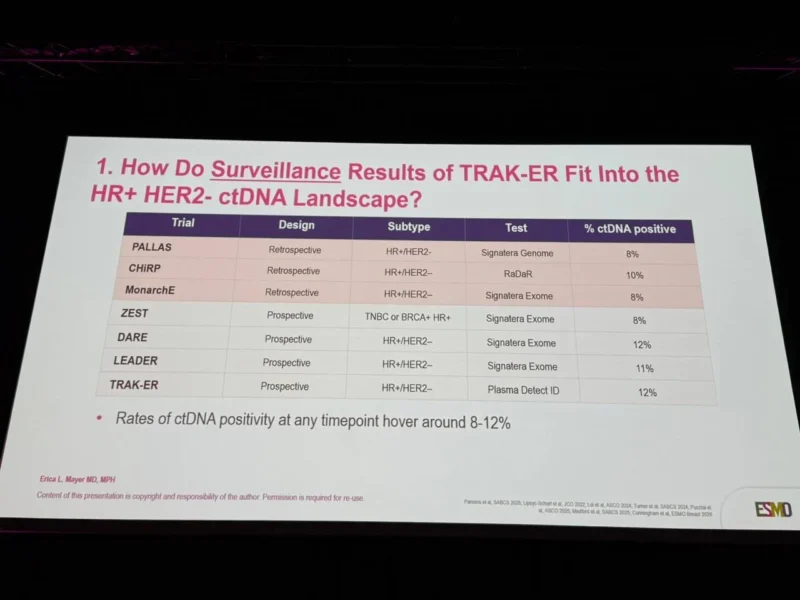
TRAK-ER Trial was presented at the ESMO Breast Cancer Annual Congress 2026, a randomized multicenter trial evaluating serial circulating tumor DNA (ctDNA) surveillance in patients with high-risk hormone receptor-positive, HER2-negative early breast cancer receiving adjuvant endocrine therapy. Among 480 patients with evaluable assays, ctDNA was detected in 2.6% of samples and in 11.3% of patients at least once during follow-up.
Background
Detection of circulating tumor DNA during adjuvant endocrine therapy has been shown to anticipate recurrence with high accuracy in hormone receptor-positive breast cancer. However, the optimal implementation of ctDNA surveillance and its clinical implications remain under investigation.
The TRAK-ER study was designed to evaluate the feasibility and performance of serial ctDNA monitoring in high-risk patients and to explore its role in identifying molecular relapse before clinical or radiographic progression.
Methods
TRAK-ER (NCT04985266) is a randomized, multicenter study incorporating ctDNA surveillance every three months for three years in patients with high-risk HR-positive, HER2-negative breast cancer receiving adjuvant endocrine therapy.
Eligible patients had completed at least six months and up to seven years of endocrine therapy. ctDNA analysis was performed using a tumor-informed assay based on whole exome sequencing, tracking 18–50 patient-specific variants.
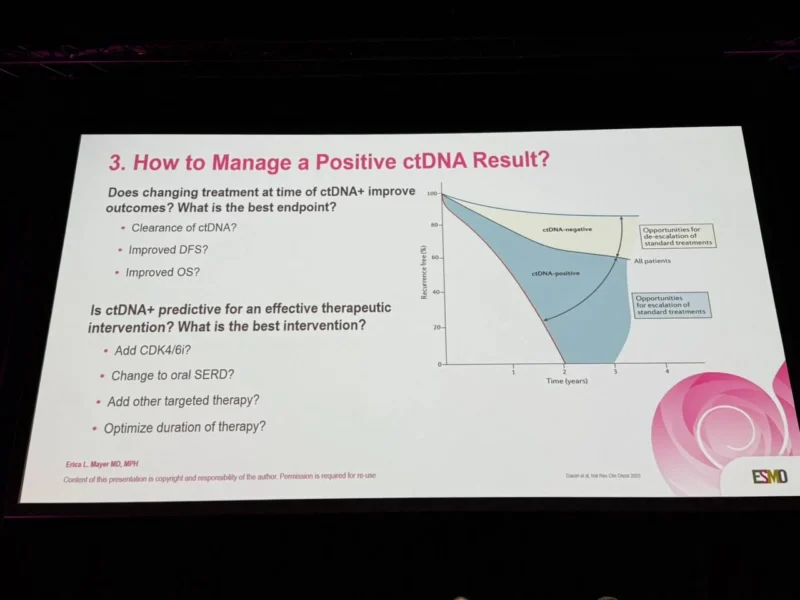
Upon ctDNA detection, patients underwent staging imaging. In the absence of radiographic disease, patients were randomized to receive palbociclib plus fulvestrant or to continue standard endocrine therapy.
This analysis included patients with more than six months of follow-up after registration.
Study Design
The study aims to recruit 1100 patients into ctDNA surveillance. This interim analysis includes data from patients enrolled between March 2022 and September 2024, focusing on ctDNA detection rates across serial time points and their association with clinical outcomes.
Results
A total of 573 patients were registered, and ctDNA panels were successfully designed for 480 patients. The panel design failure rate was 14.8%, primarily due to insufficient tumor material or insufficient detectable variants.
Across 2110 samples from 480 patients, ctDNA was detected in 2.6% of tests. At the patient level, ctDNA was detected at least once in 11.3% of patients.
The median allele fraction of detected ctDNA was 0.034%, with a range from 0.005% to 7.924%.
Detection rates varied by timing. At the first surveillance time point (Month 0), ctDNA was detected in 6.2% of patients, compared with 1.5% across subsequent time points (Month 3 and beyond).
Median allele fraction was higher at the initial test, at 0.167%, compared with 0.017% in later samples, with a statistically significant difference (p<0.0001).
The rate of metastatic disease at the time of ctDNA detection was also higher at the first time point, observed in 62% of patients at Month 0 compared with 16% at later time points (p=0.0008).
ctDNA detection was numerically more frequent in patients with higher nodal stage and stage IIIC disease and less frequent in grade 1 tumors.
Annual ctDNA detection rates decreased over time, with 7.6% in year 1, 2.9% in years 2 and 3, 1.8% in year 4, 2.5% in year 5, 2.2% in year 6, and 2.0% beyond year 7 after surgery.
Key Findings
ctDNA was detected in a small proportion of samples overall, but more than one in ten patients had detectable ctDNA at least once during surveillance.
Detection rates were higher at the first surveillance time point and were associated with a higher rate of concurrent metastatic disease.
Serial testing demonstrated lower detection rates over time but provided ongoing monitoring for molecular relapse.
Conclusion
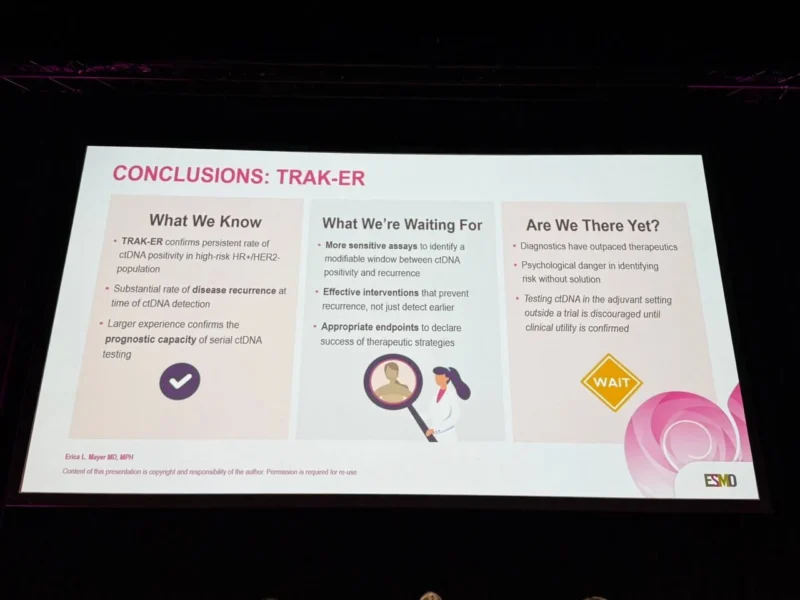
The TRAK-ER study demonstrates that ctDNA detection during adjuvant endocrine therapy occurs in a minority of patients but can identify molecular relapse, with higher detection and metastatic rates at initial testing. These findings support the role of serial ctDNA monitoring and inform the design of future trials evaluating intervention at molecular relapse.