The relationship between alcohol and breast cancer has been discussed for decades, but one question has remained especially important for clinicians and patients alike: does alcohol only affect the risk of developing breast cancer, or does it also worsen outcomes after diagnosis?
A new systematic review and meta-analysis helps clarify that distinction. Across 37 studies including 2,565,920 women, alcohol consumption was associated with a dose-dependent increase in breast cancer incidence, while it did not appear to significantly worsen breast cancer recurrence or breast cancer-specific survival after diagnosis. The analysis also suggested that light and intermediate alcohol intake were associated with slightly improved overall survival, though this finding should be interpreted cautiously and not as a reason to recommend alcohol use (Arecco et al., 2026).
For readers, the most important message is straightforward: alcohol and breast cancer incidence are clearly linked, and the risk rises as intake increases. At the same time, this study does not support the idea that prior alcohol exposure clearly worsens recurrence risk or breast cancer-specific mortality in women already diagnosed with breast cancer (Arecco et al., 2026).

Read About Breast Cancer on OncoDaily
Why This Question Matters
Breast cancer remains the most frequently diagnosed cancer among women globally and a major cause of cancer-related death. Some risk factors, such as age, sex, family history, and pathogenic variants, are not modifiable. Others, including obesity, tobacco, and alcohol use, are potentially modifiable and therefore highly relevant for prevention strategies (Arecco et al., 2026).
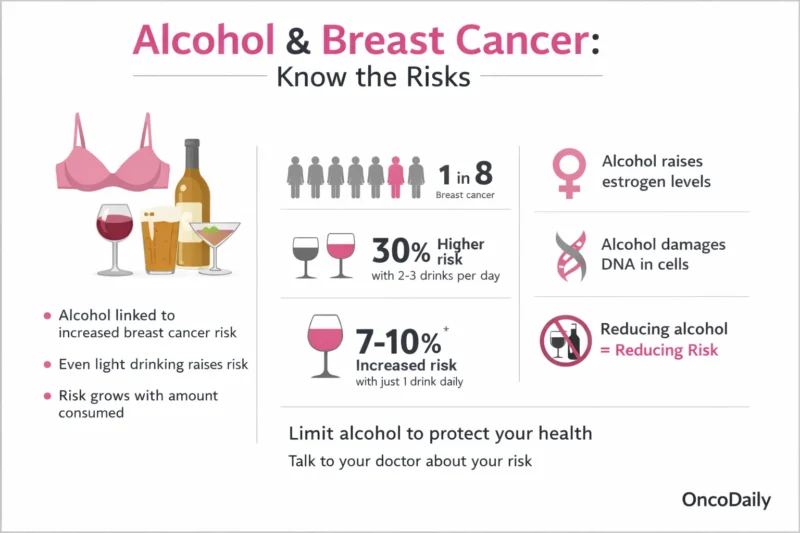
That is why understanding alcohol and breast cancer is so important from a public health perspective. Alcohol is already recognized as a Group 1 carcinogen, and the biological rationale for its carcinogenic role is strong. Ethanol metabolism produces acetaldehyde, a toxic compound capable of damaging DNA. Alcohol exposure can also increase oxidative stress, interfere with folate metabolism, and raise circulating estrogen levels, all of which are biologically plausible pathways for breast carcinogenesis (Arecco et al., 2026).
Still, while the role of alcohol in breast cancer development has been increasingly accepted, its effect on prognosis after diagnosis has remained less consistent. This meta-analysis was designed to address both sides of the question in a single large dataset (Arecco et al., 2026).
What The Meta-Analysis Included
The review followed PRISMA methodology and included studies published up to May 1, 2025. After screening 5,208 records, the investigators identified 37 eligible studies, including 30 cohort studies and 7 case-control studies. Altogether, the analysis covered 2,565,920 women (Arecco et al., 2026).
The included studies were divided into two main groups. One cohort focused on the association between alcohol exposure and breast cancer incidence. The second focused on prognosis after breast cancer diagnosis, including recurrence, breast cancer-specific survival, and overall survival.
Among the 37 studies, 17 studies evaluated breast cancer incidence, and 20 studies evaluated breast cancer outcomes. This makes it one of the most comprehensive recent efforts to assess alcohol and breast cancer across the full continuum from risk to survivorship.
Alcohol Was Linked To Higher Breast Cancer Incidence
The incidence analysis included 2,450,932 women. Among these, 53,465 women with a history of alcohol consumption were subsequently diagnosed with breast cancer, compared with 17,969 women diagnosed in the setting of no alcohol consumption (Arecco et al., 2026).
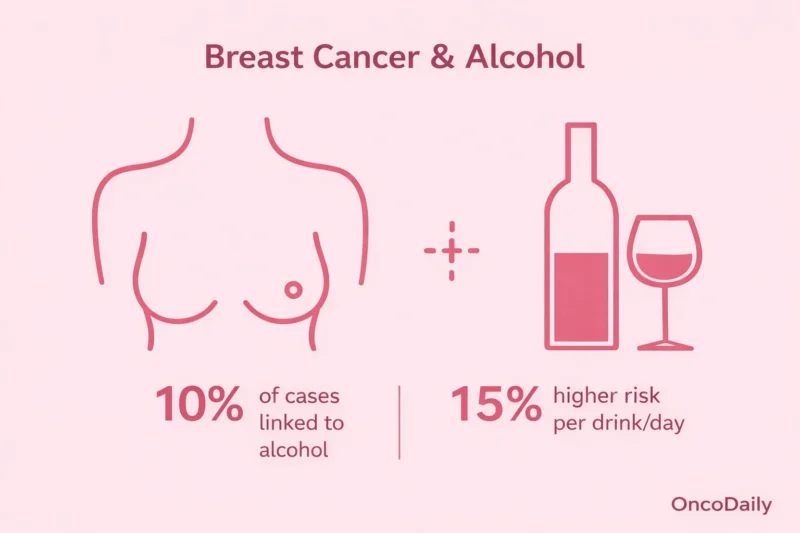
The pooled analysis showed that any alcohol consumption was associated with a 17% higher risk of breast cancer incidence, with a relative risk of 1.17 (95% CI 1.09–1.26; p < 0.001). That is the core finding of this paper and the strongest evidence reinforcing the link between alcohol and breast cancer risk (Arecco et al., 2026).
Importantly, the risk was not flat. It increased stepwise according to alcohol exposure level. Compared with no alcohol consumption, light alcohol intake was associated with a relative risk of 1.13 (95% CI 1.05–1.23; p = 0.002), intermediate intake with a relative risk of 1.28 (95% CI 1.18–1.39; p < 0.001), and heavy intake with a relative risk of 1.52 (95% CI 1.38–1.67; p < 0.001).
This dose-response gradient is one of the most important findings in the analysis. It suggests that the association between alcohol and breast cancer is not simply present, but progressively stronger with greater intake.
The Association Was Stronger In Hormone Receptor-Positive Disease
The study also explored whether alcohol exposure was linked differently to breast cancer subtypes. Among 9 studies including 921,326 women that reported incidence by hormone receptor status, alcohol intake was associated with an increased risk of hormone receptor-positive breast cancer, with a relative risk of 1.15 (95% CI 1.11–1.20; p < 0.001) (Arecco et al., 2026).
By contrast, no statistically significant association was found between alcohol consumption and hormone receptor-negative disease, where the relative risk was 1.09 (95% CI 0.95–1.26; p = 0.212).
This distinction matters clinically because it supports the theory that hormonal pathways, particularly estrogen-related mechanisms, may be central to how alcohol and breast cancer are biologically connected. It also helps explain why the effect may not be uniform across all breast cancer subtypes.
Alcohol Did Not Significantly Increase Recurrence Risk
The prognosis analysis included 114,988 patients with a prior breast cancer diagnosis. Of these, 13,872 patients with a history of alcohol consumption experienced a subsequent breast cancer event, compared with 6,797 patients without reported alcohol consumption who also had an event after diagnosis (Arecco et al., 2026).
Among the 9 studies reporting on recurrence, covering 30,033 patients, no significant association was found between alcohol consumption and breast cancer recurrence. The pooled relative risk was 1.02 (95% CI 0.93–1.11; p = 0.699).
This remained consistent across intake categories. Light consumption had a recurrence relative risk of 1.02 (95% CI 0.94–1.10; p = 0.635), intermediate intake also had a relative risk of 1.02 (95% CI 0.88–1.19; p = 0.770), and heavy intake had a relative risk of 1.12 (95% CI 0.99–1.26; p = 0.065), which did not reach statistical significance.
So while alcohol and breast cancer incidence were clearly associated, the same was not true for recurrence after diagnosis in this analysis.
Breast Cancer-Specific Survival Was Not Significantly Worse
The analysis of breast cancer-specific survival included 13 studies and 61,099 patients. Again, no significant association was found between alcohol consumption and breast cancer-specific survival. The pooled hazard ratio was 0.93 (95% CI 0.87–1.00; p = 0.050).
Subgroup analyses were also consistent. Light alcohol intake was associated with a hazard ratio of 0.93 (95% CI 0.85–1.01; p = 0.083), intermediate intake with 0.91 (95% CI 0.81–1.03; p = 0.129), and heavy intake with 1.05 (95% CI 0.87–1.27; p = 0.621).
These findings suggest that prior alcohol exposure does not clearly worsen breast cancer-specific mortality. That is a clinically important nuance in discussions about alcohol and breast cancer, especially for patients already living with the disease.
Overall Survival Looked Slightly Better In Light And Intermediate Drinkers
One of the more surprising findings came from the overall survival analysis. Among 16 studies including 117,397 patients, alcohol consumption was associated with slightly improved overall survival, with a pooled hazard ratio of 0.83 (95% CI 0.76–0.91; p < 0.001).
When examined by intake level, light alcohol consumption was associated with a hazard ratio of 0.85 (95% CI 0.78–0.92; p < 0.001), and intermediate consumption with 0.84 (95% CI 0.75–0.94; p = 0.002). Heavy alcohol consumption, however, was not associated with improved overall survival, with a hazard ratio of 0.93 (95% CI 0.85–1.03; p = 0.20) (Arecco et al., 2026).
This part of the analysis needs careful interpretation. The paper itself emphasizes that these results should not be viewed as support for drinking alcohol after breast cancer diagnosis. The lack of benefit in breast cancer-specific survival suggests that any apparent overall survival advantage is likely driven by non-cancer causes of death, residual confounding, or lifestyle differences not fully accounted for in observational data.
What This Means For Patients And Public Health
The most clinically useful takeaway is that the evidence around alcohol and breast cancer is strongest in the prevention setting. In this meta-analysis, alcohol consumption was clearly associated with an increased risk of developing breast cancer, and the increase was dose-dependent. Even light intake was associated with higher incidence, while heavy intake was linked to more than a 50% relative increase in risk compared with non-consumption (Arecco et al., 2026).
At the same time, alcohol use did not appear to significantly worsen recurrence or breast cancer-specific survival in women who had already been diagnosed. That distinction is important, but it does not change the broader public health message. Alcohol remains a carcinogen, and reducing alcohol intake remains a rational prevention strategy.
For readers, this paper strengthens a message that is both simple and actionable: alcohol and breast cancer are linked in a meaningful, dose-dependent way at the level of risk, especially for hormone receptor-positive disease. That makes alcohol reduction one of the clearer lifestyle opportunities in breast cancer prevention today.
Read full article here