A new targeted treatment combination for a difficult-to-treat subtype of lung cancer has reached an important regulatory milestone.
Cullinan Therapeutics announced on November 12, 2026, that its partner, Taiho Oncology, has completed a New Drug Application (NDA) submission to the U.S. Food and Drug Administration (FDA) for zipalertinib plus platinum-based chemotherapy. The application seeks approval for patients with previously untreated, locally advanced or metastatic non-small cell lung cancer (NSCLC) harboring EGFR exon 20 insertion mutations.
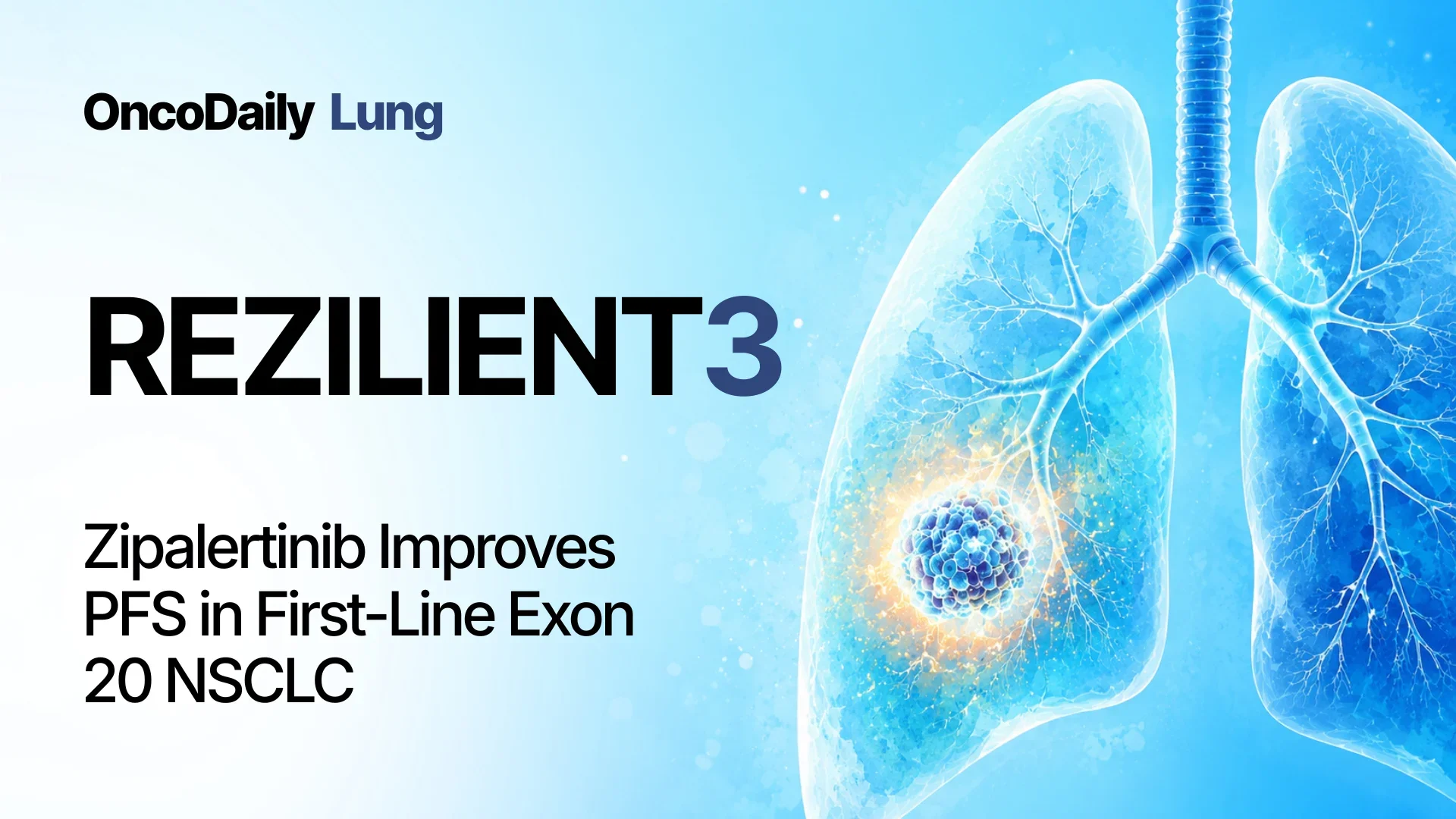
The submission follows positive results from the Phase 3 REZILIENT3 trial, in which adding zipalertinib to chemotherapy extended median progression-free survival (PFS) by six months compared with chemotherapy alone.
The findings, presented at the 2026 World Conference on Lung Cancer (WCLC), suggest that the investigational oral EGFR inhibitor could become another first-line treatment option for this molecularly defined patient population, pending regulatory approval.
From Phase 3 Success to FDA Submission
The regulatory filing is supported by results from REZILIENT3 (NCT05973773), a global, randomized, open-label Phase 3 trial evaluating zipalertinib plus platinum-pemetrexed chemotherapy against chemotherapy alone.
The trial enrolled 285 patients, including six in an initial safety lead-in phase. In the randomized portion, 279 patients with previously untreated advanced NSCLC harboring EGFR exon 20 insertion mutations received either zipalertinib 100 mg twice daily alongside chemotherapy or chemotherapy alone.
At the prespecified interim analysis, the combination demonstrated a statistically significant improvement in progression-free survival, meeting the trial’s primary endpoint.
Median PFS reached 14.5 months with zipalertinib plus chemotherapy, compared with 8.5 months with chemotherapy alone.
This represented a 50% reduction in the hazard of disease progression or death (HR 0.50; 95% CI, 0.34–0.73; P=0.00015).
The treatment benefit was also observed among patients with baseline brain metastases, with a reported PFS hazard ratio of 0.38 in this subgroup.
Higher Response Rates Strengthen the Clinical Evidence
Beyond delaying disease progression, zipalertinib plus chemotherapy demonstrated improvements in tumor response.
The objective response rate (ORR) was 65.0% in the combination arm versus 40.3% with chemotherapy alone (P<0.0001).
Responses were also more durable, with a median duration of response of 14.2 months compared with 9.9 months, respectively.
These findings suggest that incorporating targeted EGFR inhibition into first-line chemotherapy may improve both the likelihood and durability of tumor responses.
However, the effect on overall survival remains uncertain. At the interim analysis, overall survival data were only 30% mature, with a hazard ratio of 0.72 (95% CI, 0.42–1.23). Additional follow-up will be necessary to establish whether the progression-free survival improvement translates into a statistically significant survival advantage.
Commenting on the findings when they were presented at WCLC 2026, Helena A. Yu, MD, a thoracic medical oncologist at Memorial Sloan Kettering Cancer Center and REZILIENT3 investigator, said:
“These findings support the potential of zipalertinib plus platinum-based chemotherapy as a first-line treatment option for this patient population.”
Safety: Greater Efficacy Comes With Increased Toxicity
The improvement in disease control was accompanied by a higher incidence of severe adverse events.
Grade 3 or higher adverse events occurred in 87.1% of patients receiving zipalertinib plus chemotherapy, compared with 54.4% receiving chemotherapy alone.
Severe hematologic adverse events were reported in 58.6% and 28.7% of patients, respectively.
Among EGFR-related toxicities, grade 3 or higher rash occurred in 10.7% of patients in the combination arm, while severe diarrhea was reported in 1.4%.
Investigators reported no new safety signals, although the higher frequency of severe adverse events highlights the importance of careful patient selection and toxicity management.
Why EGFR Exon 20 Insertions Matter in Lung Cancer
EGFR mutations are well-established therapeutic targets in NSCLC, but not all EGFR alterations respond equally to available treatments.
EGFR exon 20 insertion mutations represent a distinct molecular subgroup, accounting for up to 4% of NSCLC cases globally. Unlike the more common EGFR exon 19 deletions and exon 21 L858R mutations, exon 20 insertions have historically been less responsive to several established EGFR tyrosine kinase inhibitors.
Zipalertinib, also known as CLN-081 or TAS6417, is an investigational, orally administered, irreversible EGFR inhibitor designed to target tumors with these mutations.
Its development reflects the growing emphasis on treatments tailored to specific molecular alterations rather than treating all EGFR-mutated lung cancers as a single disease category.
The first-line treatment landscape has already changed with the introduction of amivantamab plus carboplatin and pemetrexed, which received FDA approval in March 2024 on the basis of the Phase 3 PAPILLON trial.
Zipalertinib offers a different targeted approach, using an oral small-molecule inhibitor alongside chemotherapy rather than an intravenously administered bispecific antibody.
Importantly, REZILIENT3 compared zipalertinib plus chemotherapy with chemotherapy alone, not with amivantamab-based treatment. Its results therefore cannot establish which targeted combination provides superior efficacy or tolerability.
Zipalertinib FDA Submission: What Happens Next?
Taiho Oncology completed the application through the FDA’s Real-Time Oncology Review (RTOR) program.
This program enables regulators to begin examining selected clinical data before the entire application is submitted, potentially making the review process more efficient.
However, submission completion does not constitute FDA acceptance or approval. The agency must first determine whether the application is sufficiently complete for review. If accepted, it will assign a Prescription Drug User Fee Act (PDUFA) target action date.
The first-line application is not the only regulatory development underway for zipalertinib.
A separate NDA seeking accelerated approval of zipalertinib monotherapy for patients with previously treated EGFR exon 20 insertion-mutated NSCLC following platinum-based chemotherapy is already under FDA review.
That application is supported by the Phase 2b REZILIENT1 trial and has a PDUFA target action date of February 27, 2027.
Zipalertinib has also received FDA Breakthrough Therapy designation in the previously treated setting.
For Cullinan Therapeutics, these regulatory milestones also carry financial implications. Under its collaboration with Taiho, the company is eligible for milestone payments of $30 million upon U.S. approval in the previously treated setting and $100 million upon first-line U.S. approval.
A Potential New Chapter in Precision Lung Cancer Treatment
The completion of the zipalertinib NDA submission marks another step in the development of treatments for EGFR exon 20 insertion-mutated NSCLC.
The six-month improvement in median progression-free survival and higher response rates observed in REZILIENT3 provide a strong rationale for regulatory evaluation.
Nevertheless, questions remain regarding long-term survival, the clinical significance of increased toxicity, and how zipalertinib-based treatment might fit alongside existing targeted therapies.
With regulatory review approaching and additional survival data expected from continued follow-up, zipalertinib could contribute to an expanding range of personalized treatment options for patients with this uncommon form of lung cancer.
Read further on OncoDaily: Samvel Bardakhchyan at COGC 2026: New EGFR-Targeted Therapy Is Reshaping NSCLC