The Phase 3 REZILIENT3 trial has met its primary endpoint, with zipalertinib plus platinum-based chemotherapy significantly improving progression-free survival compared with chemotherapy alone as first-line treatment for patients with advanced non-small cell lung cancer harboring EGFR exon 20 insertion mutations.
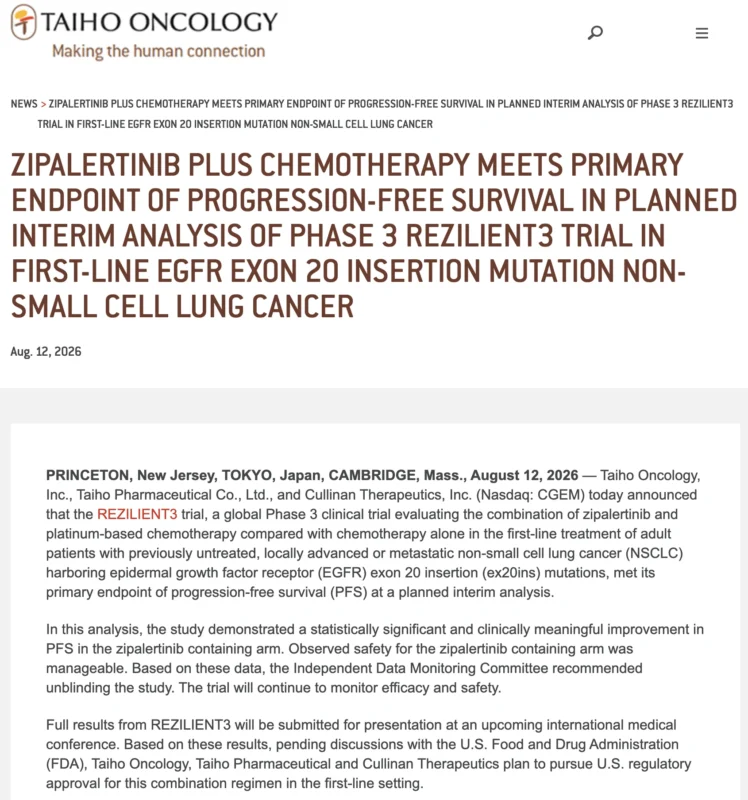
Taiho Oncology, Taiho Pharmaceutical, and Cullinan Therapeutics announced the positive topline results on August 12, 2026, following a planned interim analysis of the global randomized study.
According to the companies, the zipalertinib-containing regimen produced a statistically significant and clinically meaningful improvement in progression-free survival, while the observed safety profile was described as manageable.
Based on the interim findings, the study’s Independent Data Monitoring Committee recommended that the trial be unblinded.
Full efficacy and safety results have not yet been disclosed and are expected to be presented at a future international medical meeting (Taiho Oncology et al., 2026).
What Is the REZILIENT3 Trial?
REZILIENT3 is a multicenter, randomized, controlled, open-label Phase 3 study evaluating zipalertinib plus platinum-based chemotherapy against platinum-based chemotherapy alone.
The trial enrolled:
- 285 adults
with previously untreated:
- Locally advanced or metastatic NSCLC
- Nonsquamous histology
- Confirmed EGFR exon 20 insertion mutations
The study’s primary objective is progression-free survival between the two treatment groups (Taiho Oncology et al., 2026).
At the planned interim analysis, that primary endpoint was met.
The companies did not disclose the hazard ratio, median progression-free survival in either treatment arm, confidence intervals, response rates, or overall survival results in the topline announcement.
Those data will therefore be necessary before the magnitude and clinical context of the benefit can be fully evaluated.
What Did REZILIENT3 Show?
The most important finding announced so far is straightforward:
REZILIENT3 met its primary PFS endpoint.
Zipalertinib plus platinum-based chemotherapy demonstrated a statistically significant and clinically meaningful improvement in PFS compared with chemotherapy alone.
The Independent Data Monitoring Committee subsequently recommended unblinding the trial.
The study will continue to collect efficacy and safety data (Taiho Oncology et al., 2026).
The companies also reported that safety in the zipalertinib-containing arm was manageable.
However, no detailed adverse-event frequencies, treatment discontinuation rates, dose-modification data, or treatment-related deaths were included in the announcement.
Consequently, the efficacy-safety balance cannot yet be fully assessed.
Why Are EGFR Exon 20 Insertions Important in NSCLC?
EGFR exon 20 insertion mutations represent a distinct molecular subgroup of EGFR-driven NSCLC.
According to epidemiologic data cited in the company announcement, EGFR exon 20 insertions may occur in up to 4% of NSCLC globally.
In the United States, approximately 16% of NSCLC tumors harbor EGFR mutations, and exon 20 insertions may account for up to 12% of those EGFR alterations (Burnett et al., 2021; Riess et al., 2018).
The molecular heterogeneity of exon 20 insertions is clinically important because these alterations constitute a separate subset from the more common sensitizing EGFR mutations typically targeted by established EGFR-directed treatment strategies.
This has created a need for therapies specifically developed around exon 20 insertion biology.
What Is Zipalertinib?
Zipalertinib, previously known by the development codes CLN-081 and TAS6417, is an orally administered small-molecule EGFR inhibitor.
The drug was designed to inhibit activating EGFR alterations, with particular focus on EGFR exon 20 insertion mutations.
Zipalertinib is described as a next-generation, irreversible EGFR inhibitor being developed for this genetically defined NSCLC population (Taiho Oncology et al., 2026).
The compound originated from Taiho Pharmaceutical’s drug discovery program and is being developed by Taiho Oncology and Taiho Pharmaceutical in collaboration with Cullinan Therapeutics in the United States.
Importantly, zipalertinib remains investigational and has not been approved by any health authority.
Why Test Zipalertinib With Chemotherapy in the First-Line Setting?
REZILIENT3 is testing a combination strategy from the beginning of systemic treatment.
Patients enrolled in the study had not previously received treatment for their locally advanced or metastatic disease.
Rather than waiting until later treatment lines to introduce an exon 20-directed agent, the trial asks whether adding zipalertinib to platinum-based chemotherapy can improve disease control from the first-line setting.
The positive interim PFS result indicates that the combination met the study’s prespecified primary efficacy objective.
But several questions remain unanswered until the full data are presented.
These include the absolute difference in median PFS, duration of response, objective response rate, subgroup consistency, longer-term safety, and whether the PFS advantage will ultimately translate into an overall survival benefit.
Why Does the Interim Analysis Matter?
The trial reached its primary endpoint during a planned interim analysis, rather than only at final study readout.
This led the Independent Data Monitoring Committee to recommend unblinding the study.
That recommendation indicates that the prespecified interim efficacy criteria were met, but it does not replace the need to examine the complete dataset.
The eventual presentation should help determine how large the PFS improvement was, how mature the data are, and how consistently the effect was observed across clinical subgroups.
It will also be important to understand whether introducing zipalertinib alongside chemotherapy changes treatment exposure, chemotherapy delivery, or toxicity.
What Do We Know About Safety?
At this stage, the companies have disclosed only that the safety profile of the zipalertinib-containing regimen was manageable.
No numerical safety results were provided.
That means several clinically important questions remain open, including:
- What proportion of patients experienced Grade 3 or higher adverse events?
- How frequently did toxicity lead to dose interruption, reduction, or treatment discontinuation?
- Were there toxicities characteristic of EGFR inhibition?
- How much additional toxicity resulted from adding zipalertinib to platinum chemotherapy?
- Were any treatment-related deaths reported?
These details should be evaluated when the full REZILIENT3 dataset becomes available.
Could REZILIENT3 Support a New Regulatory Submission?
The companies indicated that, following discussions with the US Food and Drug Administration, they intend to pursue US regulatory approval for zipalertinib plus chemotherapy in the first-line setting based on the Phase 3 results.
However, no application has yet been described as submitted in the August 12 announcement.
Regulatory strategy will therefore depend on further interaction with the FDA and the complete clinical dataset (Taiho Oncology et al., 2026).
Zipalertinib remains investigational while this process continues.
Why Could First-Line Positioning Be Important?
Drug development in molecularly defined NSCLC increasingly focuses not only on whether an agent has activity, but where in the treatment sequence that activity should be used.
A therapy may initially demonstrate activity in previously treated disease and subsequently move earlier as evidence develops.
REZILIENT3 addresses this question directly for zipalertinib by evaluating targeted EGFR inhibition together with chemotherapy in patients who have not yet received systemic treatment for advanced disease.
If the full results confirm a meaningful efficacy advantage with acceptable toxicity, the trial could inform how treatment is sequenced for patients with EGFR exon 20 insertion-positive disease.
For now, however, the absence of numerical topline data prevents direct comparison of the magnitude of benefit with other treatment strategies.
What Should We Watch for in the Full REZILIENT3 Presentation?
The upcoming full dataset will be particularly important because the topline announcement leaves several major questions unanswered.
The most closely watched result will be the actual PFS hazard ratio and median PFS difference between zipalertinib plus chemotherapy and chemotherapy alone.
Objective response rate and duration of response will help clarify the depth and durability of tumor control.
Overall survival will be particularly important as follow-up matures.
Detailed safety results will determine the additional toxicity associated with the combination.
Subgroup analyses may also clarify whether the effect is consistent across different clinical and molecular characteristics within EGFR exon 20 insertion-positive NSCLC.
Until those data are available, REZILIENT3 should be described as a positive Phase 3 topline result, rather than as definitive evidence of the regimen’s complete clinical profile.
The Bottom Line
The Phase 3 REZILIENT3 trial has met its primary endpoint in first-line EGFR exon 20 insertion-positive advanced NSCLC.
Among 285 previously untreated patients with locally advanced or metastatic nonsquamous disease, zipalertinib plus platinum-based chemotherapy produced a statistically significant and clinically meaningful improvement in progression-free survival compared with chemotherapy alone at a planned interim analysis.
The Independent Data Monitoring Committee recommended unblinding the study, and the trial will continue to monitor efficacy and safety.
The companies described safety as manageable, but detailed adverse-event data have not yet been released.
Similarly, numerical PFS results, response rates, duration of response, and overall survival data remain undisclosed.
Taiho Oncology, Taiho Pharmaceutical, and Cullinan Therapeutics plan to discuss the findings with the FDA and pursue US regulatory approval for the combination in the first-line setting, pending those discussions.
The positive topline result therefore represents an important development milestone for zipalertinib.
The more consequential question will come with the full dataset: how large is the benefit, how durable is it, and what toxicity is required to achieve it?
References
- Taiho Oncology, Taiho Pharmaceutical, Cullinan Therapeutics. Zipalertinib Plus Chemotherapy Meets Primary Endpoint of Progression-Free Survival in Planned Interim Analysis of Phase 3 REZILIENT3 Trial in First-Line EGFR Exon 20 Insertion Mutation Non-Small Cell Lung Cancer. August 12, 2026.
- Burnett H, Emich H, Carroll C, et al. Epidemiological and clinical burden of EGFR exon 20 insertion in advanced non-small cell lung cancer: a systematic literature review. PLOS ONE. 2021;16(3):e0247620.
- Riess JW, Gandara DR, Frampton GM, et al. Diverse EGFR exon 20 insertions and co-occurring molecular alterations identified by comprehensive genomic profiling of NSCLC. Journal of Thoracic Oncology. 2018;13(10):1560-1568.