KRAS G12V is one of the most common KRAS mutations in non–small cell lung cancer (NSCLC), yet its clinical behavior and therapeutic implications remain insufficiently defined. This study provides a comprehensive analysis of its molecular profile, smoking association, and response to immunotherapy in a large real-world cohort.
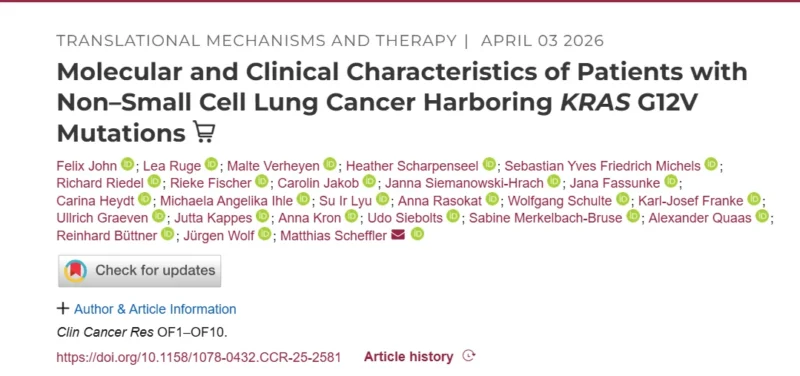
Title: Molecular and Clinical Characteristics of Patients with Non–Small Cell Lung Cancer Harboring KRAS G12V Mutations Available to Purchase
Authors: Felix John, Lea Ruge, Malte Verheyen, Heather Scharpenseel, Sebastian Yves Friedrich Michels, Richard Riedel, Rieke Fischer, Carolin Jakob, Janna Siemanowski-Hrach, Jana Fassunke, Carina Heydt, Michaela Angelika Ihle, Su Ir Lyu, Anna Rasokat, Wolfgang Schulte, Karl-Josef Franke, Ullrich Graeven, Jutta Kappes, Anna Kron, Udo Siebolts, Sabine Merkelbach-Bruse, Alexander Quaas, Reinhard Büttner, Jürgen Wolf, Matthias Scheffler
Background
KRAS mutations are among the most common oncogenic drivers in non–small cell lung cancer (NSCLC), with multiple codon-specific variants demonstrating distinct biological and clinical behaviors. While KRAS G12C has gained significant therapeutic attention due to the development of targeted inhibitors, other KRAS subtypes, including G12V, remain less well characterized. KRAS G12V is one of the most prevalent non-G12C mutations, yet its molecular landscape, tumor microenvironment, and response to systemic therapies are not fully understood.
Given the increasing use of immune checkpoint blockade (ICB) in NSCLC, defining the immunogenic profile and treatment responsiveness of KRAS G12V–mutated tumors is clinically relevant. This study provides a comprehensive evaluation of clinical features, co-mutation patterns, immune biomarkers, and real-world outcomes in patients with KRAS G12V–mutated NSCLC.
Methods
This retrospective analysis included patients diagnosed with KRAS G12V–mutated NSCLC between 2018 and 2023. Clinical and molecular data were collected and analyzed to characterize disease biology and treatment outcomes.
Key variables assessed included:
- Smoking history and cumulative tobacco exposure (pack-years)
- Co-occurring genomic alterations
- Programmed cell death ligand 1 (PD-L1) expression levels
- Tumor immune microenvironment, including CD8+ T-cell infiltration
- Treatment strategies, including chemotherapy and immune checkpoint blockade
- Real-world clinical outcomes, including response rates, progression-free survival, and overall survival
Subgroup analyses were performed based on smoking intensity and PD-L1 expression levels to better understand their impact on molecular features and therapeutic response.
Study Design
A total of 636 patients with KRAS G12V–mutated NSCLC were included in this large retrospective cohort. Molecular profiling was performed to identify co-mutations and immune-related biomarkers.
Among these patients:A subset of 151 patients with advanced disease was evaluated for treatment outcomes.
Patients received either:
- Chemotherapy alone
- Immune checkpoint blockade (ICB) monotherapy
- Combination of ICB and chemotherapy
Real-world endpoints were used, including:
- Real-world progression-free survival (rwPFS)
- Real-world overall survival (rwOS)
- Objective response rates (ORR)
Comparisons were made between treatment modalities to assess the effectiveness of immunotherapy-based approaches.
Results
KRAS G12V–mutated NSCLC demonstrated a strong association with tobacco exposure:
- 94.2% of patients were current or former smokers
- Median tobacco exposure was 40 pack-years, indicating a heavily smoking-associated disease
This finding reinforces the role of tobacco carcinogenesis in shaping the mutational landscape of KRAS G12V tumors.
Co-occurring mutations were highly prevalent and involved key oncogenic and tumor suppressor pathways:
- TP53 mutations: 40.2%
- STK11 mutations: 30.2%
- KEAP1 mutations: 29.3%
These co-mutations are clinically relevant, as they are known to influence tumor aggressiveness, immune evasion, and treatment response.
Notably, heavy smokers exhibited higher frequency of TP53, KEAP1, and NTRK1–3 mutations,a more complex genomic landscape compared with light smokers, immune microenvironment
KRAS G12V tumors demonstrated features suggestive of an immunogenic phenotype:
- Higher PD-L1 expression in heavy smokers compared with light smokers
- A trend toward increased CD8+ T-cell infiltration compared with non-G12V KRAS subtypes, although this did not reach statistical significance
These findings suggest that KRAS G12V tumors may be more responsive to immunotherapy due to enhanced immune activation.
Among patients with advanced disease:
ICB-based therapy (alone or combined with chemotherapy) resulted in higher response rates,improved real-world progression-free survival (rwPFS), improved real-world overall survival (rwOS) compared with chemotherapy alone.
Importantly, in patients with high PD-L1 expression:
- PD-L1 tumor proportion score ≥50%
- Median rwOS reached 30 months with ICB-based therapy
This represents a clinically meaningful survival benefit and supports the use of immunotherapy in this molecular subgroup.
Key Findings
KRAS G12V–mutated NSCLC represents a distinct clinical and molecular entity characterized by a strong link to tobacco exposure and a high burden of co-mutations.
The mutation landscape is dominated by alterations in TP53, STK11, and KEAP1, which are known to influence both tumor biology and therapeutic outcomes.
Heavy smoking is associated with increased genomic complexity and higher PD-L1 expression, suggesting a more immunogenic tumor phenotype.
Patients with advanced disease derive significant benefit from immune checkpoint blockade, particularly when combined with chemotherapy.
High PD-L1 expression identifies a subgroup with particularly favorable outcomes, with median overall survival reaching 30 months under ICB-based treatment.
Conclusion
KRAS G12V–mutated NSCLC is a smoking-associated disease with a complex genomic profile and a tumor microenvironment that appears responsive to immunotherapy. The high frequency of co-mutations and elevated PD-L1 expression, particularly in heavy smokers, highlights the interplay between carcinogen exposure and tumor immunogenicity.