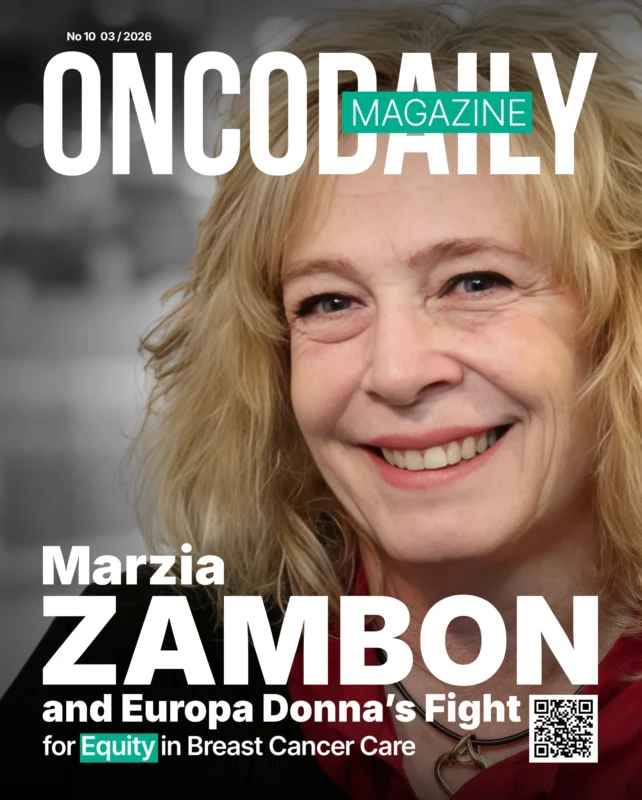
“Sometimes,” Marzia Zambon reflects, “you don’t choose a mission — the mission chooses you.”
As Executive Director of Europa Donna, the European Breast Cancer Coalition, Marzia Zambon leads one of the continent’s most influential patient advocacy networks — a Coalition spanning 47 countries and representing millions of women navigating breast cancer across vastly different health systems.
Her journey to this role did not begin in medicine. It began in law.
A Coalition Born to Unite Europe
Europa Donna was founded in 1994 with a clear and ambitious purpose: to create a pan-European patient voice in breast cancer, to influence political will, call for national screening programmes, ask for equal access to best treatment and care and ensure access to independent reliable information throughout Europe.
Unlike many organizations built at a national level, the Coalition was designed from the outset to operate across borders — advocating, lobbying, and coordinating policy efforts throughout the WHO European region, covering 52 states, far beyond the European Union.
Today, Europa Donna brings together national breast cancer patient organizations in 47 countries — 27 EU member states plus 20 others stretching across Eastern Europe and Central Asia.
Its early mission included a key objective apparently simple: ensure that reliable information reached every breast cancer patient.
But Europe’s diversity made that task complex. Languages, health systems, cultural attitudes, and governance structures vary dramatically — even within individual countries. Italy alone operates through 21 regional health systems; Sweden and Switzerland face similar fragmentation.
Europa Donna therefore evolved into something more than an information hub. It became a capacity-builder, helping national organizations grow, develop peer support, run educational programs, and provide them the tools to advocate for stronger breast cancer services at local political levels.
“Breast cancer care in Sweden looks very different from care in Slovenia, Spain, or Tajikistan,” Marzia Zambon explains. “But our goal is the same everywhere: equal access to the best possible care and reliable information.”
At both national and European level, a patient advocate’s main job is to properly represent the rights and voice the needs of a collective group. This needs training, Breast cancer advocates do not need medical background but do need to have basic scientific knowledge in order to be comfortable when interacting with medical societies, researchers and health care professionals – providing the perspective and voicing the needs of the patients as a group of interest.
At a policy level, patient groups are now, finally, viewed as important stakeholders with a right to sit at many decision-making tables, so advocates need to be trained to lobby effectively, understanding the different interests of their target audiences and seeking the win win area which can bring to positive change.
Fighting Inequality in the Era of Misinformation
For Europa Donna, equity now means not only access to treatment but also access to trustworthy knowledge.
“In the digital age,” Marzia notes, “anyone can Google and receive enormous amounts of information — but not all of it is reliable.”
Combating misinformation has therefore become central to the CCoalition’s work. Ensuring that patients know where to find credible guidance is as important as ensuring the availability of services themselves.
From Corporate Law to Patient Advocacy
Marzia Zambon’s own path into advocacy was unexpected.
A corporate lawyer by training, she spent much of her career working in international mergers and acquisitions. She also taught legal professionals — lawyers, consultants, judges, and notaries — how to operate within international legal frameworks.
Then she saw a job advertisement.
The CEO of Europa Donna was retiring.
“In Italian,” she recalls, “the word for lawyer and the word for advocate share the same root — someone who defends the rights of others.”
At nearly 50, she recognized something profound in that overlap.
“I realized I could finally serve not just a client, but a global cause.”
She applied — and the role soon transformed from employment into purpose.
“It’s no longer a job,” she says. “It’s the most meaningful thing I could do.”
The Power of Collective Energy
Marzia’s conviction is reinforced by what she sees on the ground.
At the recent 17th Pan-European Europa Donna Conference in Cyprus, 250 advocates gathered from across Europe, sharing experiences, building partnerships, and exchanging knowledge.
“The energy was extraordinary,” she recalls. “People weren’t just attending sessions — they were building a movement.”
The Coalition’s strength, she believes, lies in enabling this cross-border solidarity.
Reinventing a Historic Organization
But longevity also brings challenges.
As Europe’s oldest patient advocacy Coalition, Europa Donna must constantly adapt to remain effective.
“We started before most others,” Marzia Zambon says. “Now we must modernize.”
Digital transformation sits at the center of this evolution. The organization recently launched EmpowerED, a new digital platform designed to centralize advocacy training, educational materials, and leadership development tools for member organizations.
Each year, Europa Donna invites newly diagnosed breast cancer patients from across Europe to participate in intensive training programs covering:
- Breast cancer biology and epidemiology
- Advances in biomarkers, genetics, and genomics
- Advocacy strategies and communication skills
- Stakeholder engagement and policy influence
Experts and clinicians from international conferences contribute directly to this training effort.
“This knowledge will now be available digitally,” Marzia says, “so it can reach far more people.”
She describes being appointed to lead Europa Donna as being entrusted with something extraordinary and powerful: an organisation that shaped the very foundations of professional patient advocacy in Europe.
“I was handed a Bugatti,” she says with a smile. “A pioneering vehicle that set the standard for everything that followed. It helped define what professional advocacy could be in Europe. It brought together stakeholders, demanded results, and proved that determined, organised patient voices could achieve real progress for a single type of cancer.”
She pauses before reflecting on what the road ahead now looks like.
“What I see today is the opportunity to build something even more connected: a high-speed train linking cities, countries, and communities. One that opens its doors to many more passengers, travels through a much broader landscape of collaboration, and moves forward with shared momentum toward sustainable, patient-centred health care systems and truly people-centred societies.”
Keeping Cancer on the Political Agenda
Europa Donna’s work unfolds against a shifting European political landscape.
Marzia Zambon notes that funding priorities for Europe’s Beating Cancer Plan have already faced cuts and declining visibility amid geopolitical tensions.
“We cannot allow cancer to slip down the political agenda,” she warns.
The epidemiology is clear: today roughly one in four Europeans will develop cancer during their lifetime, rising to around one in three in some countries, and the number of cases is expected to grow substantially by 2050 as Europe’s population ages.Preparation must begin now. This is an upcoming continental epidemic, and it does not come unannounced.
Prevention, Rights, and Social Reality
Prevention plays a major role in this strategy. Risk factor reduction alone may prevent between 30 and 50% of cancers.
Since 2008, Europa Donna has marked 15 October as Breast Health Day, using the occasion each year to run breast cancer awareness campaigns that encourage healthy lifestyles and informed health choices – factors that can help reduce both the occurrence and recurrence of breast cancer.
Yet Europa Donna’s prevention messaging must never overshadow its primary mission.
“We exist to serve people who have already been diagnosed.”
That means defending civil rights as much as promoting health behaviors.
The Coalition advocates for:
- the “right to be forgotten” after cancer
- employment protections and flexible working arrangements
- social recognition of patients’ needs
- protections for caregivers
This last issue carries particular weight.
Globally, up to 70% of informal caregiving is performed by women, often during the same life period when breast cancer risk rises.
Many women simultaneously juggle careers, caregiving, and their own illness — frequently placing their health last.
“This mentality has to change,” Marzia says.
The Screening Paradox
Even when screening programs exist, participation remains lower than expected.
An OECD report shows that only about half of eligible women in the EU attend screening programs, despite their availability.
Reasons range from limited health literacy to lack of time, fear of diagnosis, or competing life responsibilities.
Europa Donna’s advocacy therefore increasingly focuses not only on access but on engagement — helping women understand why screening matters and ensuring systems accommodate real-life constraints.
Recently, we organized a Breast Health event at the European Parliament. The discussion highlighted the significant differences in participation rates across EU countries that have national breast cancer screening programmes. In response, we called for the formal recognition of a European Breast Health Day, which would strengthen awareness efforts and underline the importance of individual choices and proactive engagement in one’s own health.
Systems Change Through European Policy
In addition to its long standing lobbying presence at a EU policy level, Europa Donna has been deeply involved in the European Commission Initiative on Breast Cancer (ECIBC) since its inception.
This effort produced:
- European breast cancer screening and early-detection guidelines
- a comprehensive quality assurance scheme for breast cancer services
- standardized indicators defining what constitutes high-quality specialist care
The recently published European Commission Joint Research Centre quality assurance manual is expected to become a key advocacy tool.
Specialized breast cancer units — staffed by experienced multidisciplinary teams — are now widely recognized as essential.
“If someone reads mammograms only occasionally, outcomes are different,” Marzia Zambon notes.
“Expertise matters. Specialization saves lives.”
Europa Donna aims to use the new quality framework to push policymakers across Europe toward universal implementation of such units.
The Invisible Population: Metastatic Breast Cancer
One of the Coalition’s most important initiatives focuses on metastatic breast cancer.
Research suggests that over 30% of early breast cancer cases eventually recur in metastatic form. Yet patients with advanced disease historically felt underrepresented by advocacy movements centered on early detection and survivorship.
To address this gap, Europa Donna launched a dedicated metastatic breast cancer initiative — recognizing that significant advances in research and treatment of metastatic breast cancer mean many patients now live for years while continuously receiving therapy.
In addition to having to live with incurable cancer, these patients face unique challenges:
- long-term treatment and management of side effects (such as fatigue)
- employment instability
- social invisibility
- limited recognition of their special needs and civil rights
A critical barrier is data.
Most cancer registries record only initial diagnoses, not recurrences or metastatic relapses. As a result, large numbers of metastatic patients remain statistically invisible —thus critically limiting effective research and policy attention.
Recent developments suggest change may be coming. Northern Ireland, for example, has begun exploring systematic tracking of metastatic recurrences — a potentially transformative step.
“If you can’t count people,” Marzia Zambon says, “you can’t design policies for them.”
3Ps
Three words define Marzia Zambon’s approach to advocacy leadership: patience, persistence, and perseverance.
For her, the mission of Europa Donna is far from complete, but its direction is unmistakable. Progress has been made, yet significant challenges remain on the horizon.
“We know what the future challenges are,” she says. “The real question is whether we will act early enough. Every life counts.”
Leading Across 47 Countries
Running a Coalition that spans nearly fifty countries is not, Marzia admits, a sprint.
“It’s a marathon.”
Europa Donna’s structure includes national patient organizations across 47 countries, each operating in a different cultural, political, and healthcare context. Integrating their work into a coherent European mission requires patience, diplomacy, and flexibility.
“You have to accept differences,” she says. “And you have to train the trainers”
That principle shapes the Coalition’s operating model for its national affiliates. Rather than imposing uniform solutions, Europa Donna standardizes core information and provides training while encouraging local leaders to adapt programs to their realities.
Some countries have highly structured advocacy landscapes. Sweden’s organization is large and influential. The Netherlands maintains strong ministerial connections. Slovenia’s small size enables direct access to policymakers.
Italy, by contrast, illustrates complexity at scale: Europa Donna Italy functions as an umbrella body overseeing 190 sub-organizations, each operating within a regionally governed health system.
The challenge, Marzia explains, is not only structural but generational.
Many national organizations were founded decades ago by volunteers who remain deeply committed. Yet leadership renewal is essential.
“Young women often want to help,” she says, “but they may not have the time to volunteer. And still, we see incredible motivation.”
Coalition work, she emphasizes, is ultimately human work — aligning individuals toward a shared goal despite differing capacities and priorities.
Training Advocates for the Research Era
One of Europa Donna’s newer priorities is strengthening the role of patient advocates in clinical research.
The Coalition now participates as a consortium partner — and sometimes as work-package leader — in major EU-funded breast cancer trials, focusing specifically on patient engagement.
Marzia Zambon believes this connection between researchers and patients is essential.
“Scientists design treatments,” she says, “but patients are the ones who live with them.”
Without patient insight early in development, treatments may reach approval only to encounter adherence problems later — often due to side effects or practical barriers that could have been anticipated.
Europa Donna therefore trains advocates not only to speak but to contribute meaningfully in research settings — to understand trial design, articulate patient priorities, and provide real-world feedback.
The goal is to ensure that wherever breast cancer trials occur across Europe, patient communities have the capacity to participate as partners rather than observers.
Mapping the Network
To better support its members, Europa Donna recently conducted a comprehensive Coalition-wide mapping exercise.
National organizations were asked to complete a large survey covering governance, funding sources, volunteer capacity, programs, and policy priorities.
The data, now under analysis, will help the Coalition tailor support more effectively — identifying clusters of countries facing similar challenges and enabling peer-to-peer collaboration.
Marzia sees this as a shift from centralized guidance toward distributed expertise.
“If one country succeeds,” she says, “others should not have to reinvent the process.”
A striking example is the “right to be forgotten” legislation for cancer survivors. Advocacy leader Françoise Meunier helped several countries adopt legislation by sharing ready-to-use legislative templates and strategies.
With substantial national Europa Donna organisation involvement, both Cyprus and Slovenia successfully passed such laws with support from the network — demonstrating how shared knowledge can accelerate policy change.
The Coalition as a Living System
Marzia Zambon describes her leadership role less as directing activities and more as strengthening connections and building capacity across the network.
“What matters,” she says, “is that we share common goals and priorities, and that we follow through on them.”
While the Coalition continues to play an essential and independent coordinating role, she is encouraged to see growing spontaneous exchanges among national organisations. Increasingly, affiliates are connecting directly with one another, sharing best practices and joining forces to address common challenges: a sign that the network is becoming stronger, more collaborative, and increasingly self-sustaining.
Digital tools are accelerating this evolution.
“If our Georgian representative posts something online,” she notes, “I can translate it instantly. Suddenly everyone can learn from each other.”
For Marzia, this growing visibility and exchange is the true promise of digital transformation turning Europa Donna into a network where ideas flow laterally rather than vertically.
“That,” she says, “is my personal project.”
Leadership, Mentorship, and Gratitude
As our conversation draws to a close, I ask the question I pose to every guest: Who should be interviewed next?
Marzia pauses, then smiles.
Rather than naming a public figure, she speaks about someone closer to her journey.
When she joined Europa Donna in March 2020 — working from her kitchen during the uncertainty of the pandemic — the organization was undergoing major transition. The long-serving executive director was retiring. The president of the Coalition had stepped down for health reasons.
The organisation’s leadership passed to Tanja Spanic of ED Slovenia, a scientist and patient advocate diagnosed with breast cancer at a young age
“She was extraordinary,” Marzia says.
Tanja led the Coalition’s Board of Directors for over four years, combining scientific rigor with lived experience and becoming a powerful voice in international cancer policy discussions.
“Tanja balances her passion to drive change with insightful knowledge and profound curiosity, she often defines herself as a “nerd”. I could not have hoped for a better mentor” Marzia Zambon says simply, then adds “but, then again, what about Stella Mastora, current President of the Coalition? She is the essence of strength and determination, a natural team player and one of the most beautiful souls I have met” A big smile “I could go on and on … the beauty of this job is the incredible people you have the privilege to work with”
A Mission Still in Motion
Europa Donna’s story, like the broader fight for equity in cancer care, remains unfinished.
But under Marzia Zambon’s leadership, the Coalition is evolving — from a pioneering advocacy organization into a digitally connected, research-engaged, policy-influencing European force.
Her own journey reflects that evolution.
A lawyer who once defended corporate interests now defends something broader: access, dignity, and voice for millions of patients.
Sometimes, she says, the mission really does choose you.
Interview by Gevorg Tamamyan, Editor-in-Chief of OncoDaily