On July 9, 2026, FDA approved isatuximab-irfc (Sarclisa Escena, Sanofi Aventis) for subcutaneous injection in multiple myeloma, extending to all currently approved IV isatuximab indications:
- In combination with pomalidomide and dexamethasone for adults with multiple myeloma who have received at least one prior line of therapy, including lenalidomide and a proteasome inhibitor
- In combination with carfilzomib and dexamethasone for adults with relapsed or refractory multiple myeloma after 1-3 prior lines of therapy.
- In combination with bortezomib, lenalidomide, and dexamethasone (VRd) for adults with newly diagnosed multiple myeloma who are ineligible for autologous stem cell transplantation.
Development of Isatuximab in Multiple Myeloma
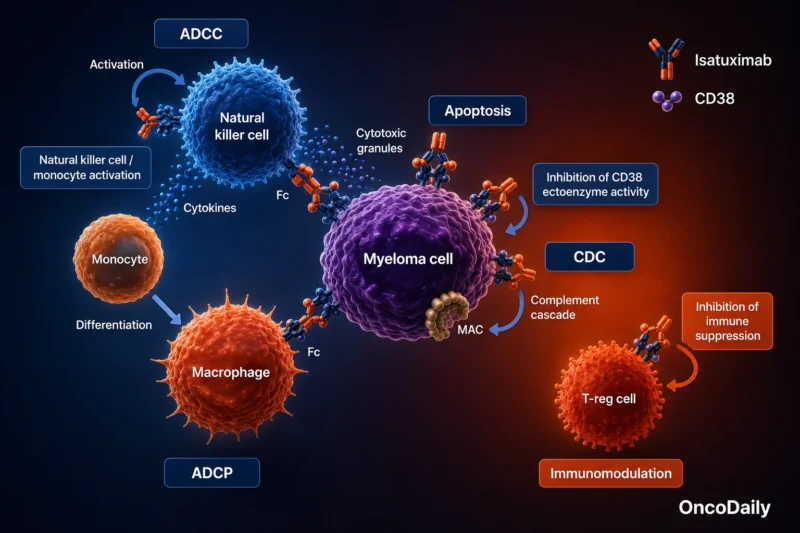
Isatuximab is a monoclonal antibody targeting CD38, a cell surface glycoprotein highly expressed on malignant plasma cells. Since its initial approval, it has become an established component of combination-based treatment regimens across both newly diagnosed and relapsed/refractory multiple myeloma.
The intravenous formulation was first approved (2020) based on the Phase 3 ICARIA-MM trial, which demonstrated superior PFS with isatuximab, pomalidomide, and dexamethasone compared with pomalidomide and dexamethasone alone in patients with relapsed or refractory multiple myeloma.
This was followed by the Phase 3 IKEMA trial, where the addition of isatuximab to carfilzomib and dexamethasone significantly improved outcomes in patients who had received 1-3 prior lines of therapy. Subsequently, the Phase 3 IMROZ trial supported the expansion of isatuximab into transplant-ineligible newly diagnosed multiple myeloma, leading to its approval in combination with VRd.
Maintaining Efficacy While Simplifying Delivery
Anti-CD38 monoclonal antibodies have historically been administered intravenously, with treatment often initiated on a weekly schedule before transitioning to less frequent dosing, making the cumulative treatment burden particularly relevant for patients receiving long-term therapy.
Daratumumab was the first CD38-targeting antibody to gain approval as a subcutaneous formulation, in May 2020. In the Phase 3 COLUMBA trial, subcutaneous daratumumab demonstrated noninferior pharmacokinetics, efficacy, and safety compared with the intravenous formulation, while substantially reducing administration time. The approval of subcutaneous isatuximab follows this evolving treatment paradigm.
Evidence Supporting Approval of the Subcutaneous Formulation
The approval was primarily supported by the Phase 3 IRAKLIA trial (NCT05405166), an open-label, noninferiority study that randomized 531 patients (1:1) to receive either subcutaneous isatuximab-irfc administered via an on-body delivery system (OBDS) or intravenous isatuximab-irfc, both in combination with Pd.
The co-primary endpoints were overall response rate (ORR), as assessed by an Independent Review Committee, and steady-state trough concentration (Ctrough) measured before Cycle 6 Day 1:
- ORR was 71.1% with subcutaneous isatuximab versus 70.5% with intravenous isatuximab.
- The geometric mean ratio for steady-state Ctrough was 1.53 (90% CI, 1.32-1.78), supporting noninferior pharmacokinetic exposure.
Additional evidence has also been generated in other settings. In the Phase 2 IZALCO study (NCT05704049), which enrolled 74 patients with relapsed/refractory multiple myeloma, subcutaneous isatuximab in combination with carfilzomib and dexamethasone achieved an IRC-assessed ORR of 79.7%.
Similarly, in the investigator-sponsored Phase 2 IsaSocut study (NCT05889221), subcutaneous isatuximab combined with VRd produced an ORR of 97.3% among 74 transplant-ineligible patients with newly diagnosed multiple myeloma.
Similar Overall Safety and Improved Administration Tolerability
The prescribing information includes warnings and precautions for hypersensitivity and other administration-related reactions, neutropenia, infections, secondary primary malignancies, laboratory test interference, and embryo-fetal toxicity.
Grade ≥3 adverse events occurred in 81.7% of patients receiving the on-body delivery system and 76.1% of those receiving intravenous isatuximab. Administration-related reactions were substantially less frequent with the OBI (1.5% vs 25.0%), while injection-site reactions occurred in 0.4% of patients and were all grade 1-2.
Recommended Dosage
The recommended dose of subcutaneous isatuximab-irfc is 1,400 mg, administered either via the CirCLIQ on-body delivery system (OBDS) or by manual administration using a syringe and infusion set, in combination with approved treatment regimens.
Innovation Beyond New Drugs
In the Phase 3 IRAKLIA trial, the subcutaneous formulation demonstrated noninferior exposure and efficacy compared with intravenous isatuximab, providing patients and clinicians with an additional administration option without altering the established therapeutic role of the antibody.
While oncology innovation is often associated with novel drugs and therapeutic targets, meaningful progress can also come from optimizing the delivery of established therapies. In multiple myeloma, where anti-CD38 antibodies are frequently administered over prolonged treatment courses, reducing administration time and simplifying delivery may improve convenience for patients while easing demands on infusion centers and healthcare resources.