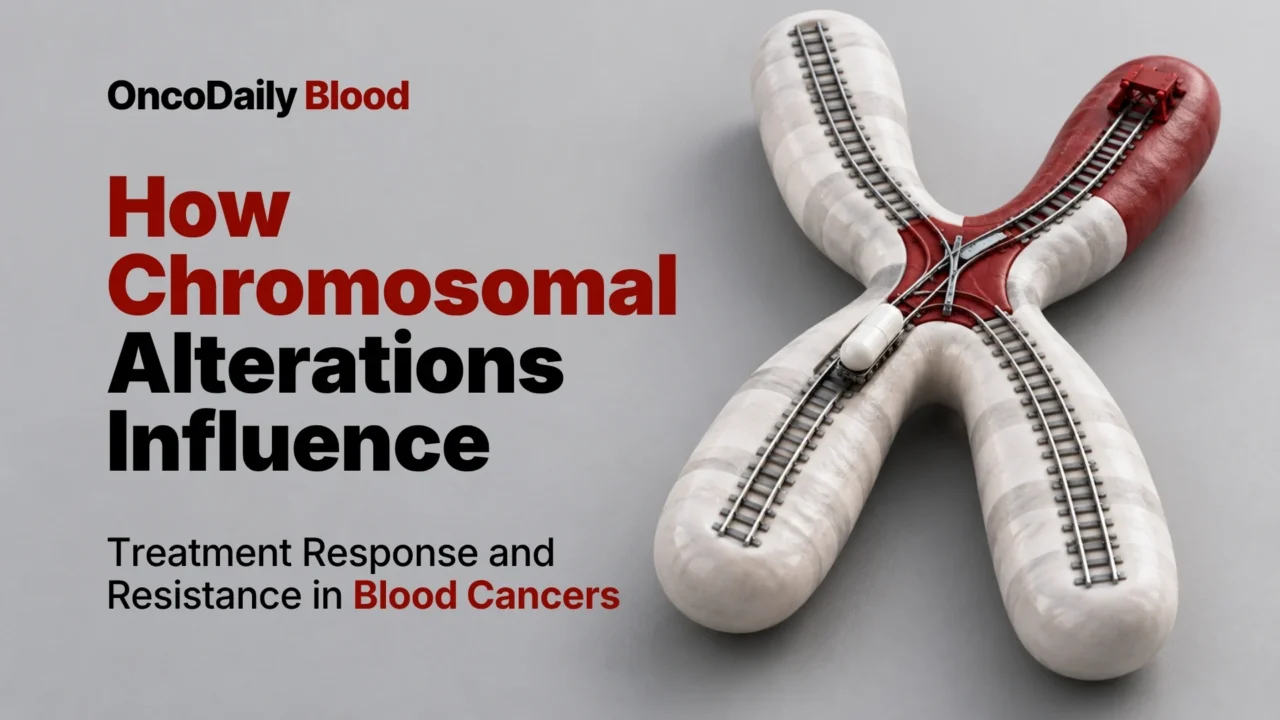
Chromosomal abnormalities have long guided the diagnosis and risk classification of hematologic malignancies, and they are now becoming specific enough to guide treatment. Some alterations mark a direct drug target. Others create a vulnerability to a drug acting elsewhere in the cell. Certain abnormalities are associated with resistance to chemotherapy, targeted agents or immunotherapy.
The Francophone Group of Hematological Cytogenetics (GFCH) reviewed these relationships in a comprehensive paper published in October, 2026, in the American Journal of Hematology. Seventeen cytogeneticists prepared the review, which covers myeloid malignancies, acute lymphoblastic leukemia, chronic lymphocytic leukemia, lymphomas and plasma cell disorders. It separates established treatment associations from emerging evidence and covers both primary response and acquired resistance.
The review rests on the difference between a prognostic marker and a predictive biomarker. An adverse karyotype can mark aggressive disease without implying resistance to a particular agent. Some rearrangements, in contrast, predict sensitivity to targeted treatment across several leukemia subtypes.
Myelodysplastic Neoplasms
Deletion 5q is among the clearest examples of cytogenetically defined drug sensitivity in myelodysplastic neoplasms (MDS). Loss of genetic material on chromosome 5 creates a dependence involving casein kinase 1 alpha, encoded by CSNK1A1. Lenalidomide acts through cereblon-mediated protein degradation, which explains its activity in del(5q) MDS.
Additional genetic abnormalities influence the response. Among patients with lower-blast-count del(5q) MDS who develop lenalidomide resistance, approximately 70% have recurrent alterations in TP53 or RUNX1. Responses to luspatercept are reduced in cases with concurrent del(5q) and an SF3B1 mutation.
Outside del(5q), chromosome-based therapeutic associations are less established. Trisomy 8 has been associated with responses to immunosuppressive therapy, reaching 67% in some reports. High-risk abnormalities, including chromosome 7 loss, 3q rearrangements and complex karyotypes, are associated with poorer responses.
Chronic Myeloid Leukemia and Other Kinase Fusion Neoplasms
The Philadelphia chromosome, t(9;22), is the defining example of a rearrangement that produces a directly targetable oncogenic protein. The BCR::ABL1 fusion 4confers sensitivity to ABL1 tyrosine kinase inhibitors, including imatinib and newer agents such as asciminib.
Variant Philadelphia translocations and cryptic insertions do not inherently reduce inhibitor sensitivity. Additional high-risk chromosomal abnormalities may signal clonal evolution and a poorer molecular response. Acquired resistance is often driven by mutations in the ABL1 kinase domain, so cytogenetic evolution and molecular resistance can coexist.
Other myeloid/lymphoid neoplasms with tyrosine kinase fusions offer similarly actionable targets. PDGFRA and PDGFRB rearrangements confer marked sensitivity to imatinib, with five-year overall survival above 90% in chronic-phase disease. FGFR1 rearrangements can be targeted with pemigatinib, and JAK2 fusions may respond to JAK inhibition. Evidence for rare FLT3 and ETV6::ABL1 rearrangements is more limited and depends on the specific fusion.
Acute Myeloid Leukemia
In acute myeloid leukemia, cytogenetics identifies both highly sensitive and exceptionally resistant subtypes.
Core-binding factor AML, defined by RUNX1::RUNX1T1 or CBFB::MYH11, responds well to intensive chemotherapy. Complete remission rates exceed 90%, and long-term survival is approximately 60%-70%. Concurrent KIT mutations may weaken this favorable prognosis, although the ELN 2022 risk classification does not formally incorporate them.
Acute promyelocytic leukemia with PML::RARA, all-trans retinoic acid and arsenic trioxide produce complete remission rates above 90% and long-term survival above 80%. Atypical retinoic acid receptor rearrangements do not share this sensitivity: ZBTB16::RARA is associated with poor response to retinoic acid, and RARB or RARG rearrangements generally do not respond to conventional differentiation therapy.
Menin inhibitors have widened the list of fusion-driven AML targets. KMT2A-rearranged leukemia depends on menin-associated transcriptional programs, and revumenib and ziftomenib have shown activity in relapsed or refractory disease. The review also names NUP98 and PICALM::MLLT10 rearrangements as potentially menin-sensitive subtypes. Acquired MEN1 mutations can disrupt inhibitor binding and cause resistance.
AML with MECOM rearrangements, complex or monosomal karyotypes, or chromosome 17p abnormalities often coexist with TP53 alterations and are associated with resistance to intensive chemotherapy and venetoclax-based regimens. In the most adverse cytogenetic groups, the review reports complete remission rates commonly below 30% and median overall survival under six months.

Acute Lymphoblastic Leukemia
In Philadelphia chromosome-positive ALL, BCR::ABL1 establishes sensitivity to tyrosine kinase inhibition. Philadelphia-like ALL offers further opportunities: ABL-class fusions may respond to imatinib or dasatinib, and JAK-STAT pathway alterations provide a rationale for JAK inhibition. Many of these approaches remain under clinical evaluation.
KMT2A rearrangements create a potential role for menin inhibitors in B-ALL and mixed-phenotype acute leukemia. The rare TCF3::HLF fusion is associated with BCL2 dependence, which supports investigating venetoclax-containing combinations.
Resistance extends beyond kinase signaling. Alterations in IKZF1, NR3C1, CREBBP and BTG1 can impair glucocorticoid response. After CD19-directed immunotherapy, loss or alteration of CD19 can produce antigen-negative relapse. Lineage switching, particularly in KMT2A-rearranged leukemia, is a second route of escape from B-cell-directed treatment.
Chronic Lymphocytic Leukemia
The review identifies no established chromosomal abnormality in CLL that directly predicts drug sensitivity. Several lesions are associated with resistance to BTK inhibitors, venetoclax or chemoimmunotherapy.
Gain of chromosome 1q21 can increase MCL1 expression, which may let leukemic cells survive BCL2 inhibition. Gain of 2p, involving genes such as REL and XPO1, has been linked to resistance to fludarabine and BTK inhibitors. Deletion 8p may impair TRAIL-mediated apoptosis and contribute to resistance across treatment classes.
Deletion 17p and TP53 abnormalities remain major determinants of treatment selection. Targeted agents retain activity in TP53-aberrant CLL, though responses may be less durable. Highly complex karyotypes, particularly those with at least five abnormalities, are associated with inferior outcomes under several approaches. Their predictive value varies with the treatment and the degree of complexity.
Lymphomas
In mantle cell lymphoma, deletions involving CDKN2A/B, BIRC3 and TP53 are associated with poor responses to chemotherapy or targeted therapy, the strength of evidence differs between abnormalities.
In Gastric MALT lymphoma, the BIRC3::MALT1 fusion produced by t(11;18) is associated with resistance to Helicobacter pylori eradication therapy, so finding it helps anticipate whether antibiotics will work.
In anaplastic large cell lymphoma, ALK rearrangements make the tumor a target for ALK inhibitors: crizotinib and alectinib. Resistance can develop through ALK amplification or kinase-domain mutations.
Multiple Myeloma
In multiple myeloma, t(11;14) is associated with increased BCL2 dependence and sensitivity to venetoclax. The same relationship applies in AL amyloidosis. The mechanism linking t(11;14) to BCL2 dependence remains incompletely understood, and cyclin D1 overexpression has not been shown to cause venetoclax sensitivity.
Gain or amplification of chromosome 1q21 has been associated with reduced sensitivity to bortezomib, daratumumab and venetoclax in selected settings. Proposed mechanisms include increased proteasomal activity and altered CD38 expression.
Genomic antigen loss matters for myeloma immunotherapy. Deletion of TNFRSF17, which encodes BCMA, can cause resistance to BCMA-directed CAR-T cells and bispecifics. Loss of GPRC5D through chromosome 12p alterations can allow escape from GPRC5D-directed treatment. Their use in routine treatment sequencing needs clinical validation.
Clinical Interpretation
The review sorts the evidence into tiers. BCR::ABL1, PML::RARA and del(5q) have established therapeutic implications. Other abnormalities mark promising targets supported by early clinical or preclinical findings. Many resistance-associated lesions remain prognostic or investigational biomarkers, and their presence alone does not justify changing treatment.
For hematologists, a chromosomal finding has to be considered against the disease subtype, the accompanying molecular alterations, prior therapy and the strength of evidence linking the lesion to a specific drug. Targeted agents and immunotherapies are also making reassessment at relapse more relevant, because resistant clones may acquire new chromosomal abnormalities or lose the antigens that treatment depends on.
You can also read: