Inflammation is now considered part of myeloid neoplasm biology, but when it appears during disease evolution, and whether it’s clinically useful, is not clear.
A 2026 HemaSphere study measured inflammasome activation and circulating cytokines across a spectrum from idiopathic and clonal cytopenias of undetermined significance (ICUS/CCUS) to myelodysplastic syndromes (MDS) and chronic myelomonocytic leukemia (CMML). Inflammatory abnormalities were present before overt myeloid neoplasia and became more pronounced as disease advanced.
Inflammasome activation was widespread but didn’t predict outcomes. Selected cytokines, especially how they changed over time, did track with progression and survival.
Inflammation Begins Before Overt Myeloid Neoplasia
The study included 223 patients: 35 with ICUS/CCUS, 139 with MDS, and 49 with CMML, alongside 39 matched non-inflammatory controls. Investigators measured plasma inflammasome specks and 45 cytokines and examined their associations with diagnosis, mutations, disease progression, and survival.
Inflammasome activity was assessed using two measurements. Double-positive ASC/NLRP3 specks reflected NLRP3 inflammasome activation, and ASC single-positive specks reflected broader ASC activation that was not necessarily related to NLRP3.
ASC/NLRP3 specks were increased in MDS and CMML, with the highest levels in CMML. ASC-only specks, were already elevated in ICUS/CCUS and remained increased in MDS and CMML. This suggests that inflammasome activation may begin before overt myeloid neoplasia and may involve pathways beyond NLRP3. Anyway, ASC-only specks are not specific to a particular inflammasome, so this remains a possible explanation, not a confirmed mechanism.
Cytokine Dysregulation Across Myeloid Disease
Inflammasome activation was accompanied by broader changes in circulating cytokines. Eighteen of the 45 measured cytokines differed significantly between patients and controls after adjustment for multiple testing.
The overall pattern was more informative than any single cytokine. Inflammatory mediators and chemokines, including CXCL8, CXCL11, CCL7, CCL8, and CCL3, were increased, while factors that support normal hematopoietic stem and progenitor cells, including CSF3 and FLT3 ligand, were reduced. TRAIL and TWEAK were also lower. These abnormalities were already present in ICUS/CCUS.
CMML showed the strongest inflammatory changes. However, these circulating cytokine levels provide only an indirect view of inflammation within the bone marrow and cannot establish a causal role in disease progression.
It was also examined whether different myeloid mutations were associated with different inflammatory patterns. Mutations involving chromatin, cohesin, signaling, transcriptional regulation, DNA methylation, and RNA splicing showed different cytokine profiles. ASXL1, RUNX1, SRSF2, and JAK2 mutations were associated with stronger inflammatory signals, while TET2 mutations were mainly associated with lower levels of factors that support the hematopoietic niche.
An isolated SF3B1 mutation was also associated with higher ASC/NLRP3 speck levels. This is notable because SF3B1-mutated MDS generally has a more favorable clinical course, suggesting that inflammasome activation is not limited to more aggressive disease.
These findings remain exploratory. Mutation groups overlapped with diagnostic categories, and some mutation subgroups were small. Multivariable analysis was therefore not performed because of the risk of collinearity and overfitting.
Inflammasome Activation and Cytokines Showed Different Prognostic Patterns
Inflammasome activation itself did not predict progression or survival. Neither ASC/NLRP3 nor ASC-only speck levels were associated with these outcomes. Cytokines showed a different pattern. Higher baseline IL-15 and MMP1 were associated with progression from MDS to acute myeloid leukemia, while higher IL-10, CXCL8, and IL-18 were associated with shorter overall survival.
This may suggest that inflammasome activation reflects an underlying feature of the disease, while cytokine levels change more closely with disease evolution. The prognostic findings are also exploratory. The analyses were adjusted for age and sex but not for established clinical and molecular risk factors.
Serial Cytokine Measurements May Be More Informative
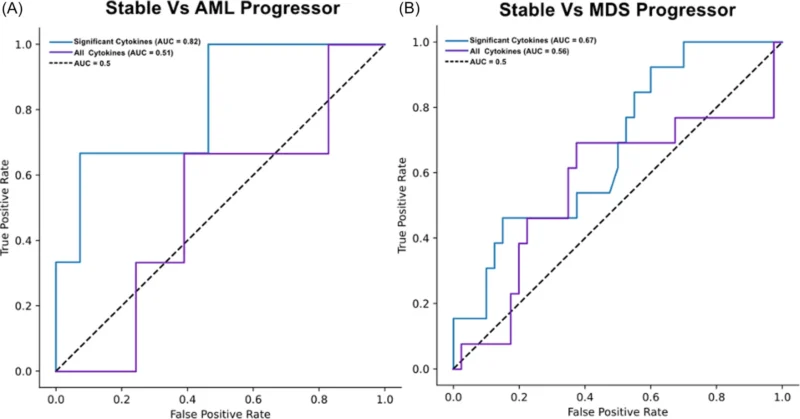
Cytokine levels measured at follow-up alone did not clearly separate patients with stable and progressive disease. Changes within individual patients over time were more informative. CCL4, CXCL11, HGF, IL-10, IL-15, and IL-18 increased in patients who progressed, while no cytokine changes were unique to patients with stable disease.
A model using these cytokines distinguished stable disease from AML progression with an area under the curve of 0.82. Its ability to distinguish stable disease from MDS progression was lower, with an area under the curve of 0.67.
The AML result is promising, but the confidence interval was wide (0.49-1.0) and the longitudinal cohort was relatively small. Serial cytokine profiling therefore needs validation before it can be considered a clinical tool.
Could the Inflammasome-IL-1 Axis Become a Therapeutic Target?
NLRP3 activation promotes IL-1-family signaling and pyroptosis, both of which have been implicated in ineffective hematopoiesis and clonal selection in MDS. In this study, IL-1β and IL-18 were elevated, while increasing IL-18 was associated with progression and higher baseline levels with worse survival. Previous preclinical studies have also shown that inhibiting NLRP3, IL-1R1, or IRAK4 can improve marrow stromal function and suppress MDS clones.
The clinical evidence, however, is limited. This study did not test anti-inflammatory treatment, and an association between inflammatory markers and progression does not show that blocking these pathways will change the course of ICUS, CCUS, or MDS.
What the Findings Support, and What They Don’t
Inflammasome activation was detectable before overt myeloid neoplasia, while cytokine abnormalities became more pronounced from ICUS/CCUS through MDS to CMML, supporting the idea that inflammation begins early in the myeloid disease spectrum.
Neither measurement is ready for routine risk assessment. The cohort was observational, several subgroup analyses were small, treatment and inflammatory comorbidities could affect circulating cytokines, and the prognostic models weren’t tested against established clinical and molecular risk scores. Plasma measurements also give only an indirect view of inflammation within the bone marrow.
For now, the strongest signal is longitudinal: inflammatory changes accompanied disease progression, while baseline inflammasome activation alone did not predict it. Whether that signal precedes progression early enough to influence clinical management remains unknown.
You can also read