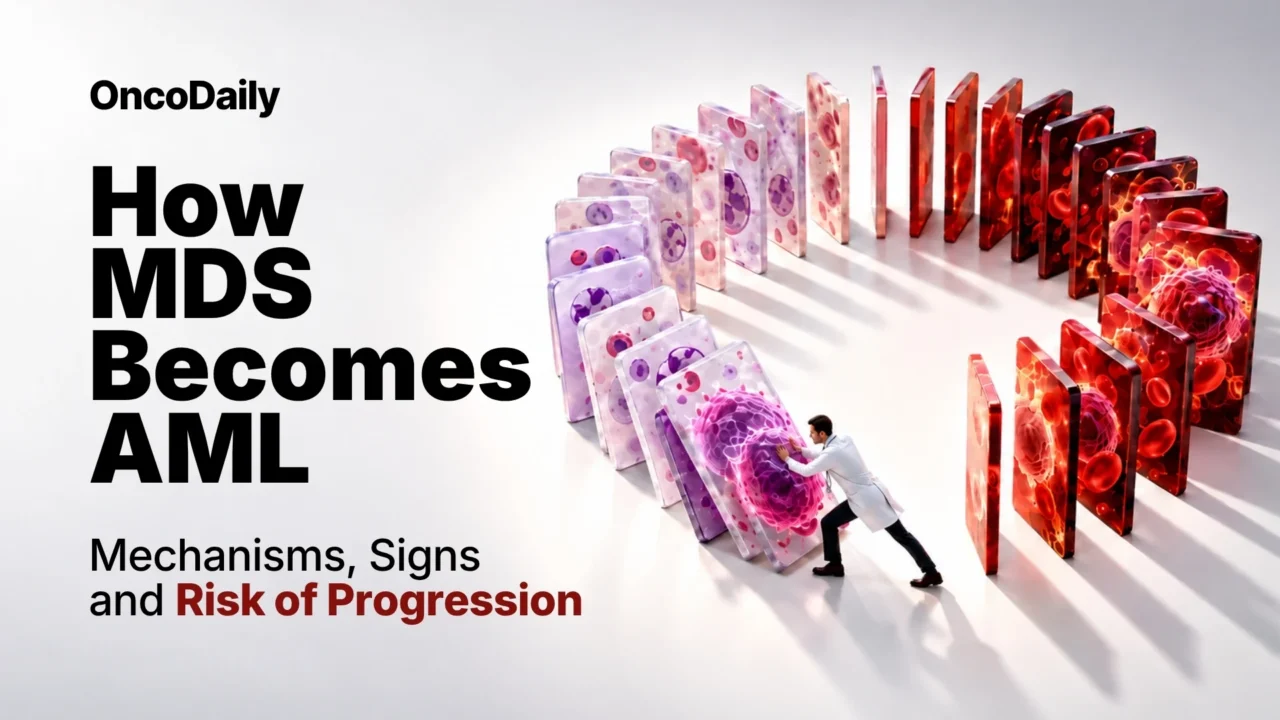
Myelodysplastic neoplasms (MDS) can follow very different clinical courses. Some patients remain stable for years with chronic cytopenias, others develop progressively worsening marrow failure or acute myeloid leukemia (AML). Historically, 30%-40% of patients with MDS have been reported to progress to AML, but the probability and timing vary by subtypes.
A 2024 study by Jain and colleagues followed 1,914 patients initially classified as very-low- or low-risk MDS by the Revised International Prognostic Scoring System (IPSS-R). Most, 68%, stayed lower-risk. Of the rest, 16.5% progressed to higher-risk MDS without developing AML, 6.5% progressed through higher-risk MDS before developing AML, and 9% transformed directly to AML. Among those who developed AML, median time to transformation was 29 months.
MDS vs AML: What Changes During Progression
MDS is already a clonal myeloid neoplasm. Abnormal hematopoietic stem and progenitor cells produce ineffective, dysplastic hematopoiesis, so the marrow may contain abundant precursors yet fail to generate enough functional circulating blood cells. Anemia, neutropenia, and thrombocytopenia can be prominent even when the blast population is small.
Early mutations in genes controlling RNA splicing, DNA methylation, or chromatin regulation can establish a persistent clonal stem-cell population long before leukemic transformation. Progression follows when additional mutations, or expansion of a previously minor subclone, give cells a growth and survival advantage with impaired differentiation, so the more aggressive subclones outgrow the rest, differentiation breaks down further, and blasts take over more of the marrow. AML arising from MDS usually retains part of this ancestral clone.
Clonal evolution can be linear, or branched, with related subclones evolving in parallel. A minor clone overtaking the dominant one can make transformation look abrupt clinically, and treatment itself can exert additional selective pressure.
You can also read:
Who Is Most Likely to Progress From MDS to AML?
Prognostic systems describe the expected behavior of the disease, and combine marrow blast percentage, cytogenetic risk, hemoglobin, platelet, and neutrophil count. Very-low and low IPSS-R groups are considered lower-risk, and high and very-high groups higher-risk. The intermediate group requires individual assessment.
A patient can move into a higher-risk category through rising blasts, worsening cytopenias, adverse genetics, or a combination, without meeting criteria for AML. Some genetically defined AML entities can now be diagnosed below the traditional 20% blast threshold.
In the 1,914-patient lower-risk cohort, progression was associated with lower neutrophil and platelet counts, higher marrow blasts, multilineage dysplasia, ferritin above 1,000 μg/L, albumin below 3.5 g/dL, and absence of ring sideroblasts. Among 49 patients with grade 2-3 marrow fibrosis, 18% progressed directly to AML.
The Molecular International Prognostic Scoring System adds molecular abnormalities across 31 genes. IDH1, IDH2, and NPM1 mutations marked direct transformation from lower-risk MDS to AML, and SRSF2, NRAS, ASXL1, TP53, and RUNX1 predicted progression to higher-risk MDS and/or AML. SF3B1, associated with MDS with ring sideroblasts, predicted a lower progression risk. A mutation’s significance depends on context: multihit TP53 disease differs from most single-alteration cases.
In an independent real-world validation of 2,876 patients, IPSS-M changed the risk category assigned by IPSS-R in 46% and discriminated leukemia-free survival better, with a concordance of 0.89 versus 0.76.
You can also read:

Signs and Symptoms That MDS May Be Progressing
Progressive anemia causes fatigue, weakness, or dyspnea, neutropenia raises infection risk, thrombocytopenia causes petechiae, bruising, or bleeding. New constitutional symptoms: fever, night sweats, unexplained weight loss, rising transfusion needs or the loss of a previous hematologic response can also mark progression.
None of this confirms AML on its own. Cytopenias can worsen as MDS becomes more severe, and infection, bleeding, nutritional deficiency, renal disease, medications, and treatment toxicity can all produce similar changes. A marrow blast increase from 3% to 12%, for instance, signals progression even without crossing any formal threshold, and the same goes for newly acquired genetic changes.
MDS can also be fatal without becoming AML. Of 273 patients with lower-risk MDS who died, only 15% had transformed to AML beforehand. Infection was the leading MDS-related cause of death (38%), followed by AML transformation (15%) and hemorrhage (13%), with progressive marrow failure accounting for the rest (Dayyani et al. 2010).
How Is MDS Progression to AML Diagnosed?
Bone marrow aspirate and biopsy determine blast burden, cellularity, dysplasia, and fibrosis. Conventional cytogenetics identifies chromosomal evolution, and molecular testing detects abnormalities relevant to classification, prognosis, and therapy. Flow cytometry can identify and quantify blast populations, aberrant patterns of myeloid maturation and antigen expression.
The traditional 20% blast threshold still applies to many cases, but the WHO/ICC 2022 classifications include genetically defined AML categories with different blast requirements. The ICC MDS/AML category covers many cases with 10%-19% blasts.
Can Treatment Stop MDS From Progressing?
Treatment follows disease risk. In lower-risk MDS, therapy targets clinically significant cytopenias and transfusion dependence, using erythropoiesis-stimulating agents, luspatercept, imetelstat, or lenalidomide in appropriate subsets. The goal is not clone eradication.
Higher-risk disease calls for therapy that modifies the natural history. The hypomethylating agents (HMAs) azacitidine and decitabine remain the standard for patients not proceeding directly to transplantation, but responses are incomplete and many patients eventually develop resistance. Studies of higher-risk MDS report complete remission rates of roughly 7%-17% and overall response rates of ~30%-52% with HMA-based approaches, with variation across populations.
Allogeneic hematopoietic cell transplantation is the only established potentially curative therapy. In indolent lower-risk MDS, early transplant exposes patients to transplant mortality and chronic graft-versus-host disease and may reduce expected survival. Timing depends on disease risk, molecular profile, blast trajectory, fitness, comorbidity, treatment response, and donor factors.
You can also read:

How Is AML Treated After MDS Progression?
Intensive induction suits selected fit patients, and azacitidine plus venetoclax is a major option for those unsuitable for intensive chemotherapy. FLT3 or IDH1/2 mutations can redirect therapy toward targeted agents. Measurable residual disease increasingly shapes consolidation and transplant timing, and allo-HCT remains central for eligible adverse-risk patients who achieve adequate disease control.
AML after HMA failure is especially difficult, because the leukemia has emerged from a clone already selected under therapy. Outcomes from treatment-naïve AML studies don’t apply directly to these patients, and reviews identify previously HMA-treated secondary AML as a distinctly adverse population.
CPX-351 is an option in secondary AML. In the pivotal randomized study of older patients with newly diagnosed high-risk/secondary AML, it improved median overall survival to 9.56 months versus 5.95 months with 7+3, and 5-year overall survival to 18% versus 10%. It isn’t the default for every patient whose MDS transforms.
Prognosis After MDS Progresses to AML
AML arising after MDS (secondary AML) has historically carried worse outcomes than de novo AML. In a SEER-Medicare analysis of 1,871 patients with MDS-derived secondary AML, Adrianzen Herrera et al. reported a median overall survival of 3.3 months after transformation. Outcomes were inferior in older patients, in those with higher-risk antecedent MDS, and in patients with red-cell or platelet transfusion dependence prior to transformation.
As a retrospective, real-world analysis, these results should not be interpreted as the expected survival of every patient treated with contemporary AML therapy. Worse outcomes are predicted by adverse genetics, complex karyotype, prior HMA failure, treatment resistance, and inability to reach allo-HCT.
You can also read:

FAQ
Can MDS Progress to AML Even If the Blast Count Is Below 20%?
Yes. The traditional definition of AML required at least 20% blasts in the blood or bone marrow, but modern WHO and ICC classifications incorporate genetics more strongly. Certain AML-defining genetic abnormalities can support an AML diagnosis below this threshold, and the ICC also recognizes an MDS/AML category for many cases with 10%–19% blasts. The exact criteria depend on the genetic abnormality and classification system used.
Can Lower-Risk MDS Suddenly Transform Into AML?
Yes. Lower-risk MDS does not guarantee a slow course. A small aggressive subclone can acquire or already carry abnormalities that provide a growth advantage and then expand relatively quickly. In the Jain et al. cohort, 9% of patients initially classified as very-low- or low-risk by IPSS-R transformed directly to AML without first being documented as higher-risk MDS.
Does a Falling Blood Count Mean MDS Is Turning Into AML?
Not necessarily. Worsening anemia, thrombocytopenia, or neutropenia can reflect progression within MDS without AML transformation and can also result from infection, bleeding, nutritional deficiencies, medications, renal disease, or treatment toxicity. Persistent unexplained deterioration usually warrants reassessment, particularly when accompanied by rising blasts, new cytogenetic abnormalities, or molecular evolution.
Can Genetic Testing Predict Which Patients With MDS Will Develop AML?
It can improve risk estimation, but it cannot predict transformation with certainty. Mutations involving TP53, RUNX1, ASXL1, SRSF2, RAS-pathway genes, and other abnormalities can be associated with adverse outcomes, whereas the significance of any mutation depends on co-mutations, cytogenetics, allelic state, and other disease features. IPSS-M integrates molecular data with clinical and cytogenetic variables to estimate leukemic transformation and survival more accurately than older clinical scoring alone.
If MDS Progresses to AML, Can It Still Be Cured?
Yes, in selected patients. Transformation to AML substantially worsens prognosis, but it does not eliminate the possibility of long-term remission or cure. Treatment depends on AML genetics, previous MDS therapy, fitness, response to induction or lower-intensity therapy, and transplant eligibility. For suitable patients with adverse-risk disease, achieving disease control followed by allogeneic hematopoietic cell transplantation remains an important potentially curative strategy.