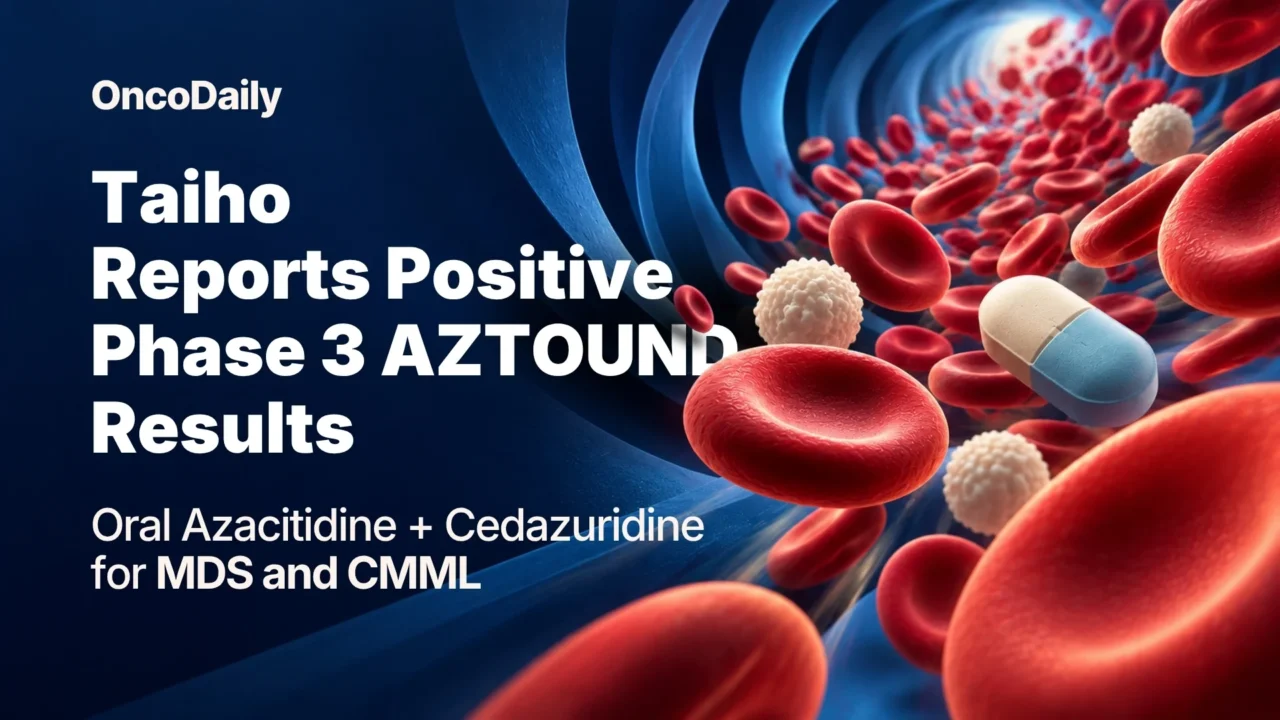
Taiho Oncology and Taiho Pharmaceutical announced positive topline results from the Phase 3 AZTOUND trial. The study evaluated oral azacitidine and cedazuridine in adults with myelodysplastic syndromes (MDS) or chronic myelomonocytic leukemia (CMML). The investigational combination is being developed as an oral alternative to injectable azacitidine, with the aim of offering patients a more convenient way to receive treatment.
For patients receiving repeated injections, treatment can involve frequent visits to healthcare facilities and additional demands on patients and caregivers. The investigational combination aims to offer a more convenient route of administration while achieving azacitidine exposure comparable to subcutaneous treatment. The announcement marks a further step in efforts to make an established treatment approach available as an all-oral regimen.
Phase 3 Trial Compares Oral and Subcutaneous Treatment
The Phase 3 study enrolled 88 adults and used a randomized, open-label crossover design. AZTOUND is part of a broader development program that includes earlier dose-escalation and dose-expansion stages.
The crossover approach allows participants to receive both treatment formulations in successive cycles. The sponsor’s trial overview describes two treatment sequences: oral azacitidine and cedazuridine followed by subcutaneous azacitidine, or the reverse order. Subsequent cycles use the oral combination. This design supports comparison of drug exposure within the same patient.
Fabio Benedetti, Global Chief Medical Officer at Taiho Pharmaceutical, added that these encouraging results represent a major step forward in creating novel treatments that boost clinical efficacy and improve patient well-being in hematological malignancies. He also extended his sincere thanks to the study participants, caregivers, and clinical trial teams whose dedication is helping bring this combination regimen to reality.
Harold Keer, Chief Medical Officer, Taiho Oncology, said,
“The positive topline results of the Phase 3 AZTOUND trial support the potential of an all-oral regimen of azacitidine and cedazuridine to meet the treatment needs of patients with MDS and CMML without the time and treatment burden associated with parenteral therapies.”
What the Primary Endpoint Measures
The primary endpoint assessed the ratio of total-cycle azacitidine exposure after oral treatment versus subcutaneous administration, using area under the concentration–time curve from zero to 24 hours. This pharmacokinetic comparison addresses whether the oral regimen delivers the intended systemic drug exposure. It does not, by itself, demonstrate superior cancer control or longer survival.
The announcement did not disclose the numerical exposure ratio, confidence intervals, detailed adverse-event findings or efficacy outcomes. These details will be needed to assess the findings more fully.
How Azacitidine and Cedazuridine Work Together
The investigational combination pairs azacitidine, a DNA methyltransferase inhibitor, with cedazuridine, a cytidine deaminase inhibitor. Cedazuridine helps prevent azacitidine from being degraded, supporting its delivery by the oral route.
An oral regimen could reduce the administration burden associated with repeated injections. However, improvements in treatment burden or quality of life were not demonstrated in the disclosed topline results.
About MDS and CMML
Myelodysplastic Syndromes (MDS) represent a complex group of hematopoietic stem cell disorders characterized by ineffective blood cell production. In the United States, an estimated 10,000 to 15,000 new cases are diagnosed annually, though true incidence rates are likely higher due to underdiagnosis. Over time, approximately one-third of MDS cases progress to acute myeloid leukemia (AML).
Chronic Myelomonocytic Leukemia (CMML) is a clonal hematopoietic malignancy defined by the abnormal accumulation of monocytes in the bone marrow and circulating blood. Around 2,000 new cases of CMML are diagnosed each year in the U.S. Approximately 15% to 30% of CMML cases eventually transform into acute myeloid leukemia.
Chronic Myelomonocytic Leukemia (CMML): Beyond the Overlap, Toward the Bigger Picture.
FDA Submission and Conference Presentation Planned
Taiho Oncology intends to submit a New Drug Application to the U.S. Food and Drug Administration, seeking approval for adults with MDS or CMML. The companies also plan to submit the AZTOUND results for presentation at an international medical conference.
Oral azacitidine and cedazuridine remain investigational and have not been approved by any health authority.
You can also read: FDA Approves Pirtobrutinib for First-Line CLL/SLL Without 17p Deletion, a First for Non-Covalent BTK Inhibitors.