
The introduction of enfortumab vedotin plus pembrolizumab has changed first-line treatment of locally advanced and metastatic urothelial carcinoma. However, its increasing use has also raised a new clinical question: which treatments should follow when the disease progresses after patients have already received both an antibody–drug conjugate (ADC) and an immune checkpoint inhibitor?
Historically, treatment sequencing involved platinum-based chemotherapy, immunotherapy and subsequent targeted agents or ADCs. With enfortumab vedotin plus pembrolizumab now recommended as the preferred first-line approach, the order in which these therapies are used has changed.
Two retrospective studies published in ESMO Open and Bladder Cancer in 2026 provide additional information about subsequent treatment patterns and outcomes after enfortumab vedotin plus pembrolizumab, although prospective evidence comparing treatment strategies remains limited.
After Enfortumab Vedotin Plus Pembrolizumab: What Comes Next?
The phase 3 EV-302/KEYNOTE-A39 trial established enfortumab vedotin plus pembrolizumab as a preferred first-line regimen, demonstrating a significant overall survival benefit compared with platinum-based chemotherapy. The benefit was maintained in the updated 2025 and 2026 analyses. However, EV-302 was not designed to determine the optimal treatment sequence after progression. (Powles et al., NEJM, 2024; Powles et al., Annals of Oncology, 2025; Powles et al., Journal of Clinical Oncology, 2026, Abstract 4507)
The ESMO Clinical Practice Guideline interim update recommends considering platinum-based chemotherapy after progression on enfortumab vedotin plus pembrolizumab, without routine maintenance avelumab in unselected patients. Erdafitinib is another option for selected tumors with actionable FGFR alterations. These recommendations were made in the absence of randomized trials specifically comparing treatment sequences following first-line ADC–immunotherapy. (Powles et al., Annals of Oncology, 2024)
The 2026 EAU guidelines give a weak recommendation to platinum-containing combination chemotherapy after enfortumab vedotin plus checkpoint inhibition and a strong recommendation to erdafitinib for patients with actionable FGFR alterations. Single-agent chemotherapy is also supported by a weak recommendation. (EAU Guidelines, 2026)
Platinum-Based Chemotherapy After Enfortumab Vedotin Plus Pembrolizumab
In 2026, Sternschuss and colleagues published a retrospective study in ESMO Open evaluating platinum-based chemotherapy after first-line enfortumab vedotin plus pembrolizumab in metastatic urothelial carcinoma. Among 236 patients who had received enfortumab vedotin plus pembrolizumab, 62 subsequently received systemic therapy. Of these, 46 patients (74%) received platinum-based chemotherapy, including 34 treated with carboplatin and 12 with cisplatin.
The objective response rate was 49% (22/45 evaluable patients), including two complete responses. Median duration of response was 5.2 months, median progression-free survival (PFS) was 5.0 months (95% CI 3.6–6.6), and median overall survival (OS) was 12 months (95% CI 10–17). No statistically significant difference in outcomes was observed between cisplatin- and carboplatin-treated patients, although the small treatment groups limited the comparison. (Sternschuss et al., ESMO Open, 2026)
Platinum-based chemotherapy showed antitumor activity after enfortumab vedotin plus pembrolizumab in this retrospective cohort. The study was conducted at a single institution and lacked a randomized comparator, limiting conclusions about the relative effectiveness of different subsequent treatments.
Nine patients received avelumab maintenance following platinum-based chemotherapy. However, this observation does not establish a benefit for maintenance immunotherapy after prior enfortumab vedotin plus pembrolizumab, a strategy not prospectively evaluated in JAVELIN Bladder 100.
What the 2026 Real-World Evidence Adds
Another 2026 study examined treatment patterns following first-line enfortumab vedotin plus pembrolizumab using electronic health record data. Gebrael and colleagues identified 757 patients who received the combination as first-line treatment. Among 120 patients who subsequently received second-line systemic therapy, 118 had evaluable survival outcomes.
Second-line regimens included carboplatin-based therapy (35%), cisplatin-based therapy (13%), enfortumab vedotin rechallenge (13%) and other treatments (38%). The latter group included erdafitinib, trastuzumab deruxtecan and sacituzumab govitecan. Median real-world OS ranged from 7.1 months with carboplatin-based therapy to 14.0 months in the heterogeneous group receiving other treatments. However, these findings cannot establish comparative efficacy because treatment assignment was not randomized and important clinical and molecular characteristics were unavailable. (Gebrael et al., Bladder Cancer, 2026)
The two 2026 studies provide information about treatment patterns and outcomes after first-line enfortumab vedotin plus pembrolizumab. Nevertheless, they do not identify a superior second-line regimen or establish the optimal treatment sequence.

FGFR3 Alterations: The Role of Erdafitinib
Molecular testing is important in advanced urothelial carcinoma because selected FGFR alterations can identify patients eligible for erdafitinib, an oral FGFR inhibitor. The phase 3 THOR trial evaluated erdafitinib versus investigator’s choice of docetaxel or vinflunine in previously treated advanced urothelial carcinoma harboring susceptible FGFR alterations. In cohort 1, 266 patients who had received prior systemic treatment, including a PD-1 or PD-L1 inhibitor, were randomized.
Median OS was 12.1 months with erdafitinib versus 7.8 months with chemotherapy (HR 0.64; 95% CI 0.47–0.88; P=0.005). Median PFS was 5.6 versus 2.7 months (HR 0.58; 95% CI 0.44–0.78; P<0.001). (Loriot et al., NEJM, 2023)
In January 2024, the FDA approved erdafitinib for adults with locally advanced or metastatic urothelial carcinoma harboring susceptible FGFR3 genetic alterations after progression on or following at least one prior systemic therapy. The US indication specifies FGFR3 alterations, and erdafitinib is not recommended for patients eligible for PD-1 or PD-L1 inhibitor therapy who have not yet received it. (FDA, 2024)
THOR provides randomized evidence supporting erdafitinib in molecularly selected patients. However, it did not specifically evaluate treatment following first-line enfortumab vedotin plus pembrolizumab. Erdafitinib also requires monitoring for treatment-related adverse events, including hyperphosphatemia and ocular toxicity.
HER2-Directed ADCs in Previously Treated Disease
HER2 expression may identify another subgroup of patients eligible for ADC-based treatment after prior systemic therapy. The phase 2 DESTINY-PanTumor02 trial evaluated trastuzumab deruxtecan in previously treated HER2-expressing solid tumors, including urothelial carcinoma. At the 2026 ASCO Genitourinary Cancers Symposium, updated findings from the bladder cancer cohort were reported.
Among 41 patients treated with trastuzumab deruxtecan, the investigator-assessed objective response rate was 41.5% (17/41; 95% CI 26.3–57.9). Response rates were 56.3% (9/16) in patients with centrally assessed HER2 IHC 3+ tumors and 40.0% (8/20) in those with IHC 2+ tumors.
Median duration of response was 9.5 months, median PFS was 7.0 months, and median OS was 12.8 months. Drug-related interstitial lung disease or pneumonitis occurred in four patients (9.8%), all grade 1 or 2. (Jung et al., Journal of Clinical Oncology, 2026, Abstract 734) Responses were observed with trastuzumab deruxtecan, although the urothelial carcinoma cohort was small and lacked a randomized comparator.
The FDA granted tumor-agnostic accelerated approval to trastuzumab deruxtecan in April 2024 for previously treated unresectable or metastatic HER2-positive solid tumors with IHC 3+ expression and no satisfactory alternative treatment options.
The 2026 EAU guidelines recommend trastuzumab deruxtecan after previous enfortumab vedotin, checkpoint inhibition and platinum-based therapy in patients with HER2 IHC 3+ disease, with consideration in those with IHC 2+ expression. This is a weak recommendation and should be distinguished from the FDA’s tumor-agnostic indication, which specifies HER2 IHC 3+ tumors. (EAU Guidelines, 2026; FDA, 2024)
When Previous Treatment Was Chemotherapy
Treatment sequencing differs for patients who received platinum-based chemotherapy rather than enfortumab vedotin plus pembrolizumab as first-line therapy.
For patients previously treated with platinum chemotherapy and a checkpoint inhibitor who have not received enfortumab vedotin, the ADC remains an evidence-based subsequent treatment option.
In the phase 3 EV-301 trial, enfortumab vedotin improved median OS to 12.88 months compared with 8.97 months with investigator’s choice of chemotherapy (HR 0.70; 95% CI 0.56–0.89). Median PFS was 5.55 versus 3.71 months (HR 0.62; 95% CI 0.51–0.75). (Powles et al., NEJM, 2021)
Find more videos on OncoDaily YouTube TV.
What NCCN Guidelines Version 3.2026 Recommend
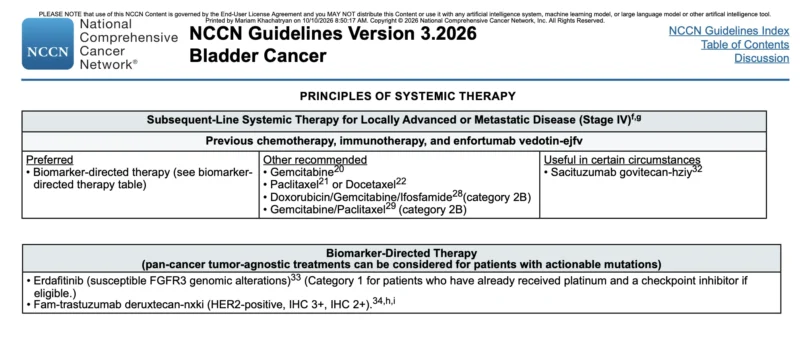
The NCCN Guidelines for Bladder Cancer, Version 3.2026, distinguish subsequent systemic treatment for locally advanced or metastatic urothelial carcinoma according to previous exposure to chemotherapy, immunotherapy and enfortumab vedotin.
For patients previously treated with enfortumab vedotin and immunotherapy but not chemotherapy, preferred options include biomarker-directed therapy, cisplatin plus gemcitabine, and dose-dense MVAC with growth factor support. Carboplatin plus gemcitabine is also listed as a preferred option, with a Category 2B recommendation.
For patients previously treated with chemotherapy but not immunotherapy or enfortumab vedotin, enfortumab vedotin plus pembrolizumab is preferred. Following chemotherapy and immunotherapy without prior enfortumab vedotin, enfortumab vedotin monotherapy is a preferred Category 1 option, alongside biomarker-directed therapy.
For patients previously exposed to chemotherapy, immunotherapy and enfortumab vedotin, biomarker-directed therapy remains preferred when appropriate. Biomarker-directed options include erdafitinib for susceptible FGFR3 alterations and trastuzumab deruxtecan for HER2-positive disease (IHC 3+ or IHC 2+), subject to applicable eligibility criteria. Additional chemotherapy options are also listed. (NCCN Clinical Practice Guidelines in Oncology: Bladder Cancer, Version 3.2026) These recommendations emphasize the importance of previous treatment exposure and molecular testing when selecting subsequent therapy.
Toxicity, Treatment Access and Remaining Evidence Gaps
Prior treatment-related toxicity can influence subsequent therapy. Residual neuropathy after enfortumab vedotin may complicate the use of other neurotoxic agents, while renal function, hearing impairment and performance status remain important when assessing cisplatin eligibility. Targeted agents introduce additional considerations. Erdafitinib requires ocular and phosphate monitoring, while trastuzumab deruxtecan carries a recognized risk of interstitial lung disease.
Not all ADCs have demonstrated a survival advantage in randomized later-line trials. In the phase 3 TROPiCS-04 study, sacituzumab govitecan did not significantly improve OS compared with investigator’s choice of chemotherapy in patients previously treated with platinum chemotherapy and checkpoint inhibition. Median OS was 10.3 versus 9.0 months (HR 0.86; 95% CI 0.73–1.02; P=0.087), with a higher incidence of grade ≥3 treatment-related adverse events in the sacituzumab govitecan arm. (Powles et al., Annals of Oncology, 2025) The FDA withdrew the accelerated approval of sacituzumab govitecan for locally advanced or metastatic urothelial carcinoma on November 22, 2024. (FDA, 2024)
Treatment availability also varies between healthcare systems. Access to biomarker testing, targeted therapies, ADCs and clinical trials may influence the options available after progression. The 2026 evidence provides useful information about treatment outcomes following enfortumab vedotin plus pembrolizumab, but randomized comparisons of subsequent strategies remain lacking. Patient selection, previous therapy, molecular findings and treatment tolerability therefore remain central to treatment decisions.
Join OncoDaily Grand Rounds at ESMO 2026
Join OncoDaily Grand Rounds at ESMO 2026: Bladder Cancer Edition on October 25, 2026, from 2:00 PM to 6:00 PM, at Novotel Madrid Feria and Airport, Madrid, Spain. Chaired by Prof. Andrea Necchi, the event will bring together international experts to discuss treatment selection and sequencing in advanced urothelial carcinoma, toxicity management, and multidisciplinary decision-making.
Through interactive clinical scenarios, faculty discussions, and live polling, participants will explore how emerging evidence, treatment access, and healthcare resources influence bladder cancer care across different countries.
The event is supported by an independent medical education grant from Astellas and Pfizer via the Pfizer–Astellas Alliance.

Sources
- Powles T, et al. Enfortumab Vedotin and Pembrolizumab in Untreated Advanced Urothelial Cancer. New England Journal of Medicine. 2024;390:875–888.
- Powles TB, et al. Enfortumab vedotin plus pembrolizumab in untreated locally advanced or metastatic urothelial carcinoma: 2.5-year median follow-up of the phase III EV-302/KEYNOTE-A39 trial. Annals of Oncology. 2025;36:1212–1219.
- Powles T, et al. Enfortumab vedotin plus pembrolizumab (EV+P) vs chemotherapy for previously untreated locally advanced or metastatic urothelial carcinoma (la/mUC): 3.5-year follow-up and response analyses from the phase 3 EV-302 study. Journal of Clinical Oncology. 2026;44(suppl 16):4507. ASCO 2026 abstract.
- Powles T, et al. ESMO Clinical Practice Guideline interim update on first-line therapy in advanced urothelial carcinoma. Annals of Oncology. 2024;35:485–490.
- European Association of Urology. EAU Guidelines on Muscle-Invasive and Metastatic Bladder Cancer — Metastatic Disease. 2026.
- Sternschuss M, et al. Platinum-based chemotherapy after enfortumab vedotin and pembrolizumab in metastatic urothelial carcinoma: a real-world study. ESMO Open. 2026;11:108318.
- Powles T, et al. Avelumab Maintenance Therapy for Advanced or Metastatic Urothelial Carcinoma. New England Journal of Medicine. 2020;383:1218–1230.
- Gebrael G, et al. Treatment patterns and outcomes with second-line therapies in patients with advanced urothelial carcinoma previously treated with first-line enfortumab vedotin with pembrolizumab. Bladder Cancer. 2026;12(1):23523735261437911.
- Loriot Y, et al. Erdafitinib or Chemotherapy in Advanced or Metastatic Urothelial Carcinoma. New England Journal of Medicine. 2023;389:1961–1971.
- US Food and Drug Administration. FDA Approves Erdafitinib for Locally Advanced or Metastatic Urothelial Carcinoma. January 19, 2024.
- Jung KH, et al. Trastuzumab deruxtecan (T-DXd) in pretreated patients (pts) with HER2-expressing bladder cancer: Final results from the bladder cancer cohort in Part 1 of DESTINY-PanTumor02 (DP-02). Journal of Clinical Oncology. 2026;44(suppl 7):734. ASCO GU 2026 abstract.
- US Food and Drug Administration. FDA Grants Accelerated Approval to Fam-Trastuzumab Deruxtecan-nxki for Unresectable or Metastatic HER2-Positive Solid Tumors. April 5, 2024.
- Powles T, et al. Enfortumab Vedotin in Previously Treated Advanced Urothelial Carcinoma. New England Journal of Medicine. 2021;384:1125–1135.
- National Comprehensive Cancer Network. NCCN Clinical Practice Guidelines in Oncology: Bladder Cancer. Version 3.2026. Guideline version supplied for editorial review.
- Powles T, et al. Sacituzumab govitecan in advanced urothelial carcinoma: TROPiCS-04, a phase III randomized trial. Annals of Oncology. 2025;36:561–571.
- US Food and Drug Administration. Sacituzumab Govitecan — Urothelial Cancer Indication Withdrawal. November 22, 2024.
- OncoDaily. OncoDaily Grand Rounds at ESMO 2026: Bladder Cancer Edition. Official event information and scientific program. October 25, 2026.