


Inotuzumab Ozogamicin (Besponsa): Mechanism of Action, Dosing, Clinical Uses, Trials, and Side Effects
Key takeaways
- Inotuzumab ozogamicin is a CD22-directed antibody–drug conjugate.
- It delivers calicheamicin, causing DNA double-strand breaks and apoptosis.
- It received initial FDA approval in 2017.
- Its indication expanded to children aged one year or older in 2024.
- The initial cycle dose is 1.8 mg/m², divided across Days 1, 8, and 15.
- INO-VATE ALL demonstrated CR/CRi rates of 80.7% versus 29.4% compared with standard salvage chemotherapy.
- MRD negativity among responders was 78.4% versus 28.1%.
- The pediatric ITCC-059 study supported use in relapsed/refractory pediatric B-ALL.
- Inotuzumab ozogamicin can facilitate remission before HSCT.
- The greatest safety concern is hepatic VOD/SOS, particularly following transplantation.
- Close monitoring of liver function, blood counts, infections, bleeding, and ECG is essential.
Inotuzumab ozogamicin (Besponsa) is a CD22-directed antibody–drug conjugate (ADC) used to treat relapsed or refractory B-cell precursor acute lymphoblastic leukemia (B-ALL). It combines a humanized anti-CD22 monoclonal antibody with N-acetyl-γ-calicheamicin, a potent cytotoxic agent capable of inducing DNA double-strand breaks.
Following binding to CD22 on malignant B lymphoblasts, inotuzumab ozogamicin is internalized. Intracellular processing releases the calicheamicin payload, which damages DNA and induces leukemic-cell apoptosis.
Inotuzumab ozogamicin received its initial FDA approval on August 17, 2017, for adults with relapsed or refractory B-cell precursor ALL. On March 6, 2024, the FDA expanded its indication to include children aged one year and older with relapsed or refractory CD22-positive B-ALL.
Its efficacy was established primarily through the phase III INO-VATE ALL study and the pediatric ITCC-059 trial.
One of its most important clinical applications is achieving deep remission before hematopoietic stem cell transplantation (HSCT). However, this benefit must be balanced against the substantial risk of hepatic veno-occlusive disease/sinusoidal obstruction syndrome (VOD/SOS) and increased post-transplant non-relapse mortality.
Key Facts
- Generic name: Inotuzumab ozogamicin
- Brand name: Besponsa
- Drug class: Antibody–drug conjugate
- Target: CD22 (SIGLEC-2)
- Antibody type: Humanized IgG4κ
- Cytotoxic payload: N-acetyl-γ-calicheamicin derivative
- Linker: Acid-cleavable hydrazone-containing linker
- Mechanism: CD22 binding, internalization, calicheamicin release, DNA double-strand breaks, apoptosis
- Initial FDA approval: August 17, 2017
- Pediatric FDA approval: March 6, 2024
- Administration: Intravenous infusion over one hour
Initial cycle dose: 1.8 mg/m² per cycle, divided across Days 1, 8, and 15 - Approved indication: Relapsed/refractory CD22-positive B-cell precursor ALL
- Approved ages: Adults and children aged one year or older
- Pivotal trials: INO-VATE ALL and ITCC-059
- Essential biomarker: CD22 expression
- Major adverse reactions: Cytopenias, infections, fever, fatigue, nausea, bleeding, elevated liver enzymes
- Boxed warnings: Hepatic VOD/SOS and increased post-HSCT non-relapse mortality
- Important monitoring: CBC, liver function, VOD/SOS symptoms, ECG, electrolytes, infections, and bleeding
- Terminal half-life: Approximately 12.3 days
- Available strength: 0.9-mg single-dose vial
What Is Inotuzumab Ozogamicin?
Inotuzumab ozogamicin is an ADC designed to deliver a powerful DNA-damaging agent selectively to CD22-expressing malignant B cells.
It consists of three principal components.
1. Anti-CD22 Monoclonal Antibody
The antibody specifically recognizes CD22, a B-cell-associated transmembrane protein.
CD22 is expressed on most B-cell precursor ALL blasts, although expression intensity and the proportion of positive cells vary.
2. Cleavable Linker
A chemically cleavable linker attaches the antibody to the calicheamicin payload.
After internalization, intracellular processing permits release of the cytotoxic agent.
3. Calicheamicin Payload
Calicheamicin produces DNA double-strand breaks, resulting in cell-cycle arrest and apoptosis.
Important distinction: Inotuzumab ozogamicin and gemtuzumab ozogamicin both deliver calicheamicin. However, inotuzumab targets CD22 in B-cell ALL, whereas gemtuzumab targets CD33 in AML.
What Is the Mechanism of Action of Inotuzumab Ozogamicin?
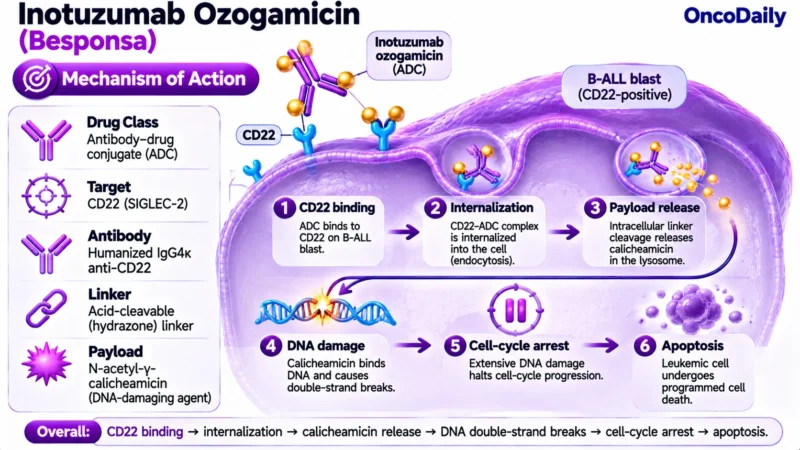
1. CD22 Recognition
Inotuzumab ozogamicin binds CD22 on the leukemic B-cell surface.
CD22 belongs to the sialic acid-binding immunoglobulin-like lectin family.
2. ADC Internalization
Following binding, the CD22–ADC complex is internalized through receptor-mediated endocytosis.
The complex enters intracellular endosomal and lysosomal compartments.
3. Calicheamicin Release
Intracellular hydrolytic cleavage of the linker releases the calicheamicin derivative.
The payload becomes activated within the cell.
4. DNA Double-Strand Breaks
Activated calicheamicin interacts with DNA and induces double-strand breaks.
These lesions activate cellular DNA-damage responses.
5. Cell-Cycle Arrest
Extensive DNA damage prevents malignant cells from progressing normally through the cell cycle.
6. Apoptosis
Persistent DNA damage triggers programmed cell death, reducing the burden of CD22-positive leukemic blasts.
Overall mechanism:
Inotuzumab ozogamicin → CD22 binding → internalization → linker cleavage → calicheamicin release → DNA double-strand breaks → cell-cycle arrest → apoptosis.
What Is the Recommended Dose of Inotuzumab Ozogamicin?
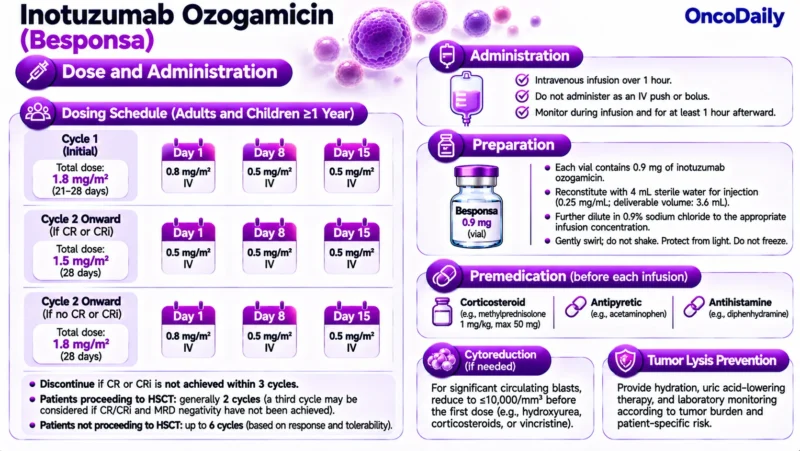
The FDA-recommended dosing schedule is the same for adult and pediatric patients aged one year or older.
Cycle 1 — All Patients
The total dose is:
1.8 mg/m² per cycle.
It is divided into three administrations:
Day 1
0.8 mg/m² IV
Day 8
0.5 mg/m² IV
Day 15
0.5 mg/m² IV
The first cycle is generally 21 days but may be extended to 28 days if remission is achieved or additional recovery time is required.
Cycle 2 Onward — Patients Achieving CR or CRi
For patients who achieve complete remission (CR) or complete remission with incomplete hematologic recovery (CRi):
0.5 mg/m² IV on Days 1, 8, and 15.
Total dose:
1.5 mg/m² per cycle.
Subsequent cycles last 28 days.
Cycle 2 Onward — Patients Without CR or CRi
For patients who have not achieved remission:
- Day 1: 0.8 mg/m²
- Day 8: 0.5 mg/m²
- Day 15: 0.5 mg/m²
Total:
1.8 mg/m² per cycle.
Patients who do not achieve CR or CRi within three cycles should discontinue treatment.
Patients Proceeding to HSCT
The recommended treatment duration is generally:
Two cycles.
A third cycle may be considered if CR/CRi and MRD negativity have not been achieved.
The objective is to avoid unnecessary cumulative exposure and reduce the risk of transplant-associated VOD/SOS.
Patients Not Proceeding to HSCT
Treatment may continue for a maximum of:
Six cycles.
The appropriate number of cycles depends on response and tolerability.
How Should Inotuzumab Ozogamicin Be Administered?
Intravenous Administration
Besponsa is administered as an intravenous infusion over:
One hour.
It must not be administered as an IV push or bolus.
Preparation
Each vial contains 0.9 mg of inotuzumab ozogamicin.
Reconstitute with:
4 mL sterile water for injection.
The resulting concentration is:
0.25 mg/mL.
The deliverable volume is 3.6 mL.
The solution should be further diluted with 0.9% sodium chloride to the appropriate infusion concentration.
- Gently swirl; do not shake.
- Protect from light.
- Do not freeze.
- Follow product-specific preparation and storage requirements.
- Filtration is not routinely required; if used, select a label-compatible filter.
Premedication
Before each infusion, administer:
- Corticosteroid
- Antipyretic
- Antihistamine
In the pediatric registration study, methylprednisolone 1 mg/kg (maximum 50 mg) was used.
Monitor patients during infusion and for at least one hour afterward.
Cytoreduction
For patients with significant circulating leukemic blasts, cytoreduction may be required before the first dose.
Hydroxyurea, corticosteroids, or vincristine may be used to reduce the peripheral blast count to 10,000/mm³ or less.
Tumor Lysis Prophylaxis
Provide hydration, uric acid-lowering therapy, and laboratory monitoring according to tumor burden and patient-specific risk.
What Should You Do If an Inotuzumab Ozogamicin Dose Is Missed?
If a dose is delayed:
- Review the reason for the interruption.
- Reassess blood counts and liver function.
- Adjust subsequent administration dates according to the label.
- Maintain a minimum interval of six days between administrations.
- Do not double subsequent doses.
The specific dose adjustment depends on the duration and cause of the interruption.
How Are Inotuzumab Ozogamicin Dose Modifications Managed?
Hepatic VOD/SOS
Permanently discontinue treatment if VOD/SOS develops.
Provide urgent specialist assessment and supportive treatment.
Liver Function Abnormalities
Interrupt treatment if:
- Total bilirubin exceeds 1.5 × ULN, or
- AST/ALT exceeds 2.5 × ULN,
unless an applicable label-defined exception is present.
Resume only after adequate recovery.
Persistent Cytopenias
Subsequent cycles may be delayed until appropriate hematologic recovery.
Management depends on baseline counts, remission status, and whether cytopenias are disease-related or treatment-related.
Infusion Reactions
Interrupt treatment and administer supportive therapy.
Life-threatening reactions may require permanent discontinuation.
Prolonged Treatment Interruption
For nonhematologic toxicity, an interruption of at least 14 days may require a 25% reduction in the total dose of the next cycle.
Further reductions in dosing frequency or permanent discontinuation may be necessary.
What Drug Interactions Are Important With Inotuzumab Ozogamicin?
Hepatotoxic Agents and HSCT Conditioning
Treatment with potentially hepatotoxic medications and certain transplant conditioning regimens increases clinical concern for liver injury.
HSCT regimens containing two alkylating agents are particularly associated with increased VOD/SOS risk.
QT-Prolonging Medications
Use caution with concomitant drugs that prolong the QT interval.
Examples include selected antiarrhythmics, antimicrobial agents, and other medications.
Monitor ECG and correct electrolyte abnormalities.
Myelosuppressive Chemotherapy
Concurrent cytotoxic therapy may increase:
- Neutropenia
- Thrombocytopenia
- Infections
- Bleeding
- Delayed marrow recovery
CYP450 Interactions
The antibody component is not primarily metabolized by CYP450 enzymes.
The released calicheamicin derivative is predominantly metabolized through nonenzymatic processes.
Conventional CYP-mediated drug interactions are not a major established concern.
Does Inotuzumab Ozogamicin Require Dose Adjustment in Renal or Hepatic Impairment?
Renal Impairment
No initial dose adjustment is generally required for mild or moderate renal impairment.
Available pharmacokinetic evidence does not indicate a major clearance change with severe renal impairment, although clinical experience is limited.
Data in end-stage renal disease and dialysis are insufficient.
Hepatic Impairment
Hepatic impairment requires particular caution because of the risk of VOD/SOS.
No initial dose adjustment is required when:
- Bilirubin is at or below 1.5 × ULN, and
- AST/ALT are at or below 2.5 × ULN.
There are limited safety data in more severe hepatic impairment.
Treatment must be interrupted for liver-function abnormalities exceeding the relevant thresholds.
What Is the Pharmacokinetic Profile of Inotuzumab Ozogamicin?
Distribution
Inotuzumab ozogamicin distributes primarily within vascular and extracellular compartments.
Its approximate volume of distribution is 12 L.
Metabolism
The antibody component undergoes proteolytic catabolism.
The released calicheamicin derivative is metabolized primarily through nonenzymatic reduction.
Half-Life
The terminal elimination half-life is approximately:
12.3 days.
Clearance
Clearance includes linear and time-dependent processes.
Repeated dosing results in accumulation, with steady-state exposure reached around Cycle 4.
What Are the Clinical Uses of Inotuzumab Ozogamicin?
Relapsed or Refractory B-Cell ALL in Adults
Inotuzumab ozogamicin is an established option for adults with CD22-positive relapsed/refractory B-ALL.
It can achieve high remission rates even after prior intensive chemotherapy.
Bridge to Hematopoietic Stem Cell Transplantation
A major clinical application is achieving remission before allogeneic HSCT.
Inotuzumab ozogamicin can reduce leukemia burden and achieve MRD-negative remission.
However, transplant planning must carefully balance this benefit against VOD/SOS and non-relapse mortality.
Pediatric Relapsed or Refractory B-ALL
Inotuzumab ozogamicin is approved for children aged one year or older.
Its use is particularly relevant after previous treatment failure and in selected patients being considered for additional consolidation or cellular therapy.
Philadelphia Chromosome-Positive B-ALL
Inotuzumab ozogamicin may be used in relapsed/refractory CD22-positive Ph-positive disease.
In the pivotal adult trial, patients with Ph-positive disease were required to have failed appropriate prior TKI-based therapy.
It should not be considered a substitute for mutation-directed TKI selection.
Frontline B-ALL
Investigational and institutional treatment programs have studied inotuzumab ozogamicin with reduced-intensity chemotherapy or sequential immunotherapy.
However, its FDA-approved indication remains relapsed or refractory CD22-positive B-ALL.
What Molecular Testing Is Required Before Inotuzumab Ozogamicin?
CD22 Expression
Confirmation of CD22 positivity is essential.
CD22 is commonly assessed using multiparameter flow cytometry on bone marrow or peripheral blood leukemic cells.
CD22 expression can vary and may change after CD22-directed therapy.
ALL Diagnostic Testing
Baseline evaluation should include:
- Bone marrow morphology
- Multiparameter flow cytometry
- Cytogenetic assessment
- BCR::ABL1 testing
- Relevant leukemia-associated molecular alterations
- MRD assessment using an appropriate validated method
MRD Monitoring
MRD evaluation is important for assessing remission depth and planning subsequent treatment.
MRD negativity after inotuzumab ozogamicin has important prognostic and therapeutic implications.
What Did the Pivotal Clinical Trials Show?
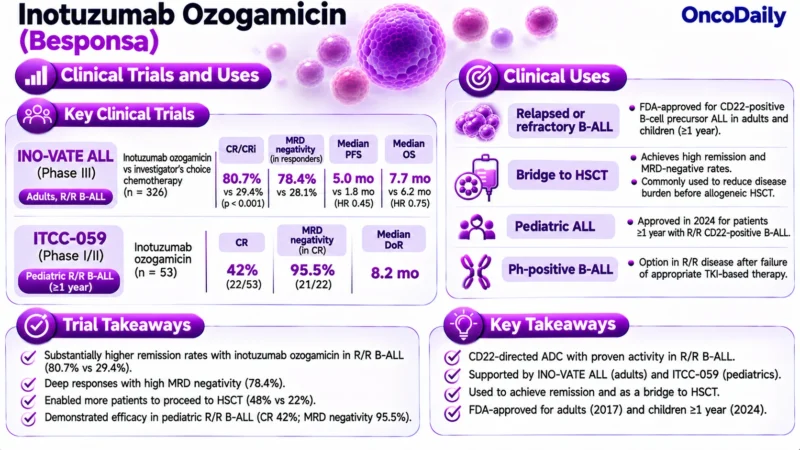
INO-VATE ALL — Adult Relapsed or Refractory B-ALL
INO-VATE ALL was a randomized phase III trial evaluating:
- Inotuzumab ozogamicin
- Investigator’s choice of standard salvage chemotherapy
The study randomized 326 adults with relapsed/refractory B-cell precursor ALL.
Complete Remission or CRi — Primary Analysis
- Inotuzumab ozogamicin: 80.7%
- Standard chemotherapy: 29.4%
p < 0.001
MRD Negativity Among Patients With CR/CRi
- Inotuzumab ozogamicin: 78.4%
- Standard chemotherapy: 28.1%
Median Progression-Free Survival
- Inotuzumab ozogamicin: 5.0 months
- Standard chemotherapy: 1.8 months
HR: 0.45
Final Median Overall Survival
- Inotuzumab ozogamicin: 7.7 months
- Standard chemotherapy: 6.2 months
Two-Year Overall Survival
- Inotuzumab ozogamicin: 22.8%
- Standard chemotherapy: 10.0%
The final analysis reported an overall survival HR of approximately 0.75.
Subsequent HSCT
- Inotuzumab ozogamicin: 48%
- Standard chemotherapy: 22%
The trial demonstrated substantially higher remission and MRD-negative response rates with inotuzumab ozogamicin.
However, hepatic VOD/SOS occurred more frequently.
ITCC-059 — Pediatric Relapsed or Refractory B-ALL
ITCC-059 was a multicenter phase I/II study evaluating inotuzumab ozogamicin in children with relapsed or refractory CD22-positive B-ALL.
The FDA approval was supported by an analysis involving 53 pediatric patients.
Complete Remission Rate
42%
22 of 53 patients achieved CR.
MRD Negativity Among Patients With CR
95.5%
By flow cytometry, 21 of 22 patients achieving CR were MRD negative.
Median Duration of Complete Remission
8.2 months
The results supported expansion of the FDA indication to patients aged one year or older in March 2024.
Does Inotuzumab Ozogamicin Have CNS Activity?
Inotuzumab ozogamicin is a large antibody–drug conjugate with limited penetration across the intact blood–brain barrier.
Its efficacy as a standalone treatment for CNS leukemia has not been established.
Patients with CNS involvement require appropriate CNS-directed treatment, including intrathecal chemotherapy and other measures according to leukemia protocols.
Inotuzumab ozogamicin should not be considered a replacement for CNS prophylaxis or treatment.
Is Inotuzumab Ozogamicin FDA Approved?
Yes.
August 17, 2017
Initial FDA approval for adults with relapsed or refractory B-cell precursor ALL.
March 6, 2024
FDA approval expanded to patients one year of age or older with relapsed or refractory CD22-positive B-cell precursor ALL.
The current approved indication includes adults and pediatric patients aged one year or older.
What Is the Current Clinical Role of Inotuzumab Ozogamicin in 2026?
Relapsed or Refractory B-ALL
Inotuzumab ozogamicin remains an important CD22-directed salvage treatment.
Its role must be considered alongside:
- Blinatumomab
- CAR-T-cell therapies
- Allogeneic HSCT
- Other salvage regimens
- Molecularly targeted therapies in selected subtypes
Watch More: Dose Optimization of Inotuzumab Ozogamicin in Adult Patients With Relapsed/Refractory ALL.
MRD-Negative Remission
The ability to achieve deep responses is one of its principal advantages.
Remission depth may help guide subsequent transplantation or other consolidation strategies.
Bridge to Transplantation
Inotuzumab ozogamicin can facilitate HSCT in patients who achieve remission.
However, cumulative exposure and transplant conditioning must be carefully managed because VOD/SOS risk increases after HSCT.
Pediatric ALL
Following the 2024 FDA expansion, inotuzumab ozogamicin is an approved option for pediatric relapsed/refractory B-ALL.
Its sequencing relative to blinatumomab, CAR-T therapy, and transplantation requires specialist assessment.
What Are the Major Side Effects of Inotuzumab Ozogamicin?
Hepatic Veno-Occlusive Disease/Sinusoidal Obstruction Syndrome
VOD/SOS is the most important life-threatening adverse reaction and carries an FDA boxed warning.
Symptoms may include:
- Rapid weight gain
- Hepatomegaly
- Right upper quadrant pain
- Hyperbilirubinemia
- Ascites
- Fluid retention
- Liver failure
In the adult INO-VATE ALL study, VOD/SOS occurred in approximately 14% of inotuzumab-treated patients.
Among patients who subsequently underwent HSCT, the incidence was approximately 23%.
Severe and fatal events occurred.
Read More: Zhemal Rakhmanova at LeukO 2026: SOS/VOD – The Deadly Complication of Life-Saving Treatment by OncoDaily.
Increased Post-HSCT Non-Relapse Mortality
Inotuzumab ozogamicin carries a second boxed warning for increased non-relapse mortality after HSCT.
Major causes include VOD/SOS and serious infections.
Thrombocytopenia and Hemorrhage
Thrombocytopenia is common and can cause:
- Epistaxis
- Gastrointestinal hemorrhage
- Intracranial hemorrhage
- Other bleeding complications
Neutropenia and Serious Infections
Neutropenia and febrile neutropenia occur frequently.
Infections may include:
- Pneumonia
- Sepsis
- Neutropenic infections
- Viral and fungal infections
Infusion-Related Reactions
Symptoms can include:
- Fever
- Chills
- Rash
- Hypotension
- Dyspnea
Severe reactions are uncommon but possible.
QT-Interval Prolongation
Inotuzumab ozogamicin may prolong the QT interval.
Patients receiving QT-prolonging medications or those with electrolyte disturbances require additional monitoring.
Other Adverse Reactions
Common effects include:
- Fatigue
- Nausea
- Vomiting
- Headache
- Abdominal pain
- Elevated liver enzymes
Embryo-Fetal Toxicity
Inotuzumab ozogamicin can cause fetal harm.
Effective contraception is recommended:
- Females: During treatment and for eight months after the final dose.
- Males: During treatment and for five months after the final dose.
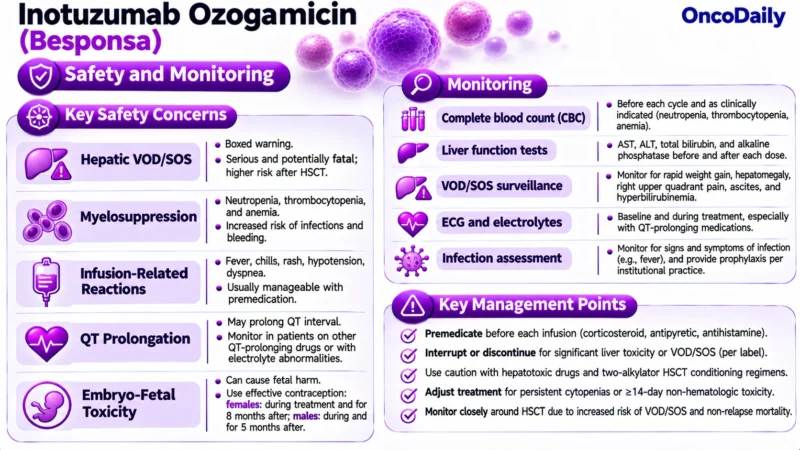
What Monitoring Is Required During Inotuzumab Ozogamicin Treatment?
Complete Blood Count
Monitor:
- Neutrophils
- Hemoglobin
- Platelets
- Total leukocytes
Assess for infection and hemorrhage.
Liver Function
Check before and after each dose:
- AST
- ALT
- Total bilirubin
- Alkaline phosphatase
VOD/SOS Monitoring
Monitor for:
- Rapid weight gain
- Abdominal pain
- Hepatomegaly
- Ascites
- Bilirubin elevation
For patients undergoing HSCT, monitor liver tests at least weekly during the first month after transplantation.
Infection Monitoring
Assess for fever, respiratory symptoms, and other infections.
Provide antimicrobial prophylaxis according to individual risk and institutional protocols.
ECG and Electrolytes
Perform ECG and electrolyte assessment at baseline and during treatment.
Monitor more frequently when concomitant QT-prolonging medications are administered.
MRD and Disease Response
Evaluate marrow response after treatment cycles.
Assess:
- Morphologic remission
- Flow cytometric MRD
- Molecular MRD when applicable
- CD22 expression when relevant to subsequent treatment
HSCT Planning
Before transplantation, assess hepatic function, conditioning-regimen hepatotoxicity, and previous inotuzumab exposure.
Avoid unnecessary additional cycles when patients are ready for HSCT.
Reproductive Monitoring
Assess pregnancy status when appropriate and provide fertility and contraception counseling.