


Cabozantinib: Understanding Its Mechanism, Dosing, Clinical Uses, and Role in RCC, HCC, Thyroid Cancer, and Neuroendocrine Tumors
Key takeaways
- Cabozantinib is an oral multikinase inhibitor targeting VEGFR, MET, AXL, RET, and other kinases.
- Cabometyx tablets and Cometriq capsules are not interchangeable.
- Standard Cabometyx monotherapy dosing is 60 mg once daily.
- With nivolumab in RCC, cabozantinib is given at 40 mg once daily.
- Standard Cabometyx dose reductions are 60 → 40 → 20 mg once daily.
- Cabozantinib is taken on an empty stomach.
- METEOR demonstrated improved PFS, OS, and ORR versus everolimus in previously treated RCC.
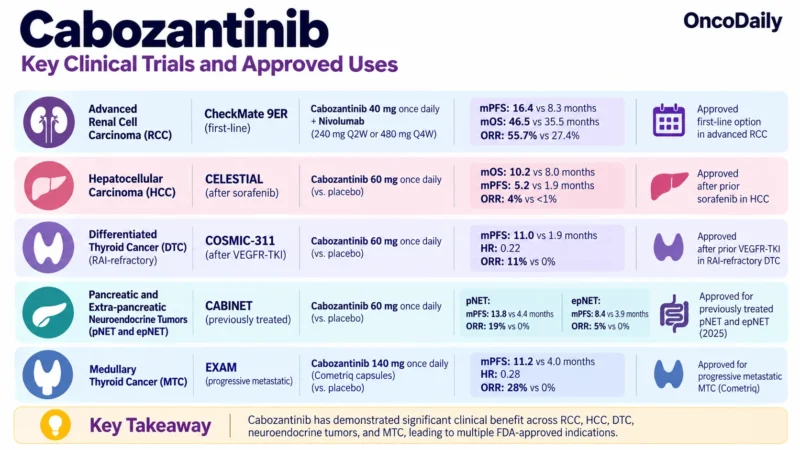
- Final CheckMate 9ER follow-up showed median OS 46.5 vs 35.5 months and PFS 16.4 vs 8.3 months with nivolumab + cabozantinib versus sunitinib.
- CELESTIAL showed OS 10.2 vs 8.0 months in previously treated HCC.
- COSMIC-311 demonstrated PFS 11.0 vs 1.9 months in previously VEGFR-treated radioactive iodine-refractory DTC.
- CABINET demonstrated substantial PFS benefit in both pNET and epNET, leading to FDA approval in 2025.
- Important toxicities include hypertension, diarrhea, PPE, bleeding, thromboembolism, hepatotoxicity, proteinuria, fistula/perforation, cardiac failure, and impaired wound healing.
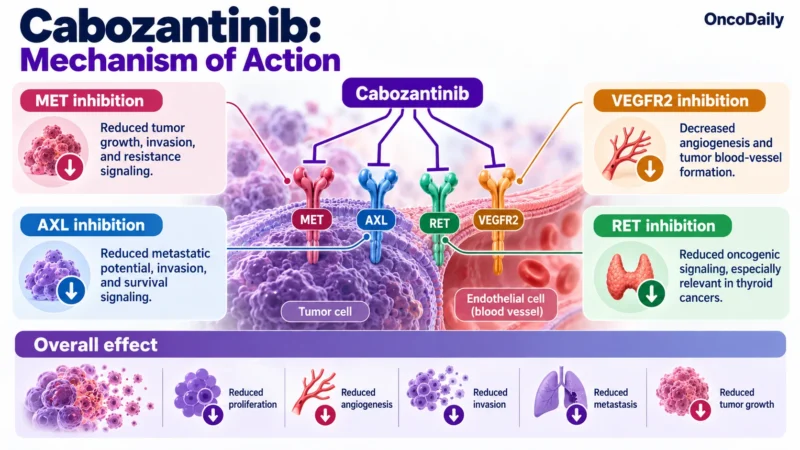
Cabozantinib is an oral multikinase inhibitor with antiangiogenic and direct antitumor activity. It inhibits several receptor tyrosine kinases involved in tumor growth, invasion, metastasis, and angiogenesis, particularly VEGFR2, MET, AXL, and RET, with additional activity against kinases including KIT and FLT3. This broader target profile helps explain its activity across multiple tumor types and its ability to inhibit signaling pathways associated with resistance to VEGF-directed therapy.
Cabozantinib is marketed in two formulations that are not interchangeable: Cabometyx tablets and Cometriq capsules. As of 2026, Cabometyx is FDA approved across advanced renal cell carcinoma, previously treated hepatocellular carcinoma, previously treated radioactive iodine-refractory differentiated thyroid cancer, and previously treated pancreatic and extra-pancreatic neuroendocrine tumors; Cometriq remains approved for progressive metastatic medullary thyroid cancer.
Key Facts
- Generic name: Cabozantinib
- Brands: Cabometyx; Cometriq
- Drug class: Multitargeted receptor tyrosine kinase inhibitor
- Major targets: VEGFR2, MET, AXL, RET; also KIT, FLT3 and other kinases
- Route: Oral
- Initial US approval: 2012
- Cabometyx tablet strengths: 20 mg, 40 mg, 60 mg
- Cabometyx standard monotherapy dose: 60 mg once daily
- With nivolumab in RCC: 40 mg once daily
- Cometriq MTC dose: 140 mg once daily
- Administration: Fasting
- Major metabolic pathway: CYP3A4
- Important toxicities: Diarrhea, palmar-plantar erythrodysesthesia, hypertension, hemorrhage, thromboembolism, proteinuria, hepatotoxicity, fistula/perforation, cardiac failure, thyroid dysfunction, hypocalcemia, impaired wound healing
- Important point: Cabometyx tablets and Cometriq capsules must not be substituted for one another.
What Is Cabozantinib?
Cabozantinib is a small-molecule inhibitor of multiple receptor tyrosine kinases involved in both:
- Angiogenesis
- Tumor-cell signaling
Its most clinically important targets include:
VEGFR2
Promotes tumor-associated angiogenesis.
MET
Involved in tumor growth, invasion, migration, and resistance to VEGF-targeted therapy.
AXL
Associated with invasion, epithelial-mesenchymal transition, treatment resistance, and metastatic progression.
RET
A major oncogenic driver in medullary thyroid carcinoma and selected other tumors.
By targeting multiple pathways simultaneously, cabozantinib can suppress both the vascular support system of the tumor and signaling pathways operating directly within malignant cells.
What Is the Mechanism of Action of Cabozantinib?
1. VEGF Signaling Promotes Angiogenesis
Tumors can produce VEGF, which activates VEGFR signaling on endothelial cells.
This promotes:
- Endothelial-cell proliferation
- Migration
- Vascular permeability
- New-vessel formation
2. MET and AXL Promote Tumor Progression
Activation of:
MET
and:
AXL
can promote:
- Tumor-cell survival
- Invasion
- Metastasis
- Resistance to VEGFR-targeted therapy
3. RET Can Drive Oncogenic Signaling
RET activation is particularly relevant in:
Medullary thyroid carcinoma
and can drive malignant-cell proliferation and survival.
4. Cabozantinib Inhibits Multiple RTKs
Cabozantinib inhibits kinase activity involving:
- VEGFR2
- MET
- AXL
- RET
- KIT
- FLT3
- Other receptor tyrosine kinases
This reduces receptor phosphorylation and downstream signaling.
5. Angiogenesis and Tumor Growth Decline
The combined result is:
- Reduced angiogenesis
- Reduced vascular support
- Reduced proliferation
- Reduced tumor-cell migration and invasion
- Reduced metastatic potential
The mechanism can be summarized as:
Cabozantinib → VEGFR/MET/AXL/RET inhibition → reduced angiogenesis + reduced tumor signaling → decreased proliferation, invasion, metastasis, and tumor growth.
What Is the Dose of Cabozantinib?
Cabometyx Monotherapy
For adults with:
- Advanced RCC
- HCC after prior sorafenib
the standard dose is:
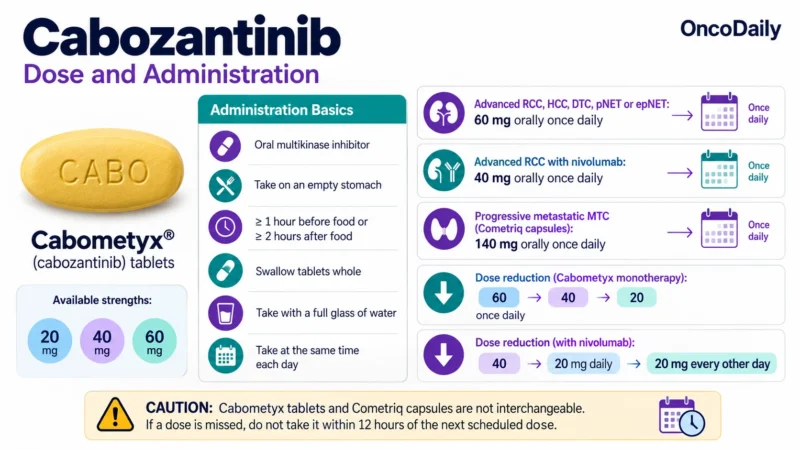
60 mg orally once daily.
For adults and pediatric patients aged ≥12 years with body weight ≥40 kg with:
- DTC
- pNET
- epNET
the recommended dose is also:
60 mg orally once daily.
Cabozantinib With Nivolumab in Advanced RCC
For first-line advanced RCC:
Cabozantinib 40 mg orally once daily
plus nivolumab.
The current FDA label allows nivolumab schedules including:
- 240 mg IV every 2 weeks
- 480 mg IV every 4 weeks
as well as approved subcutaneous nivolumab/hyaluronidase schedules.
Cabozantinib continues until:
- Disease progression
- Unacceptable toxicity
while nivolumab is generally continued for up to:
2 years.
Pediatric DTC and NET Dosing
For patients aged ≥12 years:
Body weight ≥40 kg
60 mg once daily
Body weight <40 kg
40 mg once daily.
Cometriq for Medullary Thyroid Cancer
For:
Progressive metastatic medullary thyroid carcinoma
the approved Cometriq capsule dose is:
140 mg orally once daily.
This is a different formulation from Cabometyx.
Cabometyx tablets must not be substituted for Cometriq capsules.
How Should Cabozantinib Be Taken?
For Cabometyx:
Take on an empty stomach:
- At least 1 hour before food, or
- At least 2 hours after food
Tablets should be:
Swallowed whole.
Do not:
- Crush
- Chew
- Split.
What If a Dose Is Missed?
If a Cabometyx dose is missed:
Do not take the missed dose if the next scheduled dose is within 12 hours.
Resume the normal schedule with the next dose.
How Are Cabozantinib Dose Reductions Made?
For a standard Cabometyx dose of:
60 mg once daily
the dose reductions are:
- Starting dose: 60 mg once daily
- First reduction: 40 mg once daily
- Second reduction: 20 mg once daily
If the lowest dose is not tolerated, permanent discontinuation may be required.
For cabozantinib given with nivolumab:
- Starting dose: 40 mg once daily
- First reduction: 20 mg once daily
- Second reduction: 20 mg every other day.
For pediatric patients <40 kg receiving 40 mg once daily:
- First reduction: 20 mg once daily
- Second reduction: 20 mg every other day.
When Should Cabozantinib Be Withheld?
Treatment should generally be withheld for:
- Intolerable Grade 2 adverse reactions
- Grade 3 adverse reactions
- Grade 4 adverse reactions
- Osteonecrosis of the jaw
After recovery to baseline or Grade ≤1, treatment can often be resumed at a reduced dose.
What Are the Important Drug Interactions With Cabozantinib?
Cabozantinib is predominantly affected by:
CYP3A4.
Strong CYP3A4 Inhibitors
These can increase cabozantinib exposure.
Examples include:
- Ketoconazole
- Itraconazole
- Clarithromycin
- Ritonavir
Avoid when possible.
If unavoidable:
Reduce the Cabometyx dose.
Grapefruit or grapefruit juice should also be avoided because it may increase cabozantinib exposure.
Strong or Moderate CYP3A4 Inducers
These may reduce cabozantinib exposure.
Examples include:
- Rifampin
- Carbamazepine
- Phenytoin
- Phenobarbital
- St. John’s wort
They should preferably be avoided.
If they cannot be avoided, an increase in the Cabometyx dose may be considered according to prescribing information.
Does Cabozantinib Require Renal Dose Adjustment?
No dose adjustment is generally required for:
- Mild renal impairment
- Moderate renal impairment
Experience is more limited in:
- Severe renal impairment
- End-stage renal disease
so these patients require additional clinical caution.
Does Cabozantinib Require Hepatic Dose Adjustment?
For Cabometyx:
Mild hepatic impairment
No routine dose adjustment is generally required.
Moderate hepatic impairment
The Cabometyx dose should be:
Reduced.
Severe hepatic impairment
Cabometyx should generally be:
Avoided.
The specific dose modification depends on the indication and starting dose.
What Is the Pharmacokinetic Profile of Cabozantinib?
Absorption
Median Tmax is approximately:
3–4 hours.
Food Effect
A high-fat meal increased:
- Cmax by approximately 41%
- AUC by approximately 57%
in pharmacokinetic studies of the capsule formulation.
This supports administration in the fasting state.
Protein Binding
Cabozantinib is:
≥99.7% protein bound.
Half-Life
The predicted terminal half-life of Cabometyx is approximately:
99 hours.
This long half-life contributes to significant accumulation during continuous daily treatment.
Steady State
Repeated daily administration results in approximately:
4- to 5-fold accumulation
with steady state reached by approximately:
Day 15.
Metabolism
Cabozantinib is primarily a:
CYP3A4 substrate.
Elimination
After radiolabeled cabozantinib:
- Approximately 54% of radioactivity was recovered in feces
- Approximately 27% in urine
Unchanged cabozantinib was found in feces but not meaningfully in urine.
What Are the Clinical Uses of Cabozantinib?
1. Advanced Renal Cell Carcinoma
Cabometyx is FDA approved:
- As single-agent therapy for advanced RCC
- With nivolumab as first-line therapy for advanced RCC.
2. Hepatocellular Carcinoma
Cabometyx is approved for:
HCC previously treated with sorafenib.
3. Differentiated Thyroid Cancer
Cabometyx is approved in adults and pediatric patients aged ≥12 years with:
- Locally advanced or metastatic DTC
- Progression after prior VEGFR-targeted therapy
- Radioactive iodine-refractory disease or ineligibility for radioactive iodine.
4. Pancreatic Neuroendocrine Tumors
In March 2025, the FDA approved Cabometyx for previously treated:
Well-differentiated pNET
that is:
- Unresectable
- Locally advanced
- Metastatic
in adults and pediatric patients aged ≥12 years.
5. Extra-Pancreatic Neuroendocrine Tumors
Cabometyx is also FDA approved for previously treated:
Well-differentiated epNET
in adults and pediatric patients aged ≥12 years. U.S. Food and Drug Administration
6. Progressive Metastatic Medullary Thyroid Cancer
Cabozantinib capsules marketed as:
Cometriq
remain FDA approved for:
Progressive metastatic MTC.
What Did the METEOR Trial Show?
The phase III METEOR trial evaluated cabozantinib versus everolimus in patients with advanced RCC after prior VEGFR-targeted therapy.
A total of:
658 patients
were randomized.
Patients received:
- Cabozantinib 60 mg daily
- Everolimus 10 mg daily.
Progression-Free Survival
Median PFS:
- 7.4 months with cabozantinib
- 3.8 months with everolimus
Hazard ratio:
0.58
P < 0.001.
Objective Response Rate
- Cabozantinib: 21%
- Everolimus: 5%.
Overall Survival
Final median OS:
- 21.4 months
- 16.5 months
Hazard ratio:
0.66
P = 0.00026.
METEOR established cabozantinib as an important post-VEGFR therapy in advanced RCC.
What Did CheckMate 9ER Show?
CheckMate 9ER compared:
Nivolumab + cabozantinib
with:
Sunitinib
as first-line treatment for advanced RCC.
A total of:
651 patients
were randomized.
Cabozantinib was given at:
40 mg once daily
with nivolumab.
Final 5.6-Year CheckMate 9ER Results
With a median follow-up of:
5.6 years
median PFS was:
- 16.4 months with nivolumab + cabozantinib
- 8.3 months with sunitinib
Hazard ratio:
0.58.
Median OS was:
- 46.5 months
- 35.5 months
Hazard ratio:
0.79.
Objective response rate:
- 55.7%
- 27.4%
Complete response:
- 13.9%
- 4.6%.
These long-term data support nivolumab + cabozantinib as an established first-line RCC regimen.
What Did the CELESTIAL Trial Show?
The phase III CELESTIAL trial evaluated cabozantinib in previously treated advanced HCC.
Median overall survival:
- 10.2 months with cabozantinib
- 8.0 months with placebo
Hazard ratio:
0.76
P = 0.005.
Median PFS:
- 5.2 months
- 1.9 months
Hazard ratio:
0.44
P < 0.001.
ORR was:
- 4%
- <1%.
These findings led to cabozantinib’s role after prior sorafenib in HCC.
What Did COSMIC-311 Show?
COSMIC-311 evaluated cabozantinib in patients with radioactive iodine-refractory DTC that had progressed after:
- Lenvatinib
- Sorafenib
- Or both.
Patients received:
Cabozantinib 60 mg daily
or placebo.
Updated results showed:
Median PFS
- 11.0 months with cabozantinib
- 1.9 months with placebo
Hazard ratio:
0.22
P < 0.0001.
ORR
- 11.0%
- 0%.
Benefit was subsequently shown across prior VEGFR therapies and multiple DTC histologic subgroups.
What Did the CABINET Trial Show?
The phase III CABINET trial established cabozantinib in previously treated, progressive advanced neuroendocrine tumors.
The trial enrolled separate cohorts for:
- Extra-pancreatic NETs
- Pancreatic NETs.
Extra-Pancreatic NET Cohort
Median PFS:
- 8.4 months with cabozantinib
- 3.9 months with placebo
Hazard ratio:
0.38
P < 0.001.
ORR:
- 5%
- 0%.
Pancreatic NET Cohort
Median PFS:
- 13.8 months
- 4.4 months
Hazard ratio:
0.23
P < 0.001.
ORR:
- 19%
- 0%.
These results led to the March 2025 FDA approval for previously treated pNET and epNET.
What Did the EXAM Trial Show?
The phase III EXAM trial evaluated Cometriq in:
Progressive metastatic medullary thyroid cancer.
A total of:
330 patients
were randomized to:
- Cabozantinib 140 mg daily
- Placebo.
Median PFS:
- 11.2 months
- 4.0 months
Hazard ratio:
0.28
P < 0.001.
Objective response rate:
- 28%
- 0%.
Final median OS was:
- 26.6 months
- 21.1 months
but the overall difference was not statistically significant.
Is Cabozantinib FDA Approved?
Yes.
As of 2026, cabozantinib has multiple FDA-approved uses.
Cabometyx Tablets
Approved for:
- Advanced RCC
- First-line advanced RCC with nivolumab
- HCC previously treated with sorafenib
- Previously VEGFR-treated radioactive iodine-refractory/ineligible DTC
- Previously treated well-differentiated pNET
- Previously treated well-differentiated epNET.
Cometriq Capsules
Approved for:
Progressive metastatic medullary thyroid carcinoma.
What Is the Current Clinical Role of Cabozantinib in 2026?
Advanced RCC
Cabozantinib remains one of the most important VEGFR-targeted TKIs in RCC.
Its major contemporary roles include:
- Nivolumab + cabozantinib as an established first-line regimen
- Single-agent cabozantinib in subsequent-line therapy
- Treatment after prior immune checkpoint inhibition or VEGF-directed treatment
The final CheckMate 9ER results continue to support durable PFS, OS, and response benefits with nivolumab + cabozantinib.
Read more: Phase 2 CaboNivo at ASCO 2026: Final Results With Cabozantinib Plus Nivolumab in Non–Clear Cell RCC on OncoDaily.
Watch more: OncoDaily discussion on advanced renal cell carcinoma and modern VEGFR-TKI + immunotherapy combinations relevant to cabozantinib.
Hepatocellular Carcinoma
Cabozantinib remains an FDA-approved later-line option after prior:
Sorafenib.
Its role has become more selective as the HCC treatment landscape has expanded with immune-checkpoint inhibitor–based regimens and other targeted therapies.
Differentiated Thyroid Cancer
Cabozantinib has an important role after progression on prior:
VEGFR-targeted therapy
in radioactive iodine-refractory DTC.
COSMIC-311 provides particularly strong evidence for its use after:
- Lenvatinib
- Sorafenib
- Or both.
Neuroendocrine Tumors
The 2025 FDA approval substantially expanded cabozantinib’s role.
CABINET established cabozantinib as an evidence-based option after prior treatment in:
- pNET
- epNET
with particularly substantial PFS improvement in the pancreatic cohort.
Medullary Thyroid Cancer
Cometriq remains approved in:
Progressive metastatic MTC.
However, contemporary treatment selection also depends strongly on:
- RET mutation status
- Availability of selective RET inhibitors
- Prior therapy
- Comorbidity profile
making the role of multikinase inhibition increasingly individualized.
What Are the Major Side Effects of Cabozantinib?
Common adverse effects with Cabometyx monotherapy include:
- Diarrhea
- Fatigue
- Palmar-plantar erythrodysesthesia
- Decreased appetite
- Hypertension
- Nausea
- Vomiting
- Weight loss
- Constipation.
Important serious toxicities include:
- Hemorrhage
- GI perforation
- Fistula
- Venous and arterial thromboembolism
- Hypertension
- Cardiac failure
- Severe diarrhea
- PPE
- Hepatotoxicity
- Proteinuria
- Osteonecrosis of the jaw
- Impaired wound healing
- PRES/RPLS
- Thyroid dysfunction
- Hypocalcemia
- Embryo-fetal toxicity.
Hemorrhage
Cabozantinib can cause:
Severe and potentially fatal hemorrhage.
Do not administer Cabometyx in patients with a recent history of significant hemorrhage.
Grade 3–4 hemorrhage requires:
Permanent discontinuation.
Perforation and Fistula
Cabozantinib can cause:
- GI perforation
- Fistula formation
Any GI perforation or Grade 4 fistula requires:
Permanent discontinuation.
Thromboembolic Events
Potential complications include:
- Deep-vein thrombosis
- Pulmonary embolism
- Myocardial infarction
- Cerebral infarction
- Other arterial events
Serious thromboembolic events may require permanent discontinuation.
Hypertension
Cabozantinib can cause significant:
Hypertension
and rarely:
Hypertensive crisis.
Monitor blood pressure regularly.
For Grade 3 hypertension:
- Withhold Cabometyx
- Optimize antihypertensive treatment
- Resume at a reduced dose after adequate control
For Grade 4 hypertension:
Permanently discontinue.
Cardiac Failure
Cabozantinib can cause cardiac failure.
Monitor throughout treatment for:
- Dyspnea
- Edema
- Fatigue
- Other symptoms of cardiac dysfunction.
Diarrhea
Diarrhea is common and may be severe.
For Grade ≥2 clinically significant diarrhea:
- Withhold treatment
- Start standard antidiarrheal therapy
- Resume at a reduced dose once toxicity improves to Grade ≤1.
Palmar-Plantar Erythrodysesthesia
PPE is one of the characteristic cabozantinib toxicities.
For:
- Intolerable Grade 2
- Grade 3
withhold cabozantinib until improvement to Grade ≤1, then resume at a reduced dose.
Hepatotoxicity
Liver toxicity is especially relevant when cabozantinib is combined with:
Nivolumab.
Grade 3–4 ALT and AST elevations are more frequent with the combination than with cabozantinib alone.
Monitor:
- ALT
- AST
- Bilirubin
before treatment and periodically throughout therapy.
Severe combination-associated hepatotoxicity may require:
- Holding both drugs
- Corticosteroids
- Permanent discontinuation.
Proteinuria
Monitor:
Urine protein.
For Grade 2–3 proteinuria:
- Withhold Cabometyx
- Resume at reduced dose after improvement to Grade ≤1
For:
Nephrotic syndrome
permanently discontinue.
Osteonecrosis of the Jaw
Cabozantinib may cause:
ONJ.
Dental evaluation should be considered before therapy in at-risk patients.
Cabozantinib should be withheld:
At least 3 weeks before invasive dental procedures.
Impaired Wound Healing
Cabometyx should be stopped:
At least 3 weeks before elective surgery.
After major surgery:
Do not restart for at least:
2 weeks
and until adequate wound healing has occurred.
Thyroid Dysfunction
Cabozantinib can cause:
- Hypothyroidism
- Hyperthyroidism
Monitor thyroid function:
- Before treatment
- During treatment.
Hypocalcemia
Clinically significant hypocalcemia can occur.
Monitor serum calcium and correct abnormalities as clinically indicated.
Severe hypocalcemia may require:
- Treatment interruption
- Dose reduction
- Permanent discontinuation.
What Monitoring Is Required?
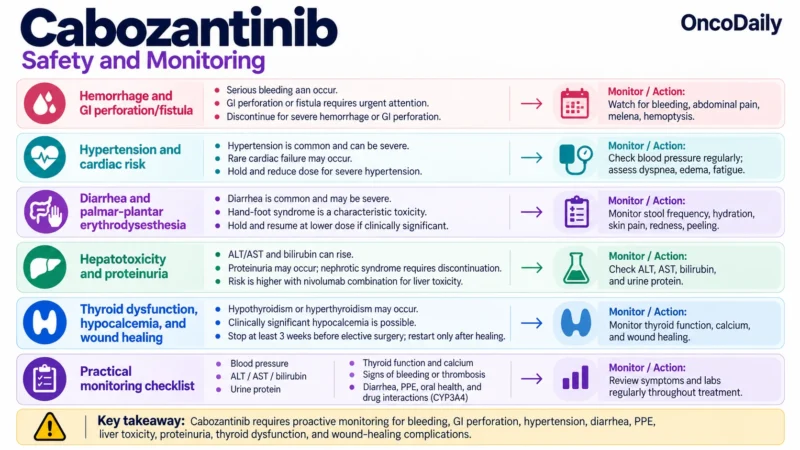
Monitoring during cabozantinib therapy should include:
- Blood pressure
- ALT
- AST
- Bilirubin
- Urine protein
- Thyroid function
- Calcium
- Electrolytes as clinically appropriate
- Signs of bleeding
- Signs of arterial and venous thrombosis
- Cardiac symptoms
- Diarrhea severity
- Palmar-plantar toxicity
- Oral/dental health
- Symptoms of fistula or GI perforation
- Neurologic symptoms suggesting PRES/RPLS
- Wound healing
- CYP3A4 drug interactions
- Pregnancy status when appropriate
- Immune-mediated toxicity when combined with nivolumab.
FAQ
What Is Cabozantinib Used For?
- Advanced RCC
- First-line RCC with nivolumab
- Previously treated HCC
- Previously VEGFR-treated radioactive iodine-refractory DTC
- Previously treated pNET and epNET
- Progressive metastatic MTC with the Cometriq capsule formulation.
What Is the Standard Cabometyx Dose?
What Is the Dose With Nivolumab?
Should Cabozantinib Be Taken With Food?
Cabometyx should be taken:
At least 1 hour before or 2 hours after eating.
How Does Cabozantinib Work?
VEGFR2, MET, AXL, and RET
thereby reducing angiogenesis, tumor growth, invasion, and metastatic signaling.
What Did METEOR Show?
3.8 to 7.4 months
versus everolimus and improved median OS from:
16.5 to 21.4 months.
What Did CheckMate 9ER Show?
- Median PFS 16.4 vs 8.3 months
- Median OS 46.5 vs 35.5 months
- ORR 55.7% vs 27.4%
versus sunitinib.
What Did CABINET Show?
- 8.4 vs 3.9 months in epNET
- 13.8 vs 4.4 months in pNET.
What Are the Dose Reductions?
60 mg → 40 mg → 20 mg once daily.
Are Cabometyx and Cometriq Interchangeable?
The tablet and capsule formulations should not be substituted for one another.