Key takeaways
- Supportive and palliative care should begin early and alongside active cancer treatment, not only at the end of life.
- Every cancer center should have a basic psychosocial pathway built around distress screening, support, referral, and follow-up.
- Survivorship brings its own challenges, including fear of recurrence, fertility concerns, identity changes, relationship difficulties, and returning to everyday life.
- In resource-limited settings, community networks, peer support, caregivers, and trained non-specialists can help extend supportive care when specialist services are scarce.
- Psychosocial support should be treated as a routine part of oncology, with models that are affordable, culturally appropriate, and sustainable within local communities.
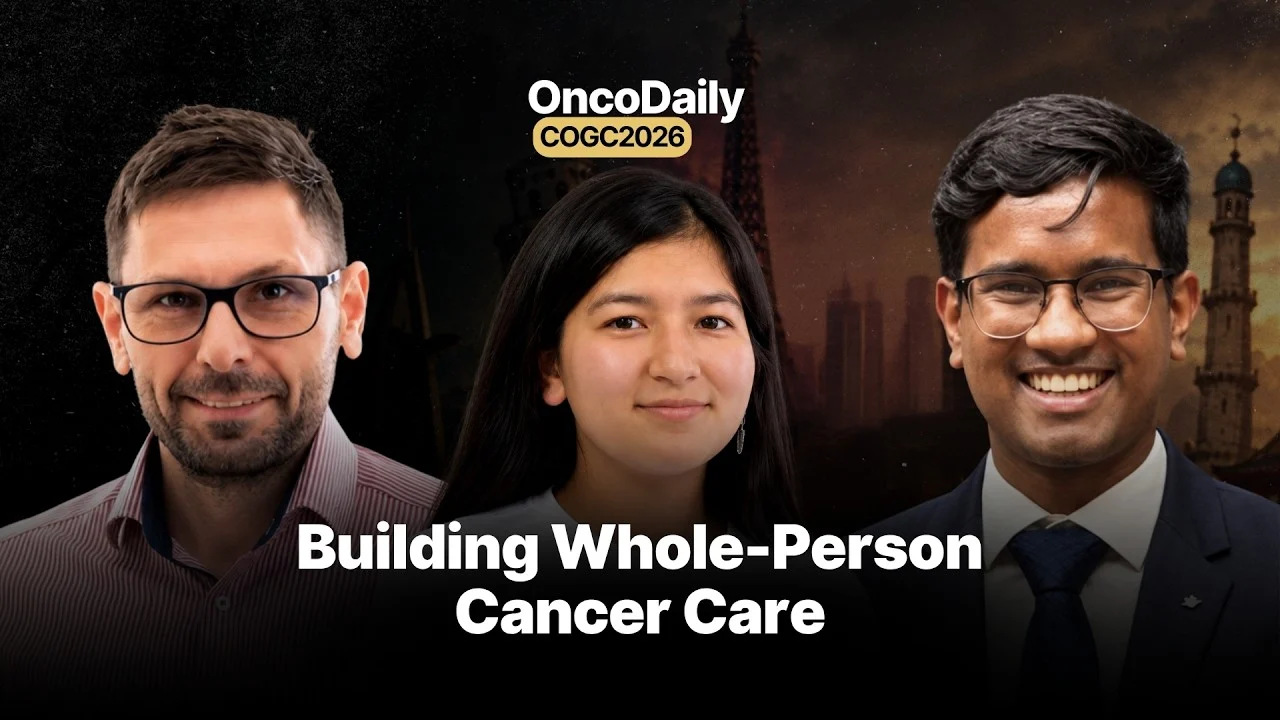
At the Community Oncology Global Congress (COGC 2026), organized by OncoDaily, Nancy Hart Wicker, CEO and CMO For Hospice and Palliative Care of the Piedmont, led a discussion with Adrian Pogacian, Founder of INCKA Psycho-oncology Center; Vijay C, Psycho-Oncologist, Manipal Hospice and Respite Care Centre (MHRCC), MAHE; and Terisa Tamang, Founder, President and Counselor of Dhairya Cancer Foundation, on what cancer care needs beyond chemotherapy, radiation, and surgery.
Their discussion moved across psycho-oncology, palliative care, survivorship, rehabilitation, nutrition, caregiver support, rural access, community-based programs, reimbursement, and artificial intelligence.
But the central question was simpler: what happens to the person and family while cancer is being treated – and after treatment ends?
Cancer Brings More Than One Diagnosis
Pogacian noted that decades of work in psycho-oncology have expanded the understanding of a cancer diagnosis
“We arrived after 40 years talking about two diagnoses: one is medical and one is emotional.”
In many places, he argued, the second diagnosis is still poorly addressed.
Vijay described the problem as both clinical and structural. In lower-resource settings, access to oncology-trained mental health professionals may be unrealistic, but even a basic stepped-care pathway – where patients can move from community support to more specialized care as needed – may be missing.
Tamang brought the discussion back to what patients and families experience in everyday life.
“Medical treatment may address the disease, but the patient is still experiencing the fear, anxiety, uncertainty, financial stress, and changes in the family relationships.”
And that burden does not stop with the patient.
Caregivers may be managing appointments, finances, practical responsibilities, and their own emotional distress at the same time.
“Cancer care needs to ask two questions: how is the disease being treated, and how are the person and the family coping with the experience?”
Wicker added another layer from rural South Carolina: transportation, isolation, and lack of social support can determine whether patients are able to access treatment at all.
Palliative Care Should Begin Before the Final Days
The panel repeatedly returned to one of the most persistent misconceptions in cancer care: that palliative care means treatment is ending.
Vijay described seeing referrals made across the entire spectrum, from early in the disease course to the final days of life.
The difference, he said, is substantial.
“When the treating team makes an early referral to the palliative care or supportive care department, their symptoms are more effectively managed.”
Late referral can create confusion and distrust, particularly if patients and families interpret the transfer as a signal that the oncology team has nothing left to offer.
“Making a referral early on actually means that they’re going above and beyond for the patient and the family.”
Tamang made a similar point from Nepal, where physical treatment can dominate the consultation while emotional distress receives much less attention.
A simple question such as “How are you feeling?” may still be missing from care.
Pogacian described the same problem in Romania and Eastern Europe.
“We have a problem of understanding the term because palliative care is often understood as end-of-life care. But palliative care begins at the moment of diagnosis… it is not about that. It is a more complex concept.”
Across the discussion, palliative care was framed not as a marker that treatment has failed, but as part of cancer care itself – something that can begin early, alongside active treatment, and continue as patients’ needs change.
Every Cancer Center Needs a Minimum Psychosocial Package
When Wicker asked what every community cancer center should be able to provide, Tamang did not describe an ideal multidisciplinary service.
She described a minimum package.
“At minimum, every community cancer center should have the way to identify psychosocial distress, someone trained to provide basic psychosocial support, and a clear referral pathway.”
That pathway should include more specialized psychological or psychiatric care when needed, caregiver support, and follow-up.
In settings without large specialist teams, she supported a stepped-care model in which appropriately trained staff or community workers provide basic support and refer more complex cases onward.
“Psychosocial care needs to be part of the cancer care pathway rather than something the patient has to find by themselves.”
Her framework was straightforward: screen, support, refer, and follow up.
Pogacian added something even more basic.
“You should have kindness. I understand that we face a disease that is still very, very hard to manage. But to be kind does not cost anything. And from kindness we can go to communication, which is lacking in every component of oncology care, especially after the treatment is over.”
Wicker agreed that waiting for a specialist who may never arrive is not a workable strategy. Existing nurses, clinicians, and community staff can be trained to identify distress and provide basic support.
Vijay added that even oncologists and nurses can be taught simple screening approaches that take only minutes.
Change the Way We Talk About Palliative Care
If patients hear “palliative care” and interpret it as “there is nothing more we can do,” referral will always be difficult.
Vijay said one practical approach is to frame it as supportive care – a team that helps manage symptoms, pain, treatment effects, and quality of life.
“Mentioning it as supportive care instead of palliative care reduces the anxiety of uncertainty.”
Tamang described it as an additional layer of support.
“Palliative care doesn’t mean giving up treatment. It means adding another layer of care to help the patient.”
Pogacian offered a different communication lesson.
Early in his career, he would meet patients by asking what he could do for them.
Later, after training with Prof. William Breitbart, he changed the question.
“What is the most important thing for you?”
For Pogacian, that small shift matters because cancer can leave people feeling that they have lost control over their own lives.
Asking what matters to them gives some of that control back.
“I can still choose what I want to do further.”
Wicker described another strategy: normalization.
Rather than introducing palliative care only when disease is worsening, clinicians can explain that everyone with a similar cancer receives this added layer of support.
If early referrals become routine and patients experience real benefits, the meaning of palliative care may gradually change within the community itself.
Survivorship Creates a New Set of Problems
Completing treatment does not necessarily mean returning to the life a patient had before cancer.
Vijay described different survivorship needs across the lifespan.
Children may experience growth and neurocognitive effects after treatment. Adolescents may face fertility concerns, disrupted education, sexuality and body-image issues, and financial strain on their families. Adults may face fertility problems, relationship changes, and difficulties returning to work. Older patients may struggle to regain independence and a sense of control over everyday life.
Tamang described another persistent concern among younger survivors in Nepal: fear of recurrence.
“What will happen if I’ll have cancer again?”
For young adults, survivorship may also bring questions about marriage, fertility, identity, appearance, relationships, work, and the future.
Pogacian focused on a different transition: leaving the hospital.
During treatment, patients and caregivers may feel protected by regular access to clinicians. Going home can suddenly remove that sense of security.
“What is happening in the first few days when I’m at home?”
He also described the challenge of rebuilding identity after cancer – whether the survivor feels like an active participant in a new life or simply a witness to it.
These are not secondary concerns. They are part of survivorship itself.
Supportive Care Can Determine Whether Treatment Is Possible
Nutrition, rehabilitation, mental health, and social services were also discussed as components that can directly affect cancer outcomes.
Wicker put it simply: for the right patient, these services may be prerequisites for receiving treatment.
A patient who cannot get to the clinic cannot receive chemotherapy.
A patient weakened by illness who cannot access rehabilitation may struggle to tolerate therapy.
Poor nutrition or untreated psychological distress can create additional barriers.
Pogacian emphasized rehabilitation in particular, arguing that it should not automatically wait until treatment is finished.
“Rehabilitation… should begin at the moment of diagnosis. Do not wait for the treatment to end.”
Vijay similarly described nutritional support, physiotherapy, and occupational therapy as ways to reduce weight loss, weakness, fatigue, and other problems that can interfere with treatment and recovery.
His conclusion was that these disciplines work best when they are integrated from diagnosis rather than added only after a problem becomes severe.
In Rural Settings, Innovation May Mean Using What Already Exists
For patients living far from specialist centers, supportive care becomes even harder to deliver.
But Tamang argued that innovation in those settings does not necessarily mean expensive technology.
“Innovative doesn’t always mean expensive technology or a completely new health system.”
In Nepal, Dhairya Cancer Foundation has worked with hospitals, community organizations, shelters, caregivers, peer-support initiatives, and art-based activities for children with cancer.
These services do not replace clinical care.
They fill needs the clinical system cannot meet alone.
Wicker described a similar idea in South Carolina through an advanced illness doula program, in which trained non-medical peers provide emotional support to patients.
She said the response from volunteers, including cancer survivors, had been stronger than expected.
Tamang also acknowledged the limits of relying on volunteerism.
Mental health services in Nepal remain constrained by funding and stigma, and volunteer psychologists and counselors can only reach a limited number of patients.
“We are able to provide the services only for certain cancer patients.”
For Pogacian, the issue goes beyond the individual patient.
“Cancer is a community disease. It is not a personal disease.”
Supportive care therefore requires a closer relationship between health systems and the communities around them.
The Future Is Making Support Routine, Not Optional
When Wicker asked the panel what they would change if they could redesign supportive, palliative, and survivorship care, Tamang returned to psychosocial support.
“My biggest hope is for psychosocial support to become a routine part of cancer care rather than an optional service.”
She envisioned basic distress screening, communication, caregiver support, and clear referral pathways in every cancer center, with models adapted to local resources rather than copied wholesale from high-income settings.
“We need models that are evidence-based… affordable and culturally appropriate, as well as sustainable with local communities.”
Vijay described a similar goal from India: access to quality healthcare and education should be universal, while support models should be adapted to cultural and community structures.
He cited the Dawa-Dua model, in which psychiatric care works alongside spiritual support in culturally familiar settings, as an example of how services can be integrated into communities rather than imposed from outside.
Wicker raised another practical barrier: reimbursement.
Cancer systems readily reimburse chemotherapy and radiation because those services fit established payment structures.
Social work, chaplaincy, psychosocial care, and other supportive services often do not.
“We know that people who are supported spiritually and with psychosocial support do better. So then let’s reimburse for those services so we can add them more readily to our program.”
Without financial models that value those services, integration will remain difficult even when clinicians understand their importance.
Dignity Still Has to Be at the Center
As the discussion closed, Vijay reduced the conversation to something more fundamental than any specific service.
“Dignity of the patient and the family has to be at the center of everything.”
And dignity, he argued, is not solely the physician’s responsibility.
It extends across the entire cancer center – from clinicians and social workers to receptionists and support staff.
Pogacian ended on another principle.
“There is hope in this field of oncology.”
Fear, uncertainty, treatment effects, and the possibility of recurrence do not disappear when the treatment plan is written.
The panel’s argument was that supportive care should be built around those realities from the beginning, helping patients and families manage symptoms, distress, practical burdens, and the loss of control that can come with cancer.
In the final minutes of the session, the discussion turned briefly to artificial intelligence and whether it could help identify supportive and palliative care needs earlier.
Wicker described an Epic-based tool being piloted in her healthcare system that is intended to identify medically complex, high-risk patients and prompt clinicians to consider whether they could benefit from palliative care. She was careful not to overstate its role, noting that the pilot was still underway and that she could not yet comment on its effectiveness.
Pogacian saw a potential role for AI in helping psychologists and other clinicians recognize needs earlier and save time, particularly if tools and applications can support earlier intervention.
The exchange came at the end of a discussion that had focused much more heavily on the human and organizational parts of supportive care. Across the session, the speakers had returned to psychosocial distress, communication, caregiver burden, rehabilitation, nutrition, rural access, survivorship, and the stigma that still surrounds palliative and mental health care in many settings.
For Tamang, the priority was to make psychosocial support a routine part of cancer care rather than an optional service, with screening, basic support, caregiver involvement, and clear referral pathways that continue into survivorship. She also argued that models developed for resource-limited settings need to be affordable, culturally appropriate, and sustainable within local communities.
Vijay placed dignity and quality of life at the center of that work, extending responsibility beyond physicians to the wider care team.
Pogacian returned to hope, communication, and the emotional experience of cancer, while Wicker pointed to a more structural barrier: services such as social work, chaplaincy, and psychosocial support are often harder to sustain when reimbursement systems continue to place greater financial value on cancer treatment itself.
Their comments reflected the breadth of what supportive cancer care can involve – from symptom management and palliative care to mental health, rehabilitation, caregiver support, survivorship, and practical help with the challenges that continue alongside treatment and after it ends.
Written by Eliz Baloyan, MD, Features Writer and Editor at OncoDaily and CancerWorld