Key takeaways
- CML treatment has transformed long-term survival, allowing many patients receiving effective TKI therapy to achieve a life expectancy approaching that of the general population.
- Molecular response milestones guide personalized treatment decisions, helping clinicians assess treatment effectiveness, recognize inadequate responses, and adjust therapy when necessary.
- Treatment-free remission is becoming an achievable goal for selected patients, offering the possibility of living without continuous TKI therapy while maintaining disease control through careful monitoring.
- Medication adherence and drug interactions are critical to treatment success, and both should be evaluated before concluding that a patient has developed resistance.
- Asciminib is expanding treatment possibilities in CML, offering a distinct mechanism of action for resistant disease and promising results as a frontline treatment.
At LeukO 2026: Global Virtual Congress on Leukemias, organized by OncoDaily, Maha AlDoughaim, Assistant Professor at the College of Pharmacy, King Saud bin Abdulaziz University for Health Sciences (KSAU-HS), and Adult Oncology Clinical Pharmacist at the Ministry of National Guard Health Affairs in Saudi Arabia, explored the evolving treatment landscape of chronic myeloid leukemia (CML), including long-term survival, treatment-free remission, resistance management, and emerging therapeutic strategies.
The introduction of tyrosine kinase inhibitors (TKIs) transformed CML from a frequently fatal disease into a chronic condition that can often be managed successfully for decades. Today, many patients receiving effective treatment can achieve a life expectancy approaching that of the general population.
But as survival has improved, the questions shaping CML care have changed. Clinicians must now consider not only how to achieve disease control, but also how to maintain it with fewer complications, identify patients who may safely discontinue treatment, and overcome resistance when established therapies no longer work.
Through landmark clinical trials, real-world evidence, and recent developments in targeted therapy, AlDoughaim examined how these priorities are redefining the management of chronic-phase CML.
From a Life-Threatening Disease to Near-Normal Life Expectancy
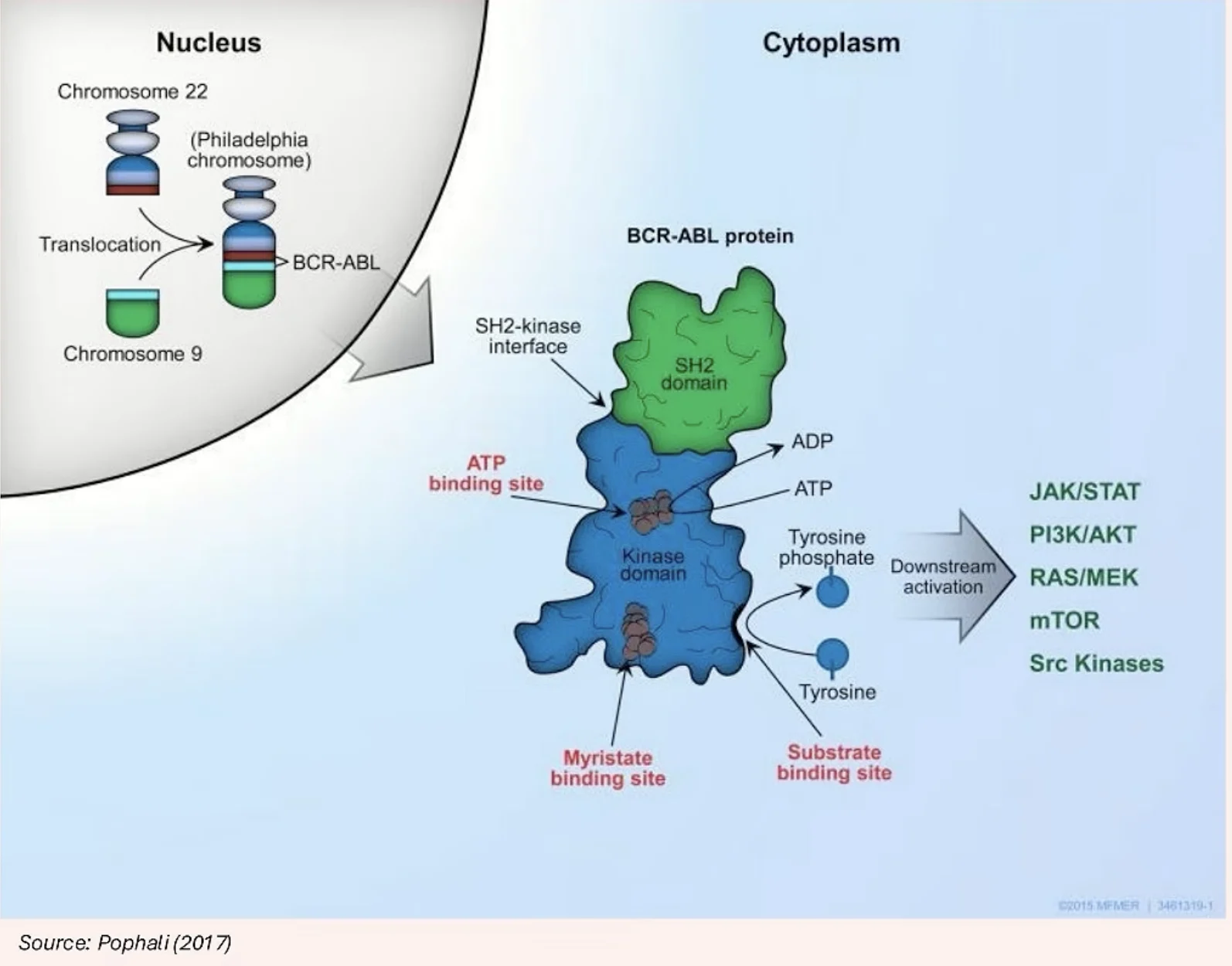
CML develops as a result of a reciprocal translocation between chromosomes 9 and 22, creating the Philadelphia chromosome and the BCR::ABL1 fusion gene. The resulting protein has continuously active tyrosine kinase activity, driving abnormal cell proliferation and the development of leukemia.
Many patients are diagnosed incidentally following routine blood testing, although symptoms such as fatigue, early satiety associated with splenomegaly, weight loss, and night sweats may also occur.
Confirmation of the diagnosis relies on detecting BCR::ABL1, while baseline investigations and risk stratification help guide treatment decisions.
AlDoughaim focused primarily on chronic-phase CML, where treatment outcomes have changed dramatically since the introduction of imatinib in the early 2000s.
Before TKIs, available therapies included interferon-based approaches and conventional cytotoxic agents, which were generally less effective and often associated with substantial toxicity.
The development of drugs that directly inhibit BCR::ABL1 changed that outlook.
Long-term follow-up from landmark clinical trials has demonstrated five-year survival rates ranging from approximately 89% to 96%, with several studies reporting survival rates of approximately 83% to 90% at ten years.
Population-based registries have also documented major improvements in survival as these therapies became more widely available.
AlDoughaim highlighted data from MD Anderson Cancer Center demonstrating how survival outcomes have improved across successive treatment eras. For many patients with chronic-phase CML receiving effective TKI therapy, life expectancy can now approach that of individuals without the disease.
However, she also drew attention to an important distinction between the outcomes observed in clinical trials and those experienced by patients in everyday practice.
Real-world studies suggest that healthcare access, insurance coverage, and other social determinants of health continue to influence survival.
In the United States, for example, patients without health insurance have experienced worse outcomes than those with coverage.
The effectiveness of modern CML therapies is therefore only part of the equation. Patients must also be able to access treatment, undergo molecular monitoring, and remain on an appropriate therapeutic regimen over time.
As long-term survival becomes an increasingly realistic expectation, treatment goals have begun to extend beyond keeping the disease under control.
The Color-Coded Roadmap to Treatment Response
Achieving long-term disease control in CML requires more than selecting an effective TKI. Clinicians must also monitor how patients respond to treatment and determine whether they are reaching the expected molecular milestones.
AlDoughaim presented a color-coded chart illustrating the different levels of treatment response, with green, yellow, orange, and red categories helping clinicians interpret response patterns over time.
These milestones, based on BCR::ABL1 molecular monitoring, provide a framework for distinguishing favorable responses from results that warrant closer observation or additional intervention.
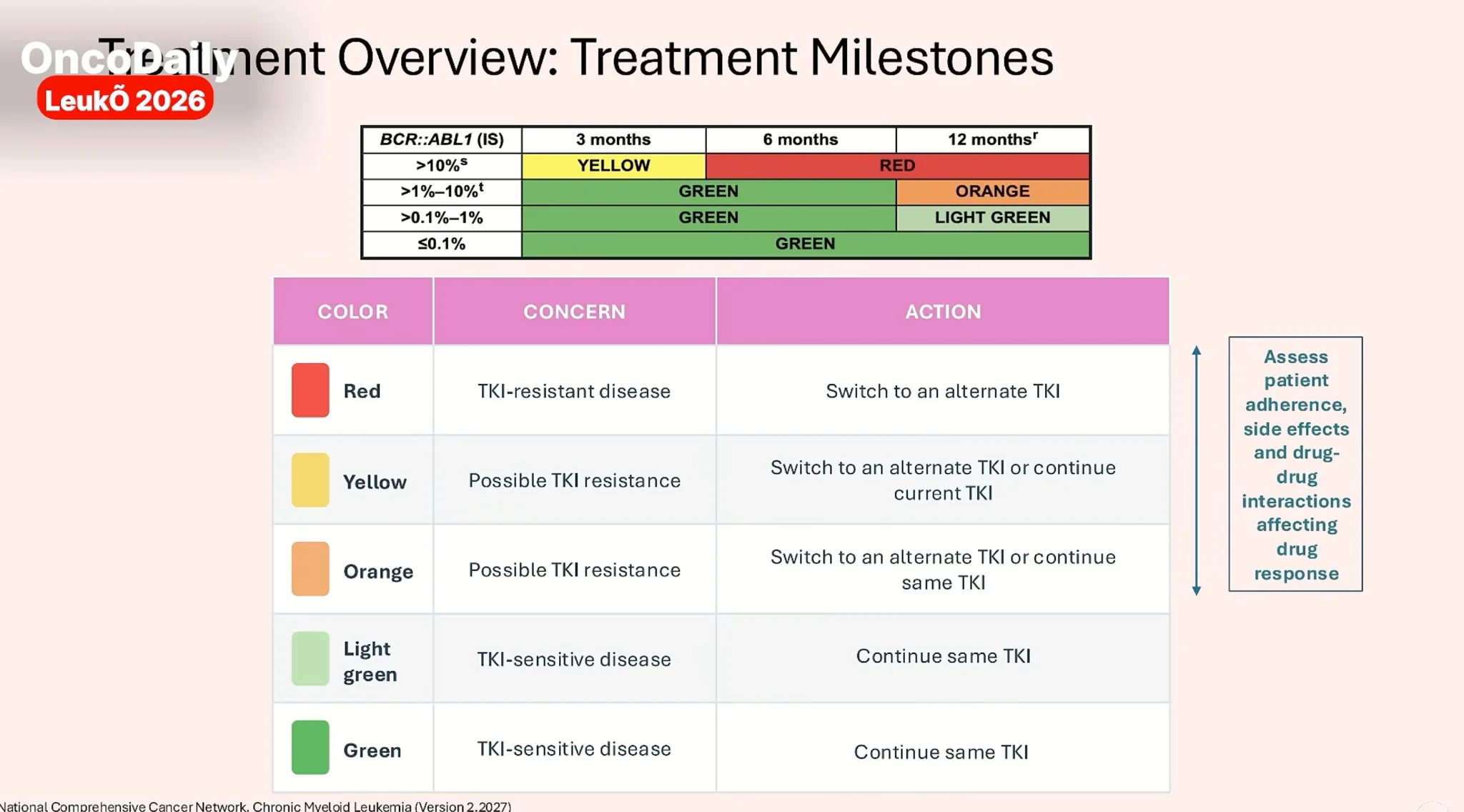
Importantly, an unfavorable molecular response does not always indicate biological resistance to treatment.
AlDoughaim emphasized that when patients fail to reach expected milestones, clinicians should first consider factors such as medication adherence and potential drug–drug interactions, both of which can significantly affect TKI effectiveness.
Depending on the clinical situation, further assessment may include repeat molecular testing, BCR::ABL1 kinase domain mutation analysis, or a change in treatment strategy.
The color-coded milestones therefore serve as more than a visual representation of treatment response. They help clinicians recognize when treatment is progressing as expected and when a more detailed investigation is needed.
The Next Goal: Life Without Continuous Treatment
One of the most significant developments in CML management is treatment-free remission (TFR), the possibility of discontinuing TKI therapy while maintaining molecular disease control.
For patients who have spent years taking medication every day, treatment-free remission can offer a meaningful change in quality of life.
Although TKIs are generally effective, long-term treatment may be associated with persistent adverse effects, including fatigue, gastrointestinal symptoms, muscle discomfort, and other complications that can affect daily activities.
Discontinuation may also be particularly important for selected patients considering pregnancy or family planning, provided this takes place through an individualized management plan.
But treatment-free remission is not appropriate for every patient.
AlDoughaim emphasized that careful selection and reliable molecular monitoring are essential before attempting treatment discontinuation.
Eligible patients generally need to have remained in chronic phase, received TKI therapy for an adequate period, and maintained a sustained deep molecular response (DMR).
Importantly, deep molecular response is more stringent than major molecular response (MMR). Contemporary recommendations generally require a prolonged MR4-level response or deeper, with the exact duration of treatment and response determined by the applicable guidelines and individual patient characteristics.
Patients must also have access to high-quality quantitative BCR::ABL1 PCR testing, particularly during the first year after discontinuation, when molecular recurrence is most likely.
Evidence from studies of imatinib, dasatinib, and nilotinib discontinuation has demonstrated that approximately 40% to 50% of appropriately selected patients can maintain treatment-free remission, although success rates vary according to the study population and follow-up duration.
AlDoughaim highlighted the long-term experience with nilotinib, in which more than 40% of patients remained in treatment-free remission at five years.
These findings demonstrate that treatment discontinuation can provide sustained freedom from therapy for a meaningful proportion of patients.
However, TFR does not mean that CML has necessarily been eradicated.
Patients continue to require molecular surveillance, and loss of MMR generally prompts reintroduction of TKI therapy. Most patients who restart treatment regain their molecular response.
This makes treatment-free remission a carefully monitored clinical strategy rather than a permanent discharge from leukemia care.
What Happens After Treatment Stops?
Discontinuing TKIs can also produce symptoms that patients and clinicians need to anticipate.
AlDoughaim discussed TKI withdrawal syndrome, characterized primarily by musculoskeletal symptoms such as myalgia, arthralgia, bone pain, and, in some cases, pruritus.
These symptoms commonly develop during the first several weeks or months after treatment cessation.
Evidence from discontinuation studies, including LAST and EURO-SKI, suggests that most cases are mild to moderate and improve over time.
In the LAST study, approximately 80% of patients experiencing withdrawal symptoms reported improvement during follow-up.
Management may include reassurance, symptomatic treatment with appropriate analgesics or nonsteroidal anti-inflammatory drugs, and occasionally short courses of corticosteroids for more troublesome symptoms.
Recognizing these effects is important when counseling patients who are otherwise good candidates for TFR.
The objective is not simply to stop medication, but to ensure that patients understand the monitoring requirements, potential symptoms, and circumstances under which treatment may need to resume.
When Treatment Stops Working: Look Beyond the Mutation
Despite the success of TKI therapy, not every patient achieves the expected molecular response, and some experience loss of response after initially responding well.
AlDoughaim distinguished between primary resistance, in which patients fail to achieve treatment milestones, and secondary resistance, which develops after an initial response.
Both situations require careful assessment before a treatment change is made.
Molecular monitoring provides the foundation for identifying inadequate responses, but an unfavorable BCR::ABL1 result does not automatically mean that the leukemia has acquired a resistant mutation.
One of the first considerations should be treatment adherence.
CML therapy depends on consistent medication exposure, and missed doses can significantly reduce the likelihood of achieving optimal molecular responses.
AlDoughaim referenced findings from the ADAGIO study illustrating the relationship between adherence and treatment success.
She summarized the importance of patient education with a straightforward message:
“Every dose counts towards achieving a complete response.”
For clinicians, this means that patients should be actively involved in treatment decisions and receive practical support in maintaining their prescribed regimen.
The second consideration is drug–drug interactions.
Many CML TKIs are affected by CYP3A4–mediated metabolism, and some are also sensitive to changes in gastric acidity.
Concomitant medications, including proton pump inhibitors, H2-receptor antagonists, and antacids, can interfere with the absorption of certain TKIs. The clinical significance depends on the specific agent and how the medications are administered.
These interactions are particularly relevant because patients with CML frequently require treatment for other chronic medical conditions.
A thorough medication review can therefore identify potentially correctable reasons for an inadequate response.
Only after evaluating adherence, interactions, and other clinical factors should treatment resistance be interpreted in the broader context of disease biology.
When appropriate, BCR::ABL1 kinase domain mutation testing can identify alterations that influence sensitivity to different TKIs and help guide subsequent treatment selection.
For patients receiving imatinib, switching to a more potent alternative may be appropriate when treatment failure is confirmed.
Dose escalation has also been investigated, but AlDoughaim noted that this strategy can increase toxicity and may not provide durable control, making it less attractive when other effective agents are available.
The broader lesson is that treatment failure should prompt a structured investigation rather than an automatic switch to another drug.
T315I: A Mutation That Changed the Treatment Strategy
Among the mechanisms of resistance in CML, the BCR::ABL1 T315I mutation remains particularly important.
Commonly referred to as the gatekeeper mutation, T315I changes the ATP-binding region of the BCR::ABL1 kinase, preventing several established TKIs from binding effectively.
It confers resistance to imatinib and the commonly used second-generation inhibitors, including dasatinib, nilotinib, and bosutinib.
Historically, the emergence of this mutation created a particularly difficult treatment situation.
However, newer agents have expanded the available options.
AlDoughaim highlighted asciminib, a first-in-class STAMP inhibitor that targets BCR::ABL1 through a different mechanism.
Unlike conventional ATP-competitive TKIs, asciminib binds to the ABL myristoyl pocket, an allosteric site distinct from the ATP-binding region.
This mechanism allows asciminib to inhibit BCR::ABL1 activity even in certain situations where mutations interfere with conventional TKI binding.
For patients with chronic-phase CML harboring T315I, the approved asciminib regimen is 200 mg twice daily, a higher dose than the standard regimen used in other chronic-phase CML settings.
AlDoughaim discussed the multicenter Phase I X2101 study, which provided evidence supporting asciminib use in patients with T315I-mutated disease.
Among 45 patients treated at the T315I-specific dose, approximately half achieved major molecular response during extended follow-up.
These results provided an important additional option for patients whose disease was resistant to several earlier TKIs.
Ponatinib, a third-generation ATP-competitive inhibitor, is another important treatment option for T315I-positive CML and for selected patients with resistance to multiple prior TKIs.
Choosing between asciminib and ponatinib requires consideration of mutation status, previous treatment exposure, comorbidities, adverse-effect profiles, and treatment availability.
Ponatinib, in particular, requires careful cardiovascular risk assessment because of its association with arterial occlusive events.
AlDoughaim also discussed compound BCR::ABL1 mutations, in which multiple mutations occur within the same leukemic clone.
Certain compound mutations, particularly those involving T315I, can reduce sensitivity to available agents, including ponatinib or asciminib.
However, not all compound mutations confer the same resistance profile. Their clinical implications depend on the specific combination, making molecular characterization and individualized treatment selection essential.
Asciminib Moves Into the Frontline Setting
Although asciminib initially emerged as a valuable treatment for patients with resistant or previously treated CML, its role has expanded into newly diagnosed disease.
AlDoughaim highlighted the Phase III ASC4FIRST trial, which compared asciminib with investigator-selected TKIs in patients with newly diagnosed chronic-phase CML.
The comparator treatments included imatinib and second-generation agents such as dasatinib, nilotinib, and bosutinib.
The trial demonstrated higher rates of major molecular response with asciminib.
At 48 weeks, 68% of patients receiving asciminib achieved MMR, compared with 49% of patients treated with investigator-selected TKIs.
These findings supported the FDA’s accelerated approval of asciminib for newly diagnosed Philadelphia chromosome-positive chronic-phase CML in October 2024.
Longer follow-up has strengthened the clinical evidence.
At 96 weeks, 74.1% of patients receiving asciminib achieved MMR, compared with 52.0% in the combined comparator group.
Asciminib also demonstrated favorable tolerability, with fewer treatment modifications due to adverse events than some comparator regimens.
The comparison with second-generation TKIs alone showed a numerical advantage in molecular response, although that particular secondary analysis was not designed to establish definitive statistical superiority.
These results suggest that asciminib may offer an important combination of efficacy and tolerability as an initial treatment option.
For patients who may require therapy over many years, the tolerability of treatment is a particularly important consideration.
Deeper molecular responses may also influence future opportunities for treatment-free remission, although longer follow-up will be required to determine how frontline asciminib affects long-term discontinuation outcomes.
Its growing role reflects a broader shift in CML management, in which clinicians increasingly have several effective frontline options and can tailor treatment according to individual patient characteristics and priorities.
A Smarter Approach to Ponatinib Dosing
Another important development concerns how ponatinib is administered in patients with resistant CML.
Although ponatinib is highly active against several resistant BCR::ABL1 variants, including T315I, its use has been limited by concerns about cardiovascular toxicity.
This has created an important treatment question: can patients receive sufficient drug exposure to achieve disease control while reducing the risks associated with prolonged higher-dose treatment?
AlDoughaim highlighted the long-term findings from the Phase II OPTIC trial, published in Leukemia in July 2026.
The study evaluated different starting doses of ponatinib and a response-adapted treatment strategy in patients with chronic-phase CML who had resistant disease or a T315I mutation.
One approach involved starting ponatinib at 45 mg daily and reducing the dose to 15 mg daily once patients achieved a BCR::ABL1 level of 1% or lower on the International Scale.
This threshold is distinct from MMR, which requires a BCR::ABL1 level of 0.1% or lower.
The five-year analysis demonstrated that response-adapted dosing could provide durable molecular responses while helping optimize the balance between efficacy and treatment-related toxicity.
The 45 mg starting-dose group achieved the highest molecular response rates, particularly among patients with T315I-mutated CML.
These findings reinforce the importance of adapting treatment intensity according to both molecular response and individual safety considerations.
Rather than viewing treatment dose as fixed throughout the course of therapy, clinicians can increasingly consider carefully monitored adjustments that preserve disease control while reducing unnecessary drug exposure.
For a disease requiring prolonged management, this approach represents another opportunity to improve the long-term treatment experience.
The Future of CML Care Is Increasingly Individualized
The treatment landscape of CML has evolved considerably since imatinib first transformed clinical outcomes.
Patients who once faced a life-threatening diagnosis can now often expect prolonged survival, and for some, sustained molecular responses have made carefully monitored treatment discontinuation possible.
Meanwhile, newer agents such as asciminib have expanded options both for newly diagnosed patients and for those with treatment resistance. Long-term data from studies such as ASC4FIRST and OPTIC are also helping clinicians refine treatment choices and dosing strategies.
But these advances have made individualized decision-making more important, not less.
The optimal approach depends on much more than the availability of a particular drug. It requires accurate molecular monitoring, careful interpretation of response milestones, assessment of adherence and drug interactions, mutation-directed treatment when necessary, and ongoing consideration of tolerability and quality of life.
AlDoughaim’s presentation reflected how much the priorities of CML management have changed.
The goal is no longer simply to help patients live longer with leukemia. It is to help them live well, with effective disease control, fewer treatment-related burdens, and, when appropriate, the possibility of living without continuous therapy.
As new evidence continues to emerge, the next chapter of CML care will increasingly depend on identifying the right treatment, for the right patient, at the right time.
Written by Eliz Baloyan, MD, Features Writer and Editor at OncoDaily and CancerWorld