Key takeaways
- CD7-directed CAR-T therapy is opening new possibilities for patients with relapsed or refractory T-ALL, demonstrating high early remission rates in patients with limited treatment options.
- Universal base-edited CAR-T cells represent a promising advance in cellular immunotherapy, using genetic engineering to overcome T-cell fratricide and support the development of ready-to-use therapies.
- Achieving remission is only the beginning, as preventing relapse and maintaining durable disease control remain major challenges following CAR-T treatment.
- New targeted approaches are expanding treatment possibilities, with agents such as nelarabine, daratumumab, and venetoclax-based combinations offering additional strategies for selected patients.
- Managing immune-related complications is essential to improving CAR-T outcomes, particularly prolonged T-cell aplasia, infections, cytopenias, and delayed immune recovery.
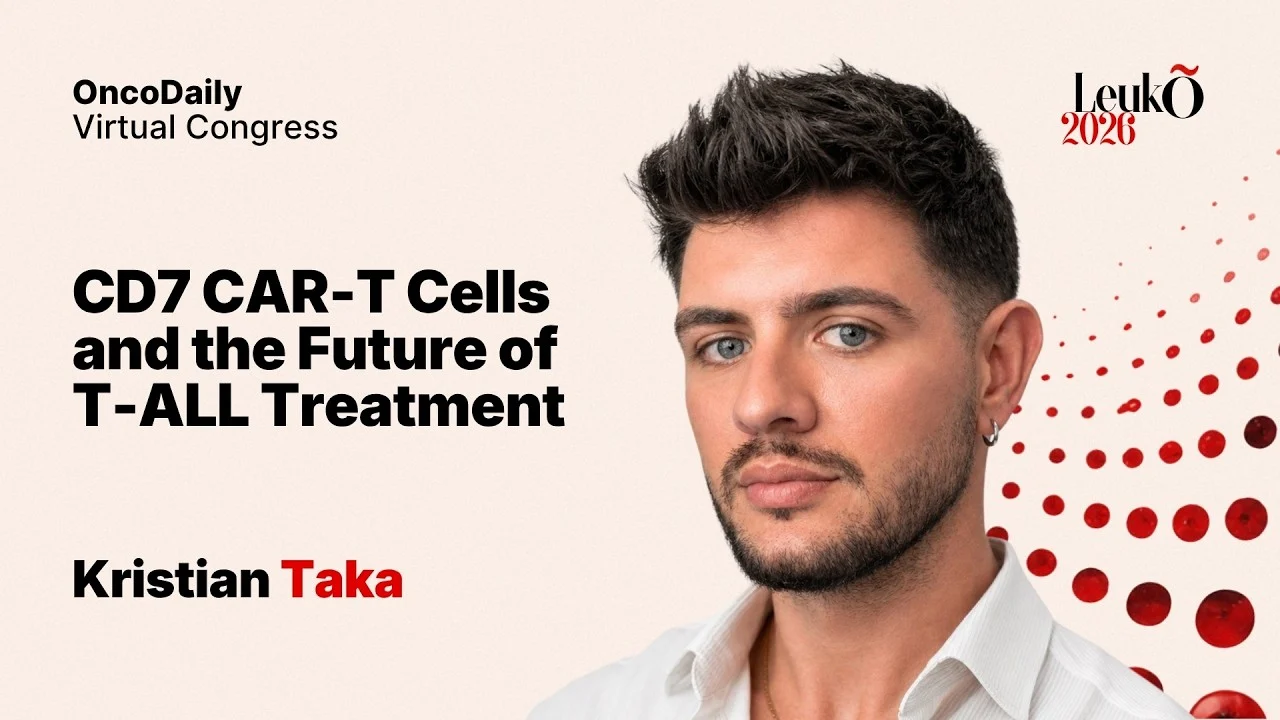
At LeukO 2026: Global Virtual Congress on Leukemias, organized by OncoDaily, Kristian Taka, Hematology Resident in the Department of Oncohematology at Policlinico Tor Vergata and Clinical Trainee in Pediatric Hematology-Oncology at Bambino Gesù Children’s Hospital in Rome, Italy, explored the challenges of treating T-cell acute lymphoblastic leukemia (T-ALL), with particular attention to emerging targeted therapies, CD7-directed CAR-T cells, and the development of universal base-edited cellular therapies.
Although treatment outcomes for pediatric T-ALL have improved considerably, relapsed or refractory disease remains difficult to manage, particularly in adults. Conventional salvage therapies frequently fail to produce lasting responses, leaving many patients with limited opportunities to proceed to potentially curative treatment.
Recent advances in CAR-T technology are beginning to change that picture. Early studies of CD7-directed therapies have demonstrated remarkable remission rates, but they have also introduced important questions about treatment durability, immune recovery, and the role of stem cell transplantation.
For Taka, the challenge is no longer simply whether CAR-T therapy can induce remission in T-ALL, but how to turn those early responses into sustained disease control.
Why T-ALL Remains a Difficult Disease to Treat
T-cell acute lymphoblastic leukemia accounts for approximately 10-15% of childhood acute lymphoblastic leukemia and around 20% of adult ALL cases.
Despite substantial improvements in pediatric outcomes, the prognosis remains less favorable in adults and particularly challenging after relapse or failure of initial treatment.
One difficulty lies in the biological complexity of T-ALL.
The disease develops through multiple cooperating genetic alterations involving T-cell development, cellular proliferation, and survival. These include abnormalities affecting NOTCH1 signaling, T-cell receptor pathways, CDKN2A, PTEN, and other genes involved in leukemic progression and treatment resistance.
The classification of T-ALL has become increasingly sophisticated, with the World Health Organization and International Consensus Classification recognizing distinct biological and genetic subgroups, including early T-cell precursor ALL (ETP-ALL).
However, these advances have not yet translated into a universally accepted molecular risk model that can reliably guide treatment decisions for every patient.
For now, measurable residual disease (MRD), clinical response, and established protocol-specific risk criteria remain essential tools for evaluating prognosis and adapting therapy.
Frontline treatment continues to rely predominantly on intensive multiagent chemotherapy, combining drugs such as corticosteroids, vincristine, asparaginase, and anthracyclines, followed by consolidation, central nervous system (CNS)-directed treatment, and maintenance.
CNS-directed therapy is particularly important because leukemic cells can persist or recur in the central nervous system even when the bone marrow appears to be in remission.
Taka highlighted nelarabine, a nucleoside analog with particular activity against T-lineage lymphoblasts, as an important advance in T-ALL treatment.
In the Children’s Oncology Group AALL0434 trial, adding nelarabine to augmented Berlin-Frankfurt-Münster chemotherapy improved disease-free survival in children and young adults with newly diagnosed T-ALL.
The best-performing treatment arm, combining nelarabine with Capizzi-style methotrexate, achieved approximately 91% five-year disease-free survival.
Nevertheless, the treatment remains intensive, and neurotoxicity associated with nelarabine requires careful monitoring.
The application of pediatric treatment strategies to older adults also presents challenges because of differences in treatment tolerance, comorbidities, and the risk of severe complications.
The situation becomes considerably more difficult when the disease returns.
At Relapse, Remission Is Only the First Step
In relapsed or refractory T-ALL, achieving a response to salvage treatment is essential, but it does not necessarily provide lasting disease control.
Taka emphasized that the objective should be to achieve a sufficiently deep remission while developing a longer-term treatment strategy, frequently involving allogeneic hematopoietic stem cell transplantation (HSCT).
Conventional salvage chemotherapy often produces complete remission rates of approximately 30-40%, with many responses failing to remain durable without effective consolidation.
This makes early treatment planning particularly important.
Patients should undergo reassessment of disease biology, including molecular profiling when appropriate, while clinicians evaluate transplant eligibility, initiate donor searches, and consider referral to clinical trials or cellular therapy programs.
Several targeted and combination approaches are providing additional options.
Nelarabine remains an important agent in relapsed T-ALL, although its neurological toxicity can limit use.
The NECTAR study investigated nelarabine combined with cyclophosphamide and etoposide in children with relapsed T-ALL or T-lymphoblastic lymphoma.
Among evaluable patients with T-ALL, the best response rate was approximately 33%. The findings demonstrated the feasibility of the combination but did not establish a clear improvement over nelarabine alone.
Another approach has involved daratumumab, an anti-CD38 monoclonal antibody.
In the DELPHINUS study, daratumumab combined with chemotherapy demonstrated promising activity in pediatric relapsed or refractory T-ALL, with an overall response rate of 83.3% and MRD negativity in 45.8% of the pediatric T-ALL cohort.
Many responding patients were subsequently able to proceed to transplantation.
Researchers are also investigating apoptosis-targeting treatments, particularly venetoclax-based combinations.
This strategy may be especially relevant in ETP-ALL and other biologically susceptible subgroups because of their dependence on anti-apoptotic proteins such as BCL-2.
In an early study combining venetoclax, navitoclax, and chemotherapy, 10 of 19 patients with T-ALL achieved complete remission or complete remission with incomplete count recovery, while six had undetectable bone marrow MRD.
Although encouraging, these results come from relatively small studies with different patient populations, making direct comparisons difficult.
Molecular profiling is becoming increasingly valuable for identifying potential therapeutic vulnerabilities and matching patients with appropriate investigational treatments.
However, targeted therapies have not yet replaced conventional treatment approaches across T-ALL.
The emerging strategy is to use these treatments to achieve deeper responses and improve the possibility of proceeding to transplantation or other cellular therapies.
The CAR-T Paradox: When the Target Is Also on Healthy T Cells
CAR-T therapy has transformed treatment for several B-cell malignancies, but developing an equivalent approach for T-cell leukemia presents a unique biological challenge.
In B-cell leukemia, CAR-T cells can target antigens such as CD19. In T-ALL, however, many potentially useful targets are also expressed on normal T cells, including the very cells used to manufacture CAR-T therapy.
This creates a problem known as fratricide.
When CAR-T cells are engineered to recognize an antigen present on their own surface, they may attack one another during manufacturing, limiting the ability to produce an effective cellular therapy.
Taka identified CD7 as one of the most promising targets for T-ALL, as it is expressed in more than 95% of T-ALL and T-lymphoblastic lymphoma cases.
But CD7 is also found on normal T cells and natural killer (NK) cells.
“The key challenge is not only finding the right target, it’s even creating a safe and persistent product.”
Several engineering approaches have been developed to overcome this obstacle.
One strategy involves removing CD7 expression from the CAR-T cells themselves. These modified cells can recognize CD7-positive leukemia cells without attacking one another.
Another approach uses protein expression blockers (PEBLs), which retain CD7 inside the engineered T cells rather than allowing it to appear on their surface.
More recently, base editing has introduced the possibility of modifying several genes simultaneously without generating the DNA double-strand breaks associated with some conventional gene-editing approaches.
In universal donor-derived CAR-T products, this can involve modifying CD7 to prevent fratricide, altering T-cell receptor genes to reduce graft-versus-host disease, and disrupting CD52 to allow the engineered cells to tolerate specific lymphodepleting treatments.
These advances are particularly relevant to the development of allogeneic, off-the-shelf CAR-T therapies.
Unlike autologous CAR-T therapy, which requires collecting and modifying an individual patient’s cells, allogeneic products can be manufactured using cells from healthy donors and potentially prepared in advance.
For patients with rapidly progressing, chemotherapy-resistant leukemia, reducing the time required to obtain a cellular therapy could be particularly valuable.
However, donor-derived products introduce additional challenges, including graft rejection, graft-versus-host disease, and the need to restore immune function after treatment.
The development of CD7 CAR-T therapy therefore depends on solving several problems simultaneously: eliminating malignant T cells, preventing CAR-T fratricide, controlling immune complications, and maintaining sufficient antileukemic activity.
CD7 CAR-T Is Producing Remarkable Early Responses
Despite these challenges, early clinical studies have demonstrated substantial antileukemic activity with CD7-directed CAR-T therapy.
Taka reviewed several trials investigating different manufacturing and engineering approaches, including naturally selected CD7 CAR-T cells, donor-derived products, and universal genetically modified therapies.
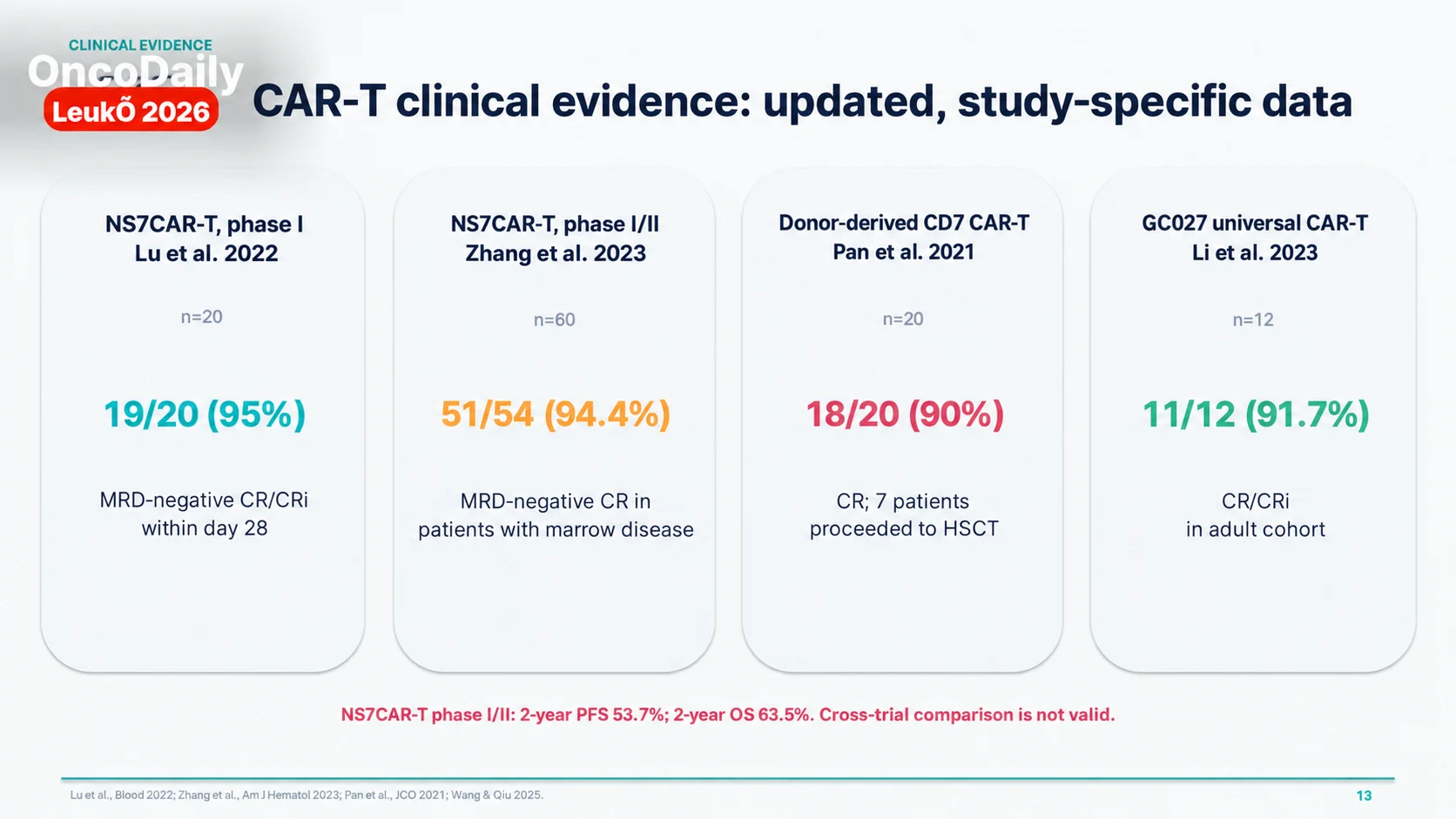
One of the earliest studies evaluated naturally selected CD7 CAR-T cells (NS7CAR-T) in 20 patients with relapsed or refractory T-ALL or T-lymphoblastic lymphoma.
By day 28, 19 of 20 patients achieved MRD-negative complete remission or complete remission with incomplete hematologic recovery.
Fourteen subsequently underwent allogeneic stem cell transplantation.
A larger Phase I/II investigation further supported the activity of this approach.
Among 60 treated patients, 54 had bone marrow involvement. Of those, 51 patients (94.4%) achieved MRD-negative complete remission.
At two years, progression-free survival was 53.7%, while overall survival reached 63.5%.
The findings suggested that CD7-directed CAR-T therapy could produce deep responses in patients with heavily pretreated disease, with some maintaining remission over extended follow-up.
Another early trial, led by Pan and colleagues, investigated donor-derived CD7 CAR-T cells in 20 patients with relapsed or refractory T-ALL.
Eighteen patients (90%) achieved complete remission, and seven proceeded to stem cell transplantation.
Researchers have also evaluated universal CAR-T products such as GC027, designed to provide a ready-to-use approach without requiring individualized cell manufacturing.
In an early adult study involving 12 patients, 11 achieved complete remission or complete remission with incomplete hematologic recovery within approximately one month.
Taken together, these studies demonstrate that CD7 can serve as an effective target for T-cell malignancies.
However, Taka cautioned against interpreting the high remission rates as proof of lasting benefit.
The trials involved different CAR-T products, patient populations, follow-up periods, and approaches to transplantation.
Their results cannot be directly compared to establish which strategy is most effective.
And despite the striking early responses, relapse and treatment-related complications remain important obstacles.
Universal Base-Edited CAR7: A New Step Toward Ready-to-Use Therapy
Among the most innovative approaches discussed was universal base-edited CAR7 (BE-CAR7), a donor-derived product engineered to overcome several of the biological barriers associated with T-cell-directed immunotherapy.
The strategy uses healthy donor T cells modified through base editing to disrupt genes involved in fratricide, graft-versus-host disease, and susceptibility to lymphodepleting antibodies.
The objective is to create a cellular product capable of recognizing CD7-positive leukemia cells while avoiding self-destruction and reducing some of the complications associated with donor-derived cells.
Taka highlighted updated Phase I results published in the New England Journal of Medicine.
The study included 11 patients with relapsed or refractory T-ALL: nine children and two adults.
All patients achieved morphologic complete remission with incomplete count recovery by day 28.
Nine patients achieved a sufficiently deep response to proceed to allogeneic stem cell transplantation.
At follow-up, seven of the 11 patients remained in remission between three and 36 months after transplantation.
These findings demonstrated the feasibility of using base-edited donor T cells to induce remission in a population with limited treatment options.
However, important complications were reported, including cytokine release syndrome, prolonged cytopenias, infections, and viral reactivation.
Two patients also experienced relapse with CD7-negative leukemia, illustrating how the disease can escape therapy by losing the antigen targeted by the CAR-T cells.
The study’s results were encouraging, but the role of transplantation is essential to their interpretation.
The patients who maintained remission had undergone subsequent stem cell transplantation, so the findings do not establish that BE-CAR7 alone can provide durable disease control.
The research nevertheless represents an important step toward developing universal cellular therapies for T-ALL.
The Real Challenge Begins After Remission
One of the most important questions raised by Taka’s presentation concerns what happens after patients respond to CD7 CAR-T therapy.
High initial remission rates are encouraging, but long-term disease control depends on more than the immediate elimination of leukemic cells.
A later Phase II study of donor-derived CD7 CAR-T therapy illustrated this challenge.
Among 55 treated patients with relapsed or refractory T-ALL or T-lymphoblastic lymphoma, 89% achieved at least a partial remission within the first three months.
However, median event-free survival was only five months, and median overall survival was 8.5 months.
Late complications were particularly concerning.
After the first month, patients experienced severe infections, prolonged cytopenias, and other complications, including infection-related deaths in remission.
The findings highlighted a central difficulty with T-cell-directed treatment: eliminating CD7-positive leukemia cells can also deplete normal CD7-positive immune cells.
This may lead to prolonged T-cell aplasia, impaired cellular immunity, viral reactivation, and increased susceptibility to opportunistic infections.
The immediate complications of CAR-T therapy, including cytokine release syndrome (CRS) and immune effector cell-associated neurotoxicity syndrome (ICANS), can often be managed through established monitoring and treatment protocols.
But prolonged immune suppression and delayed hematologic recovery present a different challenge, potentially continuing for months after infusion.
Taka emphasized that preventing these complications will be critical to improving long-term outcomes.
Where Does Stem Cell Transplantation Fit?
Allogeneic stem cell transplantation remains an important potential curative strategy for patients with relapsed or refractory T-ALL.
CD7 CAR-T therapy can help patients reach transplantation by inducing deep remission when conventional salvage treatment has failed.
In the larger NS7CAR-T study, patients who achieved complete remission and subsequently underwent transplantation had a one-year progression-free survival rate of 67.2%, compared with 15% among responding patients who did not undergo transplantation.
These findings suggest that consolidation with allogeneic transplantation may play an important role in maintaining disease control.
However, the comparison was observational, and the groups differed in ways that could influence outcomes. It does not establish that transplantation is necessary or superior for every patient.
Transplantation may also help restore hematopoietic and immune function after CD7-directed treatment, potentially reducing the consequences of prolonged T-cell depletion.
Nevertheless, questions remain about the optimal timing of transplantation, which patients are most likely to benefit, and whether some individuals can maintain durable remission without additional cellular consolidation.
“A high initial response does not automatically mean durable benefit.”
For Taka, these decisions require individualized assessment of MRD status, leukemia biology, CAR-T persistence, treatment-related toxicity, donor availability, previous transplantation, and the patient’s overall clinical condition.
Further prospective research will be necessary to establish the most effective sequencing strategies.
Beyond Remission: The Next Priorities for T-ALL
The development of CD7 CAR-T therapy has introduced possibilities that were difficult to imagine for patients with chemotherapy-resistant T-ALL.
Early studies have demonstrated that cellular therapies can induce deep, often MRD-negative remissions, while advances in gene editing are making increasingly sophisticated donor-derived products possible.
But the next phase of research must address the limitations revealed by those same studies.
Preventing antigen-negative relapse, improving immune recovery, reducing infection-related mortality, and identifying which patients require stem cell transplantation will all be essential to extending the benefits of treatment.
More refined molecular profiling and MRD assessment may also improve patient selection, helping clinicians identify those most likely to benefit from a particular cellular therapy or consolidation strategy.
For now, CD7-directed CAR-T and universal base-edited CAR7 remain investigational approaches rather than established standard treatments for T-ALL.
Their clinical potential is substantial, but broader adoption will depend on demonstrating safety and sustained benefit in larger, well-designed studies.
Taka’s presentation captured a field in which scientific innovation is progressing rapidly, even as difficult clinical questions remain unresolved.
The next major achievement in T-ALL will be determined not only by how many patients CAR-T therapy brings into remission, but by how many can remain there safely and for how long.
Written by Eliz Baloyan, MD, Features Writer and Editor at OncoDaily and CancerWorld