Key takeaways
- Workforce is the foundation of cancer care delivery; screening programs, medicines, and new equipment cannot improve outcomes without trained teams to use them effectively.
- Cancer care models must be adapted to each country’s resources, workforce, culture, and public health priorities rather than copied uniformly across Africa and the Middle East.
- Reliable cancer data is part of the infrastructure of care because it informs policy, treatment outcomes, and future improvements in service delivery.
- Access should include psychosocial support, communication, and continuity of care, especially for patients in rural, displaced, or conflict-affected settings.
- With limited funding, a functional referral pathway and digital connectivity may deliver more immediate value than building new centers or buying new equipment before patients can reliably reach existing services.
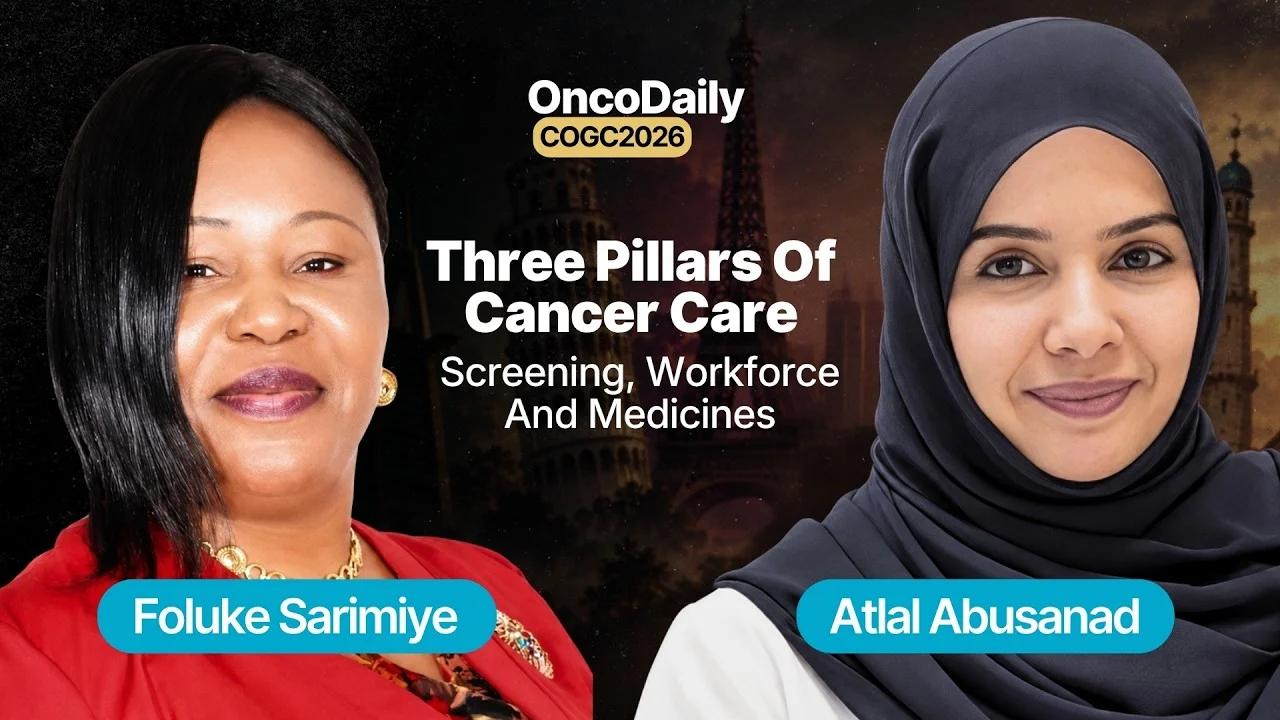
At the Community Oncology Global Congress (COGC 2026), organized by OncoDaily, Imène Hadji, Medical Oncologist at EPH Ibn Zohr Hospital in Algeria, moderated an expert discussion with Atlal Abusanad, Professor of Medicine and Medical Oncology at King Abdulaziz University in Saudi Arabia, and Foluke O. Sarimiye, Consultant Radiation and Clinical Oncologist at University College Hospital, Ibadan, Nigeria, on what cancer systems should prioritize when resources, infrastructure, and workforce are limited.
The conversation covered familiar challenges – screening, medicines, workforce shortages, weak referral pathways, limited data, psychosocial care, and unequal access.
But the panel kept returning to a more practical question:
When everything needs strengthening, what should come first?
Workforce Is the Multiplier
Hadji opened by asking the panel to choose between three priorities: screening, workforce, or medicines.
Her own answer was workforce.
“You can build a screening program or negotiate better medicine prices, but without having trained people to run them consistently, both stall.”
She pointed to Algeria’s expansion of radiotherapy infrastructure as an example. Building a center is important, but equipment cannot improve outcomes without trained teams behind it.
“A machine without a trained team behind it doesn’t move outcomes. Workforce is the multiplier.”
Sarimiye reached much the same conclusion.
“The people at the center of care need to be educated properly, understand the nature and the burden of what community oncology is all about.”
Abusanad agreed that workforce was crucial, but cautioned against treating it in isolation.
“It has to go in parallel with the resources as well, because having either one will disable the other one.”
His preference was to begin at a scale that can be supported, then expand as the service develops.
One Model Will Not Work Everywhere
The discussion then turned to whether workforce models that extend cancer care beyond major hospitals can be transferred across regions.
For Abusanad, the first mistake is treating the Middle East and North Africa as though it were one uniform health system.
“Grouping the MENA region in one sector or in one category, to me, is not very accurate.”
Countries differ in resources, population structure, workforce availability, public understanding of cancer, and government willingness to invest. That means successful models can offer direction, but they cannot simply be copied.
“Each guideline has to be tailored according to the resources, workforce as well.”
Culture matters too.
“Everything has to be tailored and delivered according to the country’s values, culture, resources as well.”
The broader lesson was that scaling cancer care requires adaptation rather than replication.
Cancer Data Is Part of the Infrastructure
Hadji then brought in an idea raised earlier by Prof. Clement Adebamowo: missing or unreliable cancer data is itself a barrier to care.
Sarimiye said that problem is particularly visible in high-volume settings.
“Sometimes you’re so stressed with the work itself, the actual work itself, that you don’t pay attention to research and getting data.”
But without reliable data, health systems lose the ability to understand outcomes, evaluate whether treatments are working, and identify where care needs to change.
“Data drives policy.
Data drives treatment outcomes.
Data drives knowledge for better treatment options.”
For Sarimiye, cancer data is not simply an academic exercise added after clinical care.
It is part of the system needed to improve that care.
Treat the Person, Not Only the Cancer
The conversation broadened further when Hadji asked Sarimiye what is lost when access is defined only through diagnosis and treatment.
Sarimiye’s answer was psychosocial care.
“As oncologists, we’re treating the patient, we’re treating a person and not the disease.”
Patients move through cancer care carrying anxiety, body image concerns, fear of recurrence, family pressures, and uncertainty about the future.
Those concerns can affect trust and adherence just as much as the treatment plan itself.
“If a patient has trust in the way an oncologist talks to them or addresses them, they adhere more to treatment.”
Sarimiye recalled one patient with advanced breast cancer who told the oncology team:
“Even if I die tomorrow, the way this team has addressed me and is taking care of me, I’m fine.”
For Sarimiye, compassionate communication also means listening rather than simply instructing.
“You should also learn to listen to what they’re actually concerned about, so that they are part of the treatment plan.”
She extended the same principle to internally displaced populations and people living in conflict-affected areas.
Geography, instability, and insecurity may make care more difficult to deliver, but they should not determine who receives cancer education, screening, referral, or treatment.
Connect What Already Exists
The final part of the discussion focused on collaboration.
Hadji argued that expanding access does not always require recreating every component of cancer care in every location.
Sometimes the faster solution is to connect existing services more effectively.
Abusanad agreed that regional collaboration could help move expertise and resources across health systems, particularly in situations involving war, displacement, or natural disasters.
He acknowledged that this is difficult because countries operate under different regulations and healthcare structures, but suggested that regional hubs could still play a role in improving access to medicines and services.
Telemedicine was another part of that strategy.
Digital health can extend specialist input beyond major centers and allow some patients to receive care closer to home rather than traveling long distances for every step of treatment.
But when Hadji asked what a country with limited funding and little existing infrastructure should build first, her answer was even simpler.
“For me, it would be a functional referral pathway before a new center, before new equipment.”
Her reasoning was practical. Good cancer care may already exist somewhere in a health system. The problem is that patients often do not know where to go, how to move between levels of care, or how to reach that service in time.
“When the patient knows where to go, you will make the most of the system you have built for them.”
Abusanad agreed, adding digital health to the same foundation.
“Having digital health can help the patients receive the care in their cities, in their rural places, as well as a good referral network.”
The panel did not offer a single blueprint for cancer care across Africa and the Middle East.
That was precisely the point.
Different countries will need different combinations of workforce development, screening, medicines, data systems, psychosocial support, digital health, and regional collaboration.
But Hadji’s closing message brought those priorities together:
“None of these systems were built with cancer care in mind from the start.”
The challenge, then, is not to wait for a perfect cancer system to appear.
It is to deliberately connect the people, services, data, and referral pathways that allow patients to reach the care that already exists — and to make every new investment work better when it arrives.
Written by Eliz Baloyan, MD, Features Writer and Editor at OncoDaily and CancerWorld
Watch the full video on YouTube.