Key takeaways
- Biomarker testing only creates value when patients receive the results, understand what they mean, and can use them in treatment discussions and future planning.
- A biomarker result can still matter even when it does not immediately change treatment, because it can guide future options, clinical trial awareness, and shared decision-making.
- Patients should be told why molecular testing is being ordered and what clinicians are looking for, helping build trust while they wait for results.
- Liquid biopsy can expand access when tissue is insufficient or difficult to obtain, but tissue and plasma testing remain complementary rather than interchangeable.
- Finding a mutation is only the beginning; clinicians still need to interpret the evidence, determine whether the alteration is actionable, and decide whether a targeted option is better than standard care.
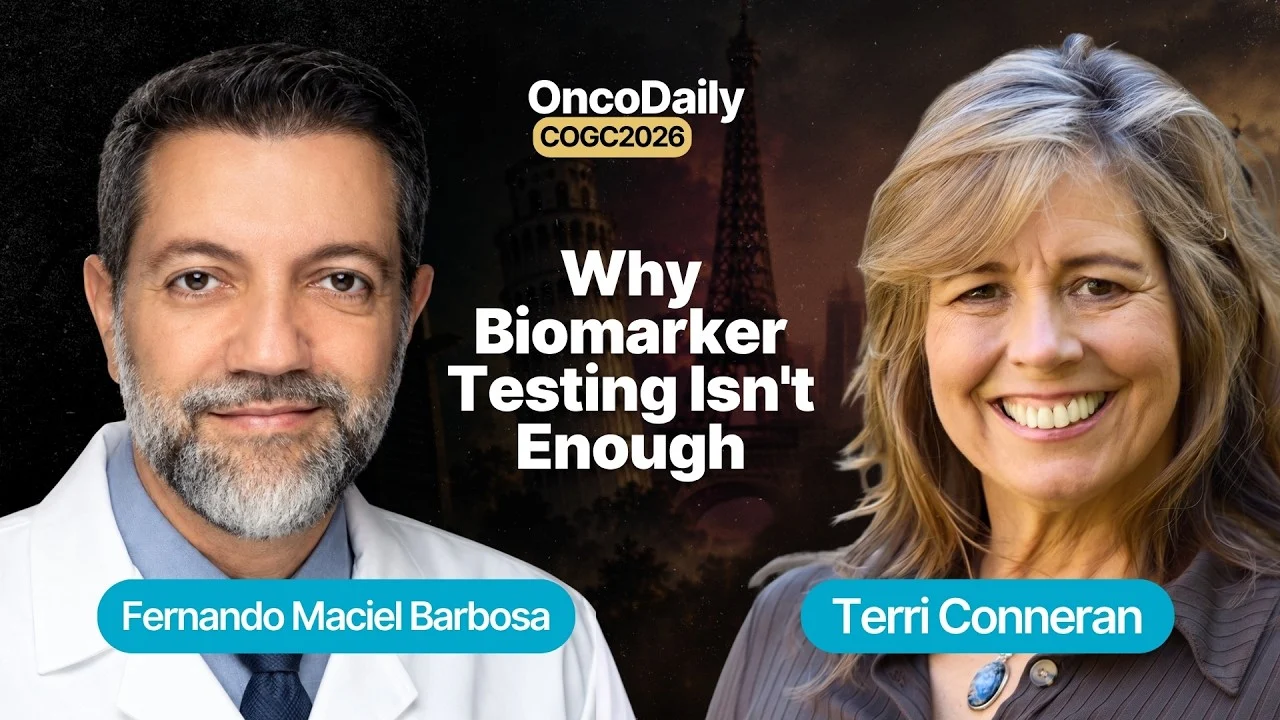
At the Community Oncology Global Congress (COGC 2026), organized by OncoDaily, Melissa L. Johnson, Director of Lung Cancer Research and Chief Scientific Officer at Sarah Cannon Research Institute, moderated an expert discussion with Fernando Maciel Barbosa, Clinical Associate Professor and Genitourinary Medical Oncology Group Leader at the University of Iowa, and Terri Conneran, Founder of KRAS Kickers, on what it really takes to expand biomarker access in community practice.
The discussion quickly moved beyond whether molecular testing is available.
A test can be ordered. A mutation can be identified. A report can reach the medical record.
And yet the patient may still never see it, understand what it means, or know whether it could matter later.
That gap between generating molecular information and making it useful became the central question of the panel.
Not Every Result Changes Treatment – But It Still Matters
Conneran brought the patient perspective through her own experience with lung cancer.
After being diagnosed with stage III disease, undergoing chemotherapy and surgery, and later experiencing multiple recurrences, she eventually learned that her cancer carried a KRAS mutation.
The result did not immediately change her treatment.
But it changed something else.
“What changed for me wasn’t just a treatment, because it didn’t change my treatment. But what changed for me is that I’ve been able to establish a community of patients to understand what we need to know so we can truly have informed and shared decision-making.”
That experience later helped shape KRAS Kickers, the patient advocacy organization she founded.
Conneran described the information gap around molecular testing as a “KRAS HOLE” – a gap in which patients may undergo testing without fully understanding what was tested, what was found, or how that information could become relevant later.
For her, specificity matters.
Knowing that a cancer is KRAS-mutated is only the beginning. Different variants can carry different therapeutic implications, and patients need enough information to understand what questions to ask next.
“With a patient having the source of the information to know their biomarker, they can take that information and identify opportunities for treatments and have that very special conversation that they need to have with their physician.”
Without that guidance, patients may instead turn to less reliable sources – including products and claims promising unproven cancer cures.
Biomarker literacy, in that sense, is also a form of protection.
Tell Patients What You Are Testing For
Johnson asked what happens when patients reach advocacy organizations before they even know whether their cancer carries a specific molecular alteration.
Conneran said this is common.
Sometimes another patient, friend, or informed member of the community is the first person to ask:
“What is your biomarker?”
For Conneran, one of the simplest improvements clinicians can make is to explain testing before the result comes back.
Rather than ordering genomic profiling without context, a clinician can tell the patient that the test is looking for molecular features that may help guide treatment now or in the future.
That explanation may not eliminate the anxiety of waiting, but it can give the patient a clearer sense of what comes next.
“It’s giving me, as a patient, trust in you, confidence for that next step, a way to identify where things are going next.”
She added another line that captured the vulnerability behind that waiting period:
“We don’t want you to give up on us before we give up on us.”
Tissue or Liquid? The Bigger Issue Is Access
Johnson then turned to the practical barriers of obtaining molecular results quickly enough to guide treatment.
For some patients, especially those with symptomatic or advanced disease, waiting for tissue-based testing can be difficult.
Liquid biopsy has increasingly become an alternative or complementary route, particularly when tissue is insufficient or another invasive procedure would be difficult.
Johnson described its growing use within the Sarah Cannon network, while Barbosa offered a different perspective from his previous experience in Brazil.
There, he said, access to comprehensive genomic testing could be far more limited, and industry-supported initiatives such as the Lung Mapping Consortium helped expand testing for eligible patients with non-small cell lung cancer.
Barbosa said tissue remained the preferred option when adequate material was available, but liquid biopsy offered an important pathway when it was not.
The distinction matters: liquid biopsy can make testing easier and faster in some settings, but it does not replace tissue in every situation. A negative plasma result may still require tissue testing, and tissue remains important for diagnosis and for alterations that circulating tumor DNA may miss.
From the patient perspective, however, Conneran emphasized the obvious appeal of avoiding another invasive biopsy whenever a reliable blood-based option exists.
The challenge is therefore not choosing one technology over the other.
It is making sure patients have a realistic route to molecular profiling at all.
A Biomarker Result Should Not Sit Unseen in the Record
The conversation then shifted from access to accountability.
Conneran raised a less visible problem: testing may already have been completed, but the patient never receives the report.
“The results can just sit and they never actually get given to a patient.”
A molecular report that remains buried in the medical record cannot empower the patient, prompt a second conversation, or help them recognize a future clinical trial opportunity.
For Conneran, patients need visibility into their own results and enough explanation to know why those results matter.
She also argued that access alone does not solve the problem if testing is not ordered consistently or early enough to guide treatment decisions.
“There’s a lot of doctors that are not ordering what needs to be done so the treatments can be decided so the patients ultimately can have the right treatment at the right time.”
That makes biomarker access a workflow issue as much as a reimbursement issue.
The test must be ordered.
It must come back in time.
The result must reach the clinician.
And the patient needs to know what it says.
Finding the Mutation Is Not the Same as Knowing What to Do With It
Barbosa added another layer: interpretation.
Even when genomic testing is available and a mutation is identified, the next decision may not be obvious.
“The main question is: how should I interpret these results?”
A molecular alteration may be biologically interesting without having strong evidence for an available therapy in that particular cancer.
The clinician still has to ask whether treatment should change, what level of evidence supports that decision, whether a targeted option is superior to the current standard of care, and whether the result is relevant now or only later.
“It’s not always that we have these robust trials, phase III trials, proving that one specific medication for one specific mutation is effective for this specific disease.”
That is why precision oncology cannot be reduced to finding a genomic alteration.
The interpretation matters just as much as the test itself.
Johnson closed by returning to the larger challenge.
“There are still lots of barriers beyond the knowledge that the testing is needed.”
For community oncology, expanding biomarker access therefore means more than increasing the number of tests performed.
It means making sure the right test is ordered, the result arrives in time, the finding is interpreted correctly, the patient receives it, and everyone understands what can – or cannot – be done with that information.
Because a molecular result only becomes useful when it reaches the decision it was meant to inform.
Written by Eliz Baloyan, MD, Features Writer and Editor at OncoDaily