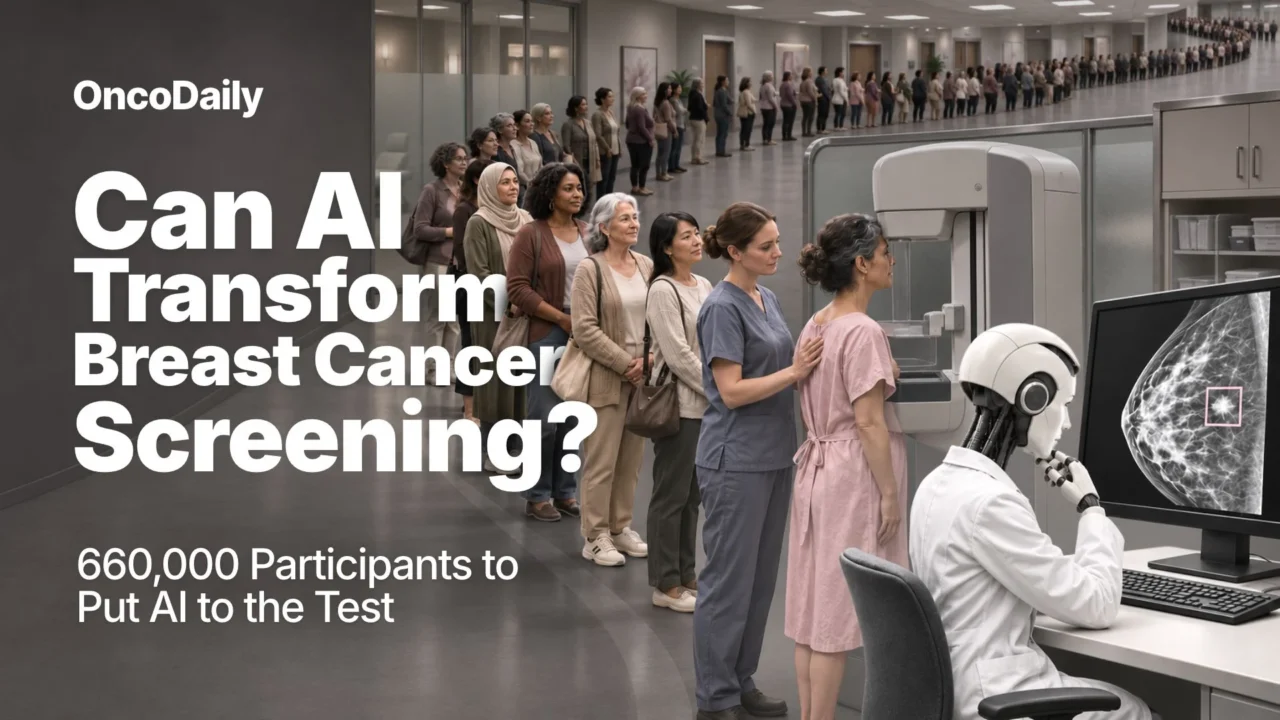
A major clinical trial has begun in the United Kingdom to investigate whether artificial intelligence (AI) can help detect breast cancer earlier, reduce radiologists’ workloads, and make mammography screening more efficient without compromising patient safety.
The study, known as EDITH (Early Detection using Information Technology in Health), aims to involve approximately 660,000 women across 30 breast screening centres. Described by its organizers as the world’s largest trial of AI-assisted breast cancer screening, the £10 million initiative has begun recruiting participants in Cambridgeshire, with additional NHS screening centres expected to join.
Led by researchers from the University of Warwick, the University of Cambridge, and Cambridge University Hospitals NHS Foundation Trust, in collaboration with NHS England, the trial could provide important evidence about how AI should be incorporated into routine cancer screening.
The central question is not simply whether AI can identify suspicious abnormalities on a mammogram, but whether combining AI with human expertise can improve cancer detection without increasing unnecessary investigations.
How Will AI Be Used in Breast Cancer Screening?
Currently, mammograms performed through the NHS Breast Screening Programme are independently examined by two trained specialists. This double-reading system helps reduce the chances of missing suspicious findings, but it also requires considerable time and specialist resources.
Around 2.1 million women undergo NHS breast screening annually, while fewer than 1% of screening mammograms result in a breast cancer diagnosis.
The EDITH trial will compare three approaches to mammogram interpretation.
In the first group, mammograms will continue to be reviewed by two NHS specialists without AI assistance, representing standard care. In the second group, an AI system will examine the images after an NHS expert has reviewed them, helping identify potentially overlooked abnormalities.
In the third group, AI will assess mammograms before specialist review and classify them according to the likelihood of cancer. Images considered lower risk may require review by one specialist, while higher-risk images will be reviewed by two.
Importantly, AI will not independently make the final clinical diagnosis. Every mammogram will continue to receive human review, with final screening decisions remaining under professional oversight.
According to the University of Warwick’s EDITH study information, participants will undergo mammography in the usual way. Those who prefer not to have their images assessed using AI can opt out of the research.
Previous Studies Have Already Shown Promising Results
The EDITH trial builds on growing scientific evidence suggesting that AI could improve mammography screening.
One of the most important studies is the Swedish MASAI trial (Mammography Screening with Artificial Intelligence), which randomized approximately 106,000 women to AI-supported mammography or conventional screening with two human readers.
Results published in The Lancet Digital Health in 2025 showed that AI-supported screening detected 6.4 cancers per 1,000 women compared with 5.0 per 1,000 using standard double reading. This represented a 29% higher cancer detection rate, while the number of mammogram readings required from radiologists decreased by 44.2%.
Importantly, the study did not identify a statistically significant increase in false-positive results. Read the original MASAI study.
Further results, published in The Lancet in January 2026, provided additional evidence about cancers diagnosed between scheduled screening appointments, known as interval cancers.
Researchers reported 1.55 interval cancers per 1,000 women in the AI-assisted group compared with 1.76 per 1,000 in the standard screening group. AI-supported screening also demonstrated higher sensitivity, at 80.5% compared with 73.8%, while specificity remained similar.
Although the interval cancer findings established non-inferiority rather than statistically significant superiority, the results strengthened the evidence supporting AI-assisted mammography.
Detecting More Cancer Is Not the Only Goal
While increased cancer detection may appear beneficial, screening programmes must also consider the potential harms of identifying abnormalities that would never have caused symptoms or required treatment.
AI systems may highlight suspicious areas that turn out to be benign, potentially leading to additional imaging, biopsies, anxiety, and healthcare costs. Increased detection may also contribute to overdiagnosis if clinically insignificant cancers are identified and treated unnecessarily.
For this reason, EDITH will measure both cancer detection rates and the proportion of women recalled for additional examinations. Researchers will also investigate interval cancers, the characteristics of detected tumours, differences in performance across patient populations, patient experiences, and the cost-effectiveness of AI-assisted screening.
The study’s longer-term follow-up will be particularly important for understanding whether detecting more cancers during screening translates into fewer cancers being diagnosed between routine mammograms.
Professor Sian Taylor-Phillips of the University of Warwick, one of the trial’s co-chief investigators, explained that AI could support specialists by identifying suspicious areas that might otherwise be missed.
The study is therefore designed to establish whether AI can provide meaningful clinical benefits while maintaining the safety and quality of existing breast cancer screening services.
Could AI Change the Future of Mammography?
For healthcare systems facing increasing imaging volumes and shortages of trained radiologists, AI-assisted screening could offer an opportunity to improve efficiency and direct specialist time toward more complex clinical decisions.
However, successful implementation will depend on more than diagnostic accuracy alone. Researchers must establish whether AI systems perform consistently across different ages, breast densities, and population groups, and whether improvements in screening justify their costs.
The findings will also need to demonstrate that AI can be integrated into everyday clinical practice without weakening professional oversight or increasing unnecessary testing.
For women participating in EDITH, the screening appointment itself will remain unchanged. The difference will occur behind the scenes, where researchers will assess how mammograms are interpreted and whether AI assistance improves the screening process.
EDITH could become an important turning point in AI-assisted cancer screening, but its results will determine whether the technology is ready for wider implementation. The ultimate goal is not to replace radiologists, but to identify clinically important breast cancers earlier while ensuring that women continue to receive safe, reliable, and evidence-based care.
You can also read: AI in Oncology: Do We Have a Vision, or Are We Doomed?