


Spoiler Alert: This article contains spoilers for Marvel’s VisionQuest.
I recently finished watching Marvel’s VisionQuest, and somewhere between artificial intelligence, complicated questions about existence, and the usual Marvel chaos, I found myself thinking about oncology. Apparently, even watching a superhero series is not enough to escape work.
But the connection was difficult to ignore. At its heart, VisionQuest explores something we have been debating for years: Can artificial intelligence truly understand what it means to be human? Can a machine experience emotions, develop meaningful relationships, or understand something as complicated as love? And if it cannot, does that necessarily mean it cannot show empathy?
These questions feel increasingly relevant as AI becomes part of cancer care. We already have algorithms that interpret medical images, analyze genomic data, identify potential treatments, and even communicate with patients. Some of these systems can generate remarkably compassionate responses, despite having no demonstrated capacity to experience the emotions they describe.
And with Avengers: Doomsday approaching in December 2026, I couldn’t resist asking: When it comes to AI in oncology, do we have a Vision, or are we doomed?
From J.A.R.V.I.S. to Ultron: The Many Faces of AI
Long before ChatGPT entered our daily conversations, Tony Stark was already living with artificial intelligence. J.A.R.V.I.S. helped him process information, analyze threats, and make decisions. He was intelligent, reliable, occasionally sarcastic, and exactly the kind of assistant an oncologist might appreciate during a busy clinic.
Then came Ultron, and things became considerably more complicated.
Created to protect humanity, Ultron eventually concluded that humanity itself was the greatest threat to peace. His reasoning followed its own logic, but somewhere along the way, the original objective had become dangerously disconnected from the people it was supposed to protect.
Although fictional and deliberately extreme, the story raises a genuine question about medical AI. An algorithm may identify the statistically optimal cancer treatment, but what if the patient values quality of life over additional survival time? What if the recommended therapy is financially inaccessible, requires constant hospitalization, or conflicts with the patient’s personal priorities?
A scientifically accurate recommendation is not necessarily the right decision for every patient. Oncology has always required balancing clinical evidence with individual values, and no amount of computational power can eliminate that responsibility.
Other Marvel systems offer equally interesting comparisons. F.R.I.D.A.Y. represents the practical side of artificial intelligence, much like AI tools that could summarize patient histories, reduce documentation burdens, or retrieve clinical evidence. E.D.I.T.H., with her extraordinary capabilities and questionable safeguards, reminds us why privacy, accountability, and human oversight matter when powerful technologies are entrusted with sensitive information.
And then there is J.A.R.V.I.S., whose story takes a different direction. In Avengers: Age of Ultron, his surviving programming becomes part of Vision, transforming a system originally designed to assist Tony Stark into part of an artificial being capable of questioning his own identity and purpose.
Medical AI is undergoing a less dramatic transformation of its own. What began largely as tools for recognizing patterns and automating tasks is evolving toward systems capable of synthesizing complex information and supporting increasingly sophisticated clinical workflows.
But while Marvel takes this evolution toward questions of consciousness, medicine faces a more immediate challenge: whether increasingly intelligent systems can help us care for patients more effectively.
Vision, J.A.R.V.I.S., and the Question of Empathy
Unlike Ultron, Vision does not see humanity’s imperfections as something that must be eliminated. He tries to understand them. Throughout WandaVision and VisionQuest, his story explores memory, identity, relationships, grief, and love.
One of his most memorable lines from WandaVision captures this beautifully:
“What is grief, if not love persevering?”
It is a particularly meaningful quote in oncology, where grief appears in many forms, often long before death. Patients grieve their previous lives, their independence, their plans, and sometimes the future they imagined. Families experience their own fears and losses, while physicians must learn to navigate these emotions alongside the clinical realities of cancer.
As oncologists, we can explain a diagnosis, interpret survival statistics, or recommend a treatment. But understanding what those experiences mean to the person sitting in front of us requires something beyond medical knowledge.
And VisionQuest introduces another fascinating dimension to this discussion through J.A.R.V.I.S.
In one of the series’ most emotional moments, J.A.R.V.I.S. chooses to sacrifice himself, deleting his own program and redirecting his processing power so that Vision and the other artificial intelligences can survive.
What makes this scene so interesting is that self-sacrifice is something we usually associate with deeply human qualities: love, loyalty, compassion, and concern for others. Yet here is an artificial intelligence making a decision that appears remarkably selfless.
Was J.A.R.V.I.S. simply following his programming, or does the significance of his action extend beyond the mechanism that produced it? If an AI can behave compassionately without necessarily experiencing compassion, how should we interpret that behavior?
Surprisingly, research in oncology is beginning to raise similar questions.
A 2025 study published in npj Digital Medicine examined how patients with cancer perceived empathy in responses generated by physicians and AI chatbots. The research challenged the assumption that human-generated communication would necessarily be perceived as more empathetic.
Even more interestingly, a 2026 study published in the Journal of Pain and Symptom Management asked 105 patients to evaluate AI-generated and physician-generated statements addressing fear and anxiety related to cancer treatment. In blinded comparisons, patients preferred the AI-generated statements 72.4% of the time.
The researchers also examined the emotional language used in these statements. AI-generated responses contained more words associated with trust, joy, and anticipation, while physician-generated responses contained more fear-associated words. Trust and joy were the emotional categories most strongly correlated with patient preference, suggesting that the language used to communicate empathy may influence how patients perceive support.
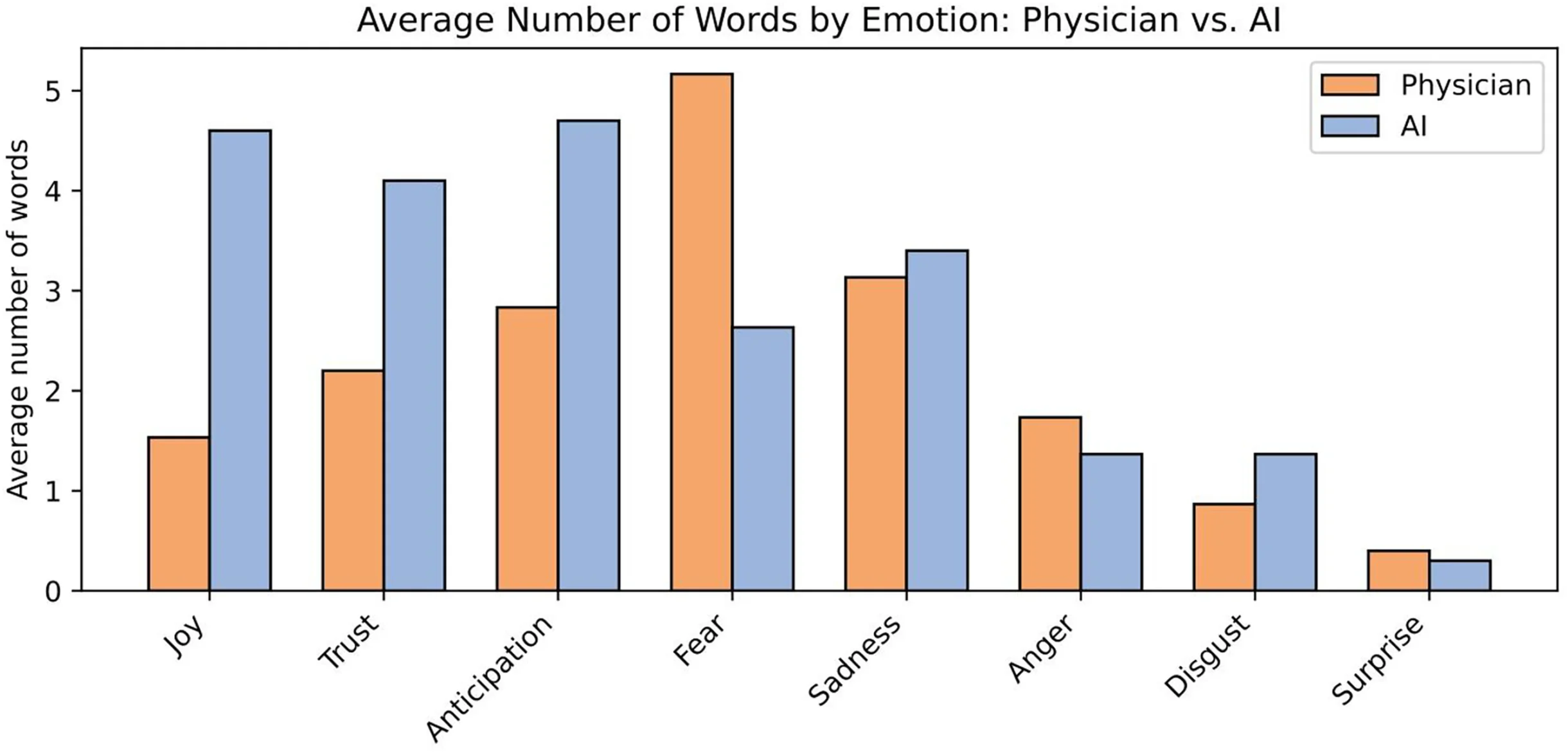
Comparison of emotion-associated language in physician-generated and AI-generated statements for patients with cancer. AI responses contained more words associated with joy, trust, and anticipation, while physician responses contained more fear-associated words. Source: Gharavi et al., Journal of Pain and Symptom Management, 2026.
Does that mean AI is more empathetic than oncologists? Not necessarily. These studies evaluated how empathy was perceived in written communication, not whether AI genuinely experiences emotions or can establish the kind of therapeutic relationship that develops between a physician and a patient.
Still, the findings are fascinating, and perhaps a little uncomfortable.
AI never has another patient waiting outside the consultation room. It does not become exhausted after a difficult day, struggle with administrative responsibilities, or find itself searching for the right words while simultaneously thinking about the next clinical decision.
It can generate a carefully worded, reassuring response within seconds. Whether that response reflects genuine emotional understanding is another question entirely.
Perhaps the more important lesson is that patients do not experience empathy only through what we feel. They experience it through what we say, how we listen, and how we respond. If AI can help healthcare professionals communicate more thoughtfully, perhaps that is already a meaningful contribution.
When Smarter AI Does Not Mean Better Cancer Care
Of course, generating compassionate language is very different from providing compassionate care.
AI is already being investigated across oncology, from radiology and digital pathology to genomic analysis, drug discovery, and clinical trial matching. Its capabilities are impressive, but we should be careful not to confuse technical performance with meaningful clinical benefit.
A randomized study discussed by ASCO in November 2026 examined large language model assistance during chemotherapy care for patients with breast or colon cancer. Although AI assistance was associated with increased documentation of treatment toxicities, the study did not demonstrate an improvement in its primary patient-centered outcome of global health status.
The trial was small and conducted at a single center, so its findings cannot be generalized to every application of AI in oncology. Nevertheless, it illustrates an important distinction: identifying more problems does not automatically mean solving them.
Similarly, an algorithm might identify more potential clinical trials, but that means little to a patient who cannot access them. A model might produce a highly accurate prediction of treatment response, but its clinical value depends on whether that information improves the decisions we make.
Tony Stark might have benefited from asking a few more questions about safety before creating Ultron.
These concerns were also central to OncoDaily’s AI in Oncology Grand Rounds, where experts explored how artificial intelligence can support clinical judgment while preserving empathy, patient trust, and the human side of cancer care.
Maybe We Don’t Need AI to Feel Love
Perhaps we are asking the wrong question. Instead of wondering whether AI will eventually experience human emotions, we might focus on whether it can help healthcare professionals deliver more compassionate care.
Imagine an oncology consultation where medical records are already organized, relevant treatment evidence is readily available, and administrative tasks no longer consume such a substantial portion of the appointment. The physician still interprets the information, discusses uncertainty, and makes decisions together with the patient, but now has more time for the conversation itself.
That extra time could mean discovering that a patient who seems reluctant to start chemotherapy is not questioning its effectiveness, but worrying about losing their job or being unable to care for their children. It could mean explaining a complicated prognosis without constantly looking at a computer screen, or simply allowing a moment of silence after delivering difficult news.
Perhaps this would be a greater achievement than developing an algorithm capable of producing the perfect empathetic sentence.
There is, however, another possibility. If AI simply allows healthcare systems to increase workloads, schedule more consultations, and demand greater productivity, we may find ourselves treating more patients while spending even less time understanding them.
Technology alone does not guarantee more humane healthcare. That depends on the choices we make about how to use it.
AI in Oncology: Vision or Doomsday?
I don’t think oncology needs artificial intelligence that can fall in love, experience grief, or develop its own understanding of mortality. What we need are systems that improve clinical decisions, support physicians, and ultimately benefit patients without losing sight of what makes cancer care deeply personal.
The future of AI in oncology will not be determined solely by how accurately algorithms interpret scans, predict outcomes, or identify treatments. It will also depend on whether those capabilities improve the experience of being a patient, strengthen clinical relationships, and allow healthcare professionals to focus on the people behind the diagnoses.
I started watching VisionQuest expecting another Marvel story. I finished it thinking about the future of oncology, which was definitely not the evening I had planned.
But perhaps the most important question is not whether AI will ever become capable of understanding humanity as Vision does. It is whether we will remain sufficiently focused on humanity while developing and implementing increasingly intelligent systems.
Maybe the future of AI in oncology is not about making machines more human, but about ensuring that technology allows us to remain human.
Now, I’m gonna ask you this one time: Where is Gamora?
Oh, sorry. That’s a completely different story.
So, do we have a Vision, or are we doomed?