






Yan Leyfman, Medical Oncologist, Co-Founder and Executive Director of MedNews Week, shared a post on X:
“Classic Hodgkin lymphoma has always been a paradox.
Under the microscope, Classic Hodgkin lymphoma looks nothing like Primary mediastinal B-cell lymphoma, yet genetically, they share common roots.
So what actually makes them different?
Researchers went straight to the source:
- Isolating rare Hodgkin and Reed-Sternberg (HRS) cells from primary tumors
- Sequencing their transcriptome
What they found tells a story of identity gone wrong.
HRS cells start as germinal center B cells… but never complete the journey.
Instead:
- They enter abortive plasma cell differentiation
- Activate the unfolded protein response (UPR), a stress program seen in Multiple myeloma
- Then stall neither B cell nor plasma cell
At the same time, they disappear from immune view:
- Shut down B-cell identity genes
- Downregulate NK-cell recognition signals (e.g., CD48)
- Becoming immunologically invisible
Compared to PMBL:
- Greater loss of lineage identity
- No clear germinal center or plasma cell signature
- Upregulation of cytoskeletal/mitotic programs – explaining their bizarre multinucleated morphology
Bottom line:
- HRS cells aren’t just malignant – they’re misdirected:
- B cells that tried to become plasma cells… and got stuck
- Cells under stress… that learned to hide
A disease defined not just by mutations – but by a failed differentiation program and immune escape.”
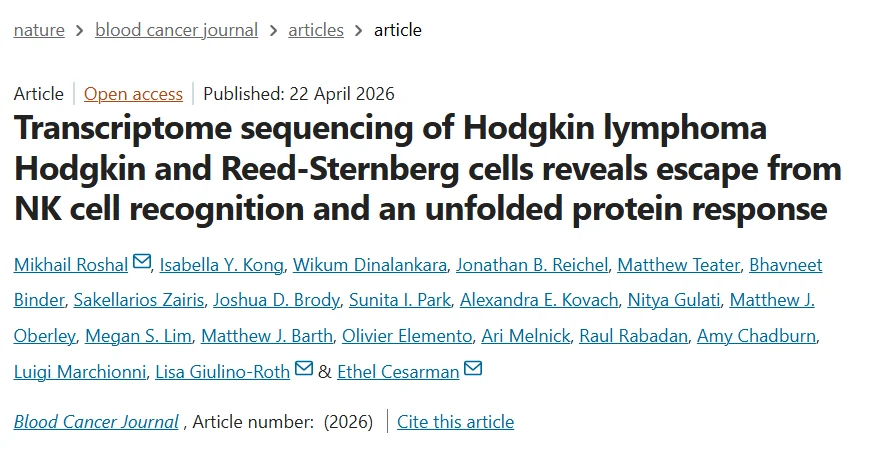
Title: Transcriptome sequencing of Hodgkin lymphoma Hodgkin and Reed-Sternberg cells reveals escape from NK cell recognition and an unfolded protein response
Authors: Mikhail Roshal, Isabella Kong, Wikum Dinalankara, Jonathan Reichel, Matthew Teater, Bhavneet Binder, Sakellarios Zairis, Joshua Brody, Sunita Park, Alexandra Kovach, Nitya Gulati, Matthew Oberley, Megan Lim, Matthew Barth, Olivier Elemento, Ari Melnick, Raul Rabadan, Amy Chadburn, Luigi Marchionni, Lisa Giulino-Roth, Ethel Cesarman
Other articles featuring Yan Leyfman on OncoDaily.