






Thaís Santana, Radio-oncologist at CEBROM, shared a post on LinkedIn:
“For a long time, radiotherapy in stage IV NSCLC was seen mainly as a palliative tool – relieving symptoms, improving comfort, and little beyond that.
That paradigm is changing.
A new IASLC Consensus Statement on Definitive Radiotherapy to the Primary Tumor in Stage IV NSCLC highlights an evolving concept: aggressive local control of the primary tumor may translate into meaningful oncologic benefit, especially in carefully selected patients.
Some key takeaways:
- In EGFR-mutant metastatic NSCLC, randomized phase III data now support thoracic radiotherapy combined with TKI, showing improvements in PFS and OS.
- In non-oncogene addicted disease, evidence is still maturing, but early prospective data suggest that higher-dose definitive thoracic RT may improve locoregional control — and possibly survival.
- Biology matters: the primary tumor may remain a continuous source of metastatic seeding, meaning local treatment is not simply “controlling the chest”, but potentially altering disease evolution.
- Timing matters: early consolidative RT after systemic induction appears to be a promising strategy.
This is precision radiation oncology in its best form: not treating because we can — but treating because biology suggests we should.
The future of stage IV lung cancer may increasingly involve asking not only:
“Which systemic therapy?”
but also:
“Should we definitively treat the primary?”
An exciting space to watch and to help define.”
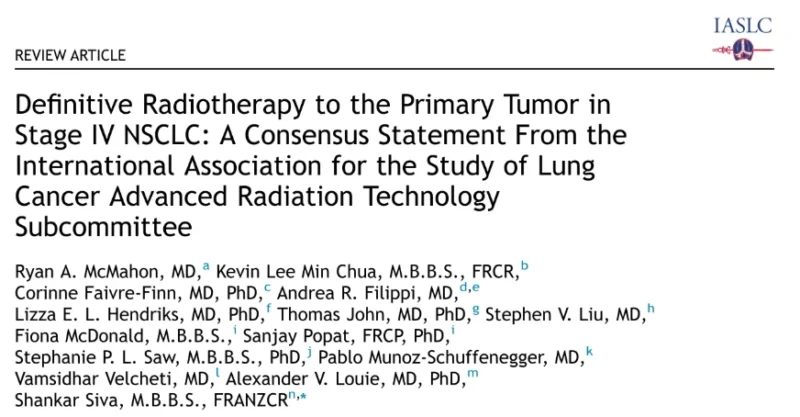
Title: Definitive Radiotherapy to the Primary Tumor in Stage IV NSCLC: A Consensus Statement From the International Association for the Study of Lung Cancer Advanced Radiation Technology Subcommittee
Authors: Ryan A. McMahon, Kevin Lee Min Chua, Corinne Faivre-Finn, Andrea R. Filippi, Lizza E.L. Hendriks, Thomas John, Stephen V. Liu, Fiona McDonald, Sanjay Popat, Stephanie P.L. Saw, Pablo Munoz-Schuffenegger, Vamsidhar Velcheti, Alexander V. Louie, Shankar Siva.
Other articles featuring Thaís Santana on OncoDaily.