Tejas Patil, Assistant Professor of Thoracic Oncology; Vice Head of Clinical Affairs, Division of Oncology, University of Colorado Anschutz, shared a post on X:
“Sometimes a single patient’s story can illuminate a deep concept!
Can methylation based ctDNA accurately detect and track small cell transformation in EGFR NSCLC?
I’m excited to share our case report, now in JCO Precision Oncology!
See below for details!
Background
1. Small cell transformation is a resistance mechanism to EGFR TKIs. Both TP53 and Rb1 loss increase risk.
2. However, significant number of changes to t-SCLC are epigenetic!
Great references: (PMID): Offin (31228622), Niederst(25758528), Lee (28498782)
Context
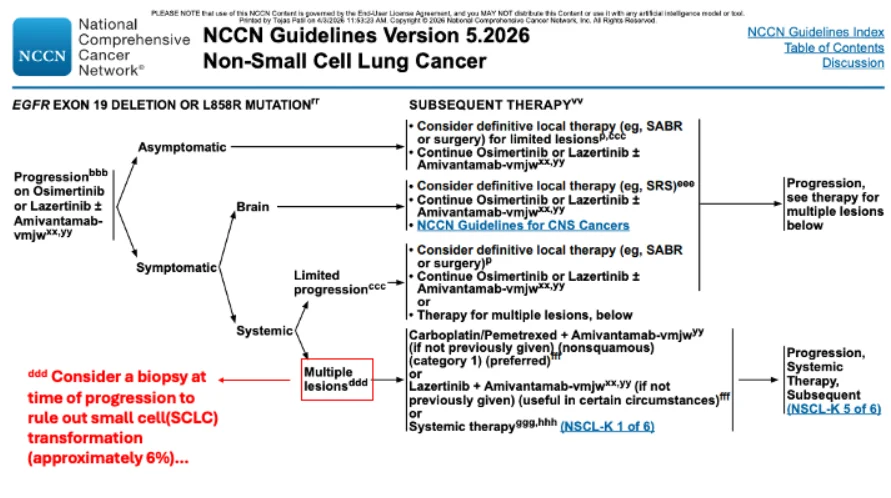
- The current gold standard for detecting small cell transformation is a tissue biopsy (per NCCN guidelines below).
- However, what do we do when a biopsy is neither feasible nor safe? Can methylation based ctDNA assays (looking for epigenetic changes) help?
Case
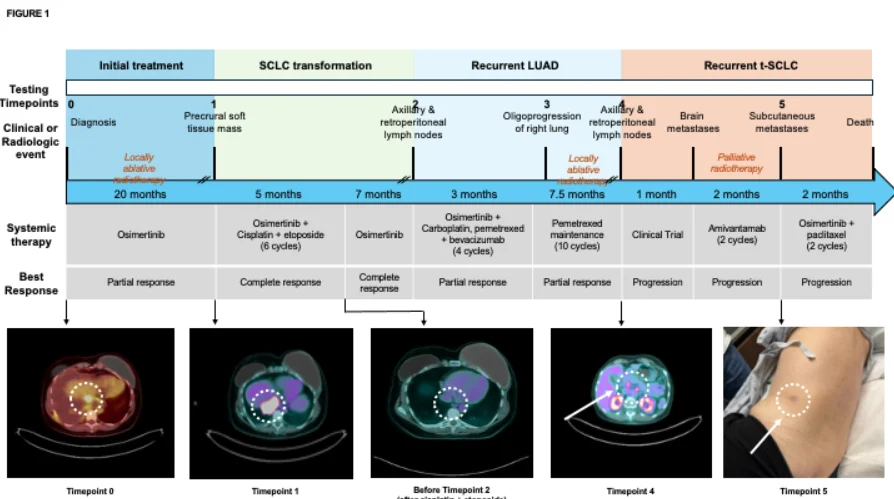
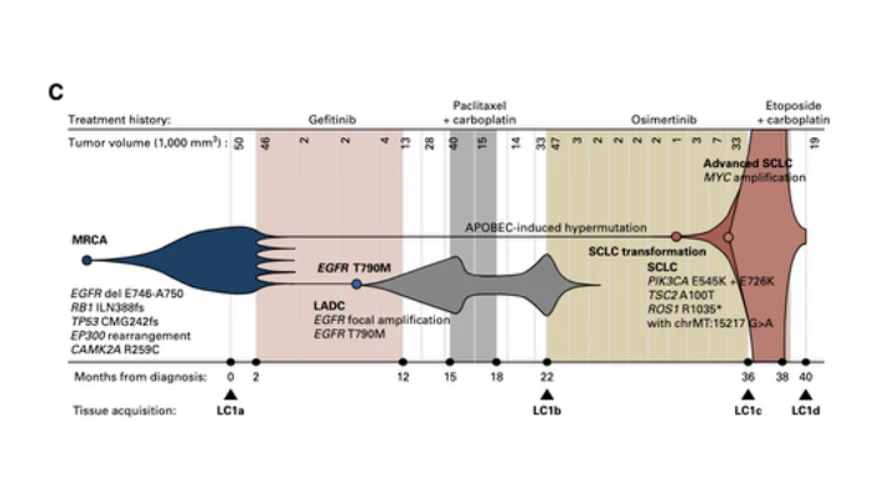
- My patient was a 52 y/o woman with stage IVB EGFR Exon 19 del NSCLC. Her cancer journey is shown below. She had both transformed SCLC AND C797S resistance mutations.
- Importantly, we had paired plasma and tissue samples at diagnosis and every progression time point.
Pathology
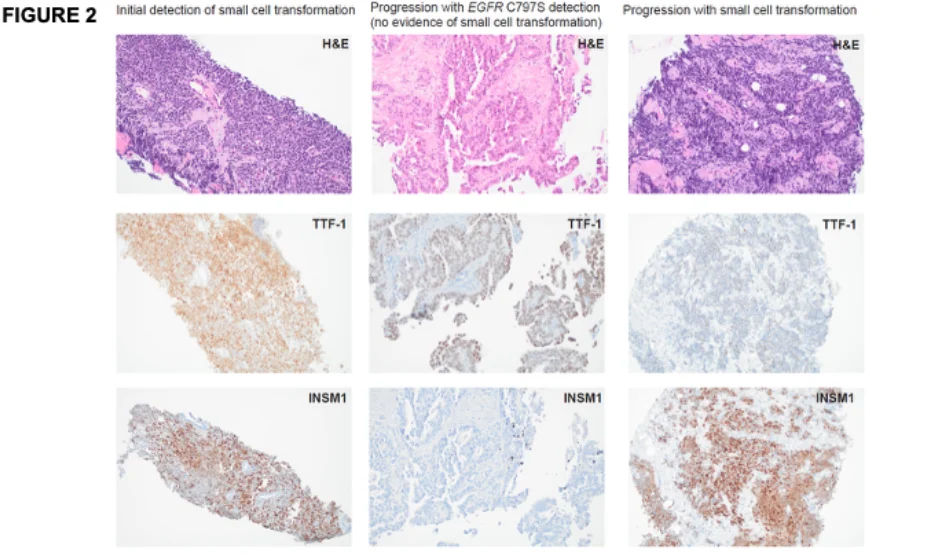
Based on the tissue biopsies, we can clear see when her transformed SCLC clone was present (ISMN1+) and when her EGFR C797S clone was present (TTF1+). This is shown below.
MLSP Classifier
- As stated earlier, not substantial number of changes to transformed SCLC are epigenomic.
- Work done by Guardant Health (reference below), shows that a methylation-based deconvolution model can discriminate adeno vs SCLC
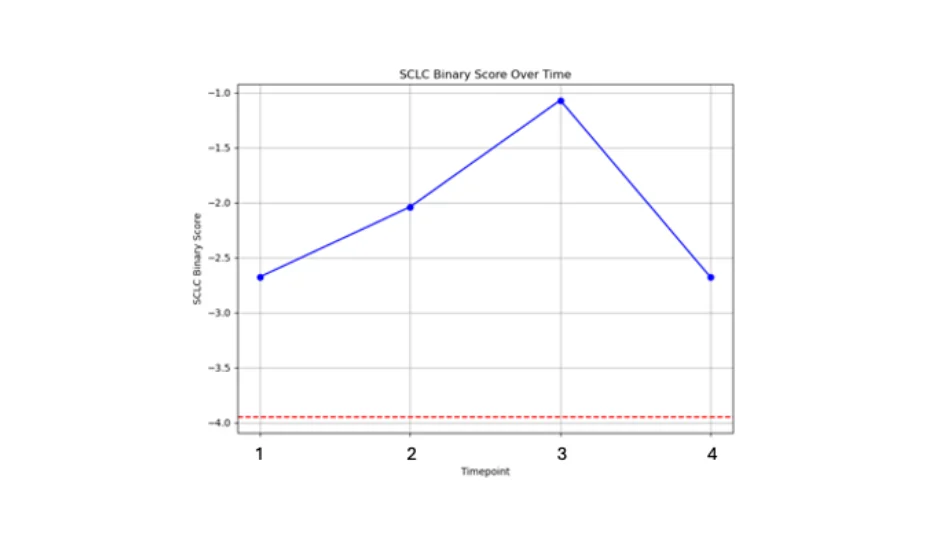
- The image below shows that our plasma samples met threshold for the classifier to make a call.
Reference to deconvolution abstract, if interested
Methylation Assay Performance
Now the really cool part! The MLSP algorithm from Guardant Health, accurately called t-SCLC and C797S clones at the relevant timepoints in patient journey! This is shown below. This exactly corresponded with changes in pathology and genomics!
Summary
To our knowledge, it is the first detailed clinical report showing serial plasma-based methylation analysis to track and discriminate t-SCLC vs C797S evolution alongside standard genomic testing.
Why is this important?
Knowledge Gained
- In this case, ctDNA methylation had high concordance with genomic changes and could tell apart transformed SCLC from adeno.
- ctDNA methylation testing is minimally invasive, and useful when biopsies are not feasible.
- Can address tumor heterogeneity.
I would like to thank Guardant Health and my co-authors for their brilliant insights. And most important, I would like to thank my patient and her family for sharing her cancer journey and making an impact.”
Title: Longitudinal, Retrospective Use of a Circulating Tumor DNA Methylation Signature Successfully Captures Small Cell Evolution in a Patient With Metastatic EGFR-Mutant Non–Small Cell Lung Cancer
Authors: Tejas Patil, Amy Guimarães-Young, Jill Tsai, Dara Aisner, Leslie Bucheit, Anton Valouev.
Other articles featuring Tejas Patil on OncoDaily.