Rawia Mohamed, Head of the Anatomical Pathology Department at Burjeel Medical City, Regional Ambassador of the Asian society of Digital Pathology and Associate Professor at RAK Medical and Health Sciences University, shared a post on LinkedIn:
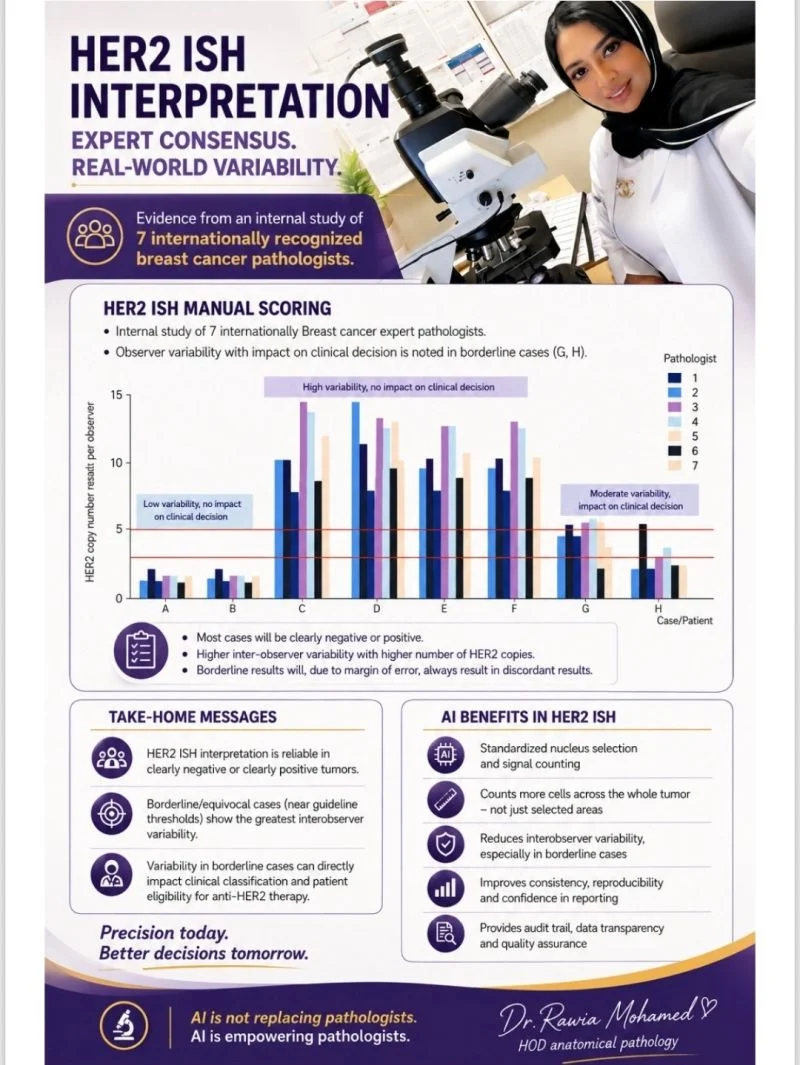
“HER2 ISH Interpretation in the Era of Precision Oncology: Why Variability Matters?
HER2 testing remains one of the most clinically impactful predictive biomarkers in breast oncology, directly influencing patient eligibility for anti-HER2 targeted therapies and shaping systemic treatment strategies.
While clearly amplified and clearly non-amplified tumors are generally reproducible among pathologists, borderline and equivocal HER2 ISH cases continue to represent a significant diagnostic challenge. Multiple international studies have demonstrated that interobserver variability increases substantially near guideline thresholds, where small differences in signal counting or nucleus selection may alter final HER2 classification and ultimately impact therapeutic decisions.
This variability becomes increasingly relevant in modern oncology practice with the expanding landscape of:
- HER2-low disease
- HER2-ultralow categorization
- Antibody-drug conjugates (ADCs)
- Personalized targeted treatment strategies
Artificial intelligence-assisted digital pathology is emerging as an important supportive tool in this setting. AI-based HER2 ISH analysis may enhance:
- Standardization of nucleus selection
- Signal quantification consistency
- Reproducibility in borderline cases
- Auditability and quality assurance
- Whole-slide quantitative assessment rather than selected hotspot evaluation
Importantly, AI is not intended to replace pathologists, but rather to augment diagnostic precision and support multidisciplinary oncology care through more consistent biomarker interpretation.
As oncology continues to move toward increasingly personalized therapeutic approaches, collaboration between oncologists, pathologists, and digital diagnostics platforms will become essential in ensuring accurate biomarker-driven treatment selection and optimized patient outcomes.”
Other articles about AI in Oncology on OncoDaily.