






Olubukola Ayodele, Breast Cancer Lead at University Hospitals of Leicester NHS Trust, shared a post on LinkedIn:
“NHS England released the latest breast screening data on the 19th of February, and there’s both progress and pause for thought.
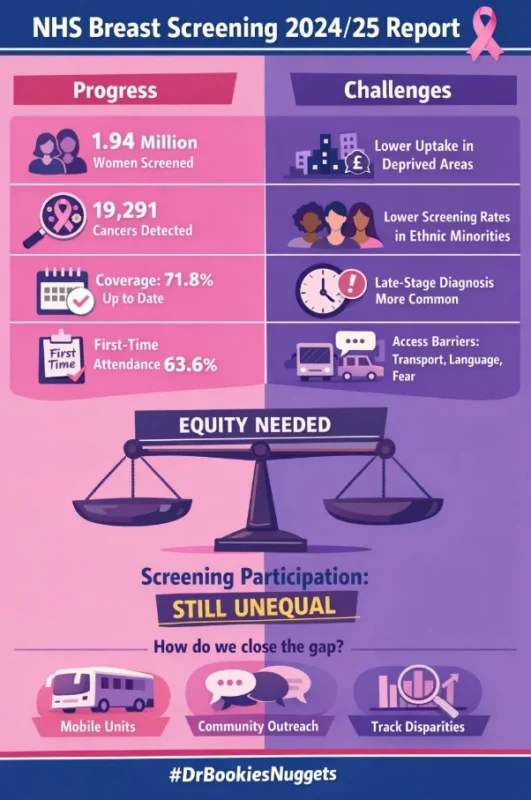
The newly published 2024/25 figures from NHS England show:
- 1.94 million women aged 50–70 attended screening within six months of invitation
- 19,291 breast cancers detected through screening
- 9 cancers found per 1,000 women screened
- Coverage up to 71.8% (women up to date within the 3-year standard)
- First-time attendance at 63.6%, the highest in a decade
On the surface, this is encouraging. More women are coming forward. More cancers are being detected early. After years of pandemic disruption, recovery is real.
But here is the uncomfortable truth.
Nearly 3 in 10 eligible women are still not up to date with screening.
And we know that non-attendance is not randomly distributed.
Coverage varies by region. Urban areas continue to lag behind some rural regions. Areas of higher deprivation consistently show lower uptake. London has historically reported lower coverage compared with other parts of England.
While headline statistics rarely break down uptake by ethnicity or deprivation in detail, decades of evidence tell us this:
- Women from more deprived communities are less likely to attend screening.
- Ethnic minority communities often have lower uptake.
- Late-stage diagnosis is more common in underserved populations.
Improvement in national averages can mask widening gaps underneath.
So what should we be asking?
- Are mobile units reaching the communities with the lowest uptake?
- Are invitations culturally and linguistically accessible?
- Are we measuring uptake by ethnicity and deprivation in real time?
- Are we working with trusted community voices?
Equity is not achieved by offering the same service to everyone. It is achieved by designing services around those least likely to access them.
As clinicians, commissioners, policymakers and industry partners, we need to move beyond celebrating improved averages and start interrogating variation.
Because if screening participation remains patterned by postcode, ethnicity and socioeconomic status, then early diagnosis will remain patterned too.
The data shows progress.
The disparities show work still to be done.
If we are serious about reducing cancer mortality, the next phase of breast screening must be defined not just by recovery but by equity.
With the new national cancer plan and the NHS 10-year health plan highly focused on prevention and early diagnosis, our breast screening program should undergo serious restructuring to ensure equitable access and embrace the use of other forms of imaging such as contrast enhanced mammograms for women with dense breasts.
Screening saves lives. But only if access is equitable.”
Other articles featuring Olubukola Ayodele on OncoDaily.