





This article is from Dr Sophie Braznell, (Research Associate, Tobacco Control Research Group) and Dr Rosemary Hiscock (Research Associate, Tobacco Control Research Group). The Tobacco Control Research Group is part of the University of Bath’s Centre for 21st Century Public Health. This article is intended to equip readers with the fundamental information they need to be able to understand the available evidence on these products and, in turn, improve decision making, such as whether to recommend products to patients.

Welcome to a beginner’s friendly guide to newer nicotine and tobacco products, specifically electronic cigarettes, heated tobacco, and nicotine pouches. We’ll cover each one in turn and then answer some frequently asked questions. This information help you better understand emerging evidence on these products and navigating this complex area of public health. Should you want to know more on this topic, check out OncoDaily’s previous article on e-cigarettes, the Tobacco Control Research Group’s work on heated tobacco products, and the newer nicotine and tobacco product pages on TobaccoTactics.org.
What are newer nicotine and tobacco products?
Electronic Cigarettes (e-cigarettes)
Common names: e-cigarettes, vapes, ENDS (electronic nicotine delivery systems), and ENNDS (electronic non-nicotine delivery systems)
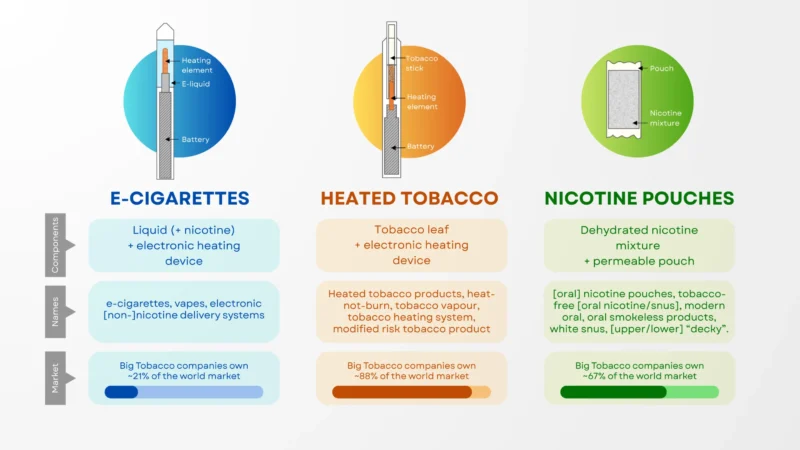
Key characteristics: E-cigarettes1 consist of a battery-powered electronic device that heat a liquid (often called ‘e-liquids’). The resulting emissions are then inhaled by the user. Some e-liquids are described as ‘a salt’ because the nicotine is present in the form of a dissolved salt2. Sometimes the device is sold separately to the liquid. These are known as pod or tank style e-cigarettes. Other e-cigarettes are sold pre-filled and ready to use. These are known as ‘disposables’.
Popular brands and key players (Euromonitor3 data): Many of the most popular brands globally are Chinese (SKE, Elf Bar and Lost Mary). Only around 21% of the market is controlled by Big Tobacco companies, i.e. world-leading cigarette manufacturers: Philip Morris International; British American Tobacco; Japan Tobacco; and Imperial Brands. British American Tobacco holds over 17% of the market with Vuse.
How are they being used?
The World Health Organization (WHO) estimated that e-cigarettes are used by over 86 million adults (16yrs+) and 14 million children aged 13-15 worldwide4. That’s about 2% of adults and 7% of 13-15-year-olds. The WHO also estimated children are nine times more likely on average to use e-cigarettes than adults, and, similar to cigarettes, more males use e-cigarettes than females. There is evidence e-cigarettes can help smokers quit and are possibly more successful than nicotine replacement therapies. However, many e-cigarette users continue to smoke cigarettes. This is known as ‘dual use’ and does not currently appear to lead to smoking cessation5.
E-cigarettes are also being used by people who had not previously smoked or used other nicotine products. This puts them at risk of adverse events and health damage6. Further, young e-cigarette users are around three times more likely to go on to smoke than non-users7.
Heated Tobacco Products (HTPs)
Common names: Heated tobacco products, heat-not-burn, tobacco vapour, tobacco heating system, modified risk tobacco product
Key characteristics: Heated tobacco products (HTPs) consist of a battery-powered electronic device that heats tobacco leaf. Most commonly, the tobacco leaf is held within a small, cigarette-like stick. Other HTPs, known as ՛hybrids՛, heat a non- nicotine or low-nicotine liquid and then pass the vapour through a pod containing the tobacco leaf. In either case, the resulting emissions are inhaled by the user. Most HTP brands sell the device and tobacco-containing element separately, often under different brand names. Popular brands and key players (Euromonitor data): This market is dominated by Big Tobacco companies, which control around 88% of the market, with Philip Morris International’s IQOS making up over 68% alone. Other global tobacco company brands include Glo, Ploom, Pulze and Lil.
How are they being used?
There is less data available on HTP use around the world, though sales have risen over recent years8. Data from 42, mostly higher-income countries gathered between 2015 and 2022 indicated around 5% of people had ever tried HTPs9. HTP use is most common amongst young adults10 and males11.
There is evidence suggesting the rise in HTP use has contributed to a decline in smoking in Japan12 – the biggest HTP market, where 11% used HTPs in 2025. However, globally HTPs do not appear to be helping smokers quit or even reduce their tobacco use13. This may in part be due to many HTP users continuing to smoke cigarettes (i.e. ‘dual use’). There are reports that HTPs can increase the likelihood of relapse14 among former smokers. HTPs are also being used by people who have not previously smoked15, with adolescents being over twice as likely as adults to have tried one16.
Nicotine Pouches
Common names: [oral] nicotine pouches, tobacco-free [oral nicotine/snus], modern oral, oral smokeless products, white snus, [upper/lower] ՛decky՛.
Key characteristics: Nicotine pouches17 typically consist of dehydrated nicotine, plus water, cellulose, flavours, additives, and sweeteners, all contained within a permeable pouch. Some use nicotine extracted from tobacco leaf and others use ՛synthetic՛ nicotine, which is created in a lab rather than from tobacco leaf. Users place the pouch between the lip and gum through which the contents can be absorbed into the bloodstream.
Nicotine pouches are sold in tins or cans of around 15-20 pouches.
Popular brands and key players (Euromonitor data): Big Tobacco companies control around 67% of the market, with Philip Morris International’s Zyn making up over 41% alone. Other Big Tobacco brands include Velo and Nordic Spirit. Further brands owned by American tobacco companies include On! and Rogue.
How are they being used?
Sales of nicotine pouches have grown rapidly over the last few years in many regions. In Sweden, where nicotine pouches were first launched18, 5% of people were using one on a daily basis in 202419. In the US, use has increased significantly, especially amongst men and younger age groups20. Use of other nicotine and tobacco products alongside nicotine pouches is also increasingly common21, particularly in youth and young adults22. Nicotine pouches are also being used by people who have not previously smoked or used e-cigarettes23.
There is limited evidence to date on24 whether nicotine pouches can help people quit. Claims they can reduce smoking rates are often based on evidence from Sweden25, where cigarette use is particularly low and snus use high. However, snus (tobacco- containing pouches) are not the same as nicotine pouches and strong tobacco control measures have also significantly reduced smoking rates in Sweden. Thus claims citing the ՛Swedish Experience՛ should be treated with caution.
There are reports of several pouches being placed in the mouth simultaneously and use of higher strength pouches expanding26. There are also reports of nicotine pouches being used in an attempt to enhance performance in sports27 and improve employees productivity in the workplace28. However, nicotine’s addictive properties lead to dependence and withdrawal symptoms that quickly undermine performance and productivity gains29.
Frequently asked questions
Do e-cigarettes emit water vapour?
The term ՛vape՛ can be misleading. While e-liquids do contain water, it typically makes up less than 10% of the total volume30. The majority is made up of humectants, like glycerin and propylene glycol31, which are thought to cause the dry mouth and throat32 commonly reported by users. The other key ingredient is nicotine – a highly addictive substance. The level of nicotine in e-liquids has repeatedly been found to be higher than the concentration written on the label33 by manufacturers and present in products labelled ՛nicotine-free՛. Other chemicals commonly found in e-liquids include flavouring compounds, trace metals, and potentially harmful chemicals, like carcinogens34.
Are HTPs a type of vape?
No. HTPs contain tobacco leaf. E-cigarettes do not. While nicotine is highly addictive, it is not thought to be the cause of some of the deadliest tobacco-related diseases. Tobacco leaf, when heated by HTPs, emits a substantial level of carcinogenic chemicals35. Conflating HTPs and e-cigarettes causes confusion and may mistakenly lead those seeking to only consume nicotine into using tobacco too.
Are nicotine pouches a type of snus?
Historically, ‘snus’ has been used to refer to pouches that contain tobacco leaf36. However, ՛snus՛ has started to become an umbrella term37 to refer to both tobacco pouches and nicotine pouches. The contents, level of evidence, and regulation38 on the two types of pouches differs greatly. Conflating them may imply the risks of one also apply to the other, and so it is important we are very clear in our terminology.
What are the harms of e-cigarettes, HTPs, and nicotine pouches?
E-cigarettes, HTPs and nicotine pouches have different contents and are used differently. So it follows that their risks will be different too. Some risks could be related to tobacco and nicotine content, like oral lesions39, and others can be independent, such as battery explosions40. It is not difficult to appear less harmful than cigarettes, which release over 7000 chemicals41 and kill up to half of users42. So, for an adult smoker, these products might lead to less disease – though opinions on this vary. To everyone else all three products pose significant risks of addiction and possibly also compromised health.
Many tobacco-related diseases take decades to appear. We are lacking the long- term, independent epidemiological data for these newer products. For example, there is evidence that e-cigarette use is associated with biomarkers43 reflective of increased risk of cancer but the overall evidence on cancer is still limited and can sometimes be conflated44 with risks from former smoking. In the meantime, the harms of these products are subject to ongoing, sometimes highly contentious, debate45. When weighing up the evidence for yourself, you may wish to consider whether the product: (1) reduces tobacco-related disease and death; (2) helps people quit smoking or nicotine altogether; (3) is being used by nicotine-naïve individuals, especially children; (4) poses new risks and harms; and (5) the quantity and quality of the evidence.
What about the environmental impact of e-cigarettes, HTPs, and nicotine pouches?
From production to consumption to disposal, these products cause significant environmental damage. Lithium used in batteries diverts it from more vital emission- reducing uses, for example in electric cars or hospital equipment. Most e-cigarettes are discarded in household waste. The lithium is then not recovered and during degradation there is leaching out of toxic chemicals46. Farmers growing tobacco for nicotine extraction for pouches use agrochemicals. Independent data on the greenhouse gas emissions for synthetic nicotine manufacture and transport are not yet available.
Can we trust the evidence on e-cigarettes, HTPs, and nicotine pouches?
A major limitation of the evidence for all three products is that much of it comes from companies that sell them, presenting a conflict of interest. Tobacco companies have a history of influencing science47 in ways that prioritise profits over public health. Little appears to have changed. Recent investigations have revealed how tobacco companies are: manipulating and misusing science to promote their newer products48; producing poor quality, biased science on HTPs49; and, more likely to report e- cigarettes50 and HTPs51 are less harmful than cigarettes compared to independent sources.
Although tobacco companies can go to great lengths to hide their influence, there are simple ways to spot possible conflicts of interest. For academic publications, check out the statements on author’s affiliation, funding and competing interests.
Other useful resources for investigating connections between a piece of evidence and the tobacco industry include Tobacco Tactics52 and the Tobacco Industry Allies Database53.
For more information
For more information on the topics discussed in this article, check out the following
links:
- Tobacco Tactics website
- Tobacco Control Research Group
- Centre for 21st Century Public Health
- TCRG LinkedIn
Sign up to receive the Tobacco Control Research Group newsletter as well as occasional notifications about our research, events and publications.
- E-cigarettes, Tobacco Tactics, updated 02 February 2023, accessed 27 April 2026.
- Hao Zhang, Shulei Han, Lei Fan, Guanglin Liu, Yuan Zhang, Huan Chen, Hongwei Hou, Qingyuan Hu, The Difference of Addictive Behavior of Free-Base Nicotine and Nicotine Salts in Mice Base on an Aerosol Self-Administration Model, Nicotine & Tobacco Research, Volume 26, Issue 12, December 2024, Pages 1626–1635
- Euromonitor International, Tobacco Tactics, updated 13 June 2023, accessed 27 April 2026.
- World Health Organization. (2025). Global report on trends in prevalence of tobacco use 2000–2024 and projections 2025–2030 (6th ed.)
- Hamoud J, Hanewinkel R, Andreas S, et al. A systematic review investigating the impact of dual use of e-cigarettes and conventional cigarettes on smoking cessation. ERJ Open Res 2025; 11: 00902-2024 [DOI: 10.1183/23120541.00902-2024].
- Jackson S, Shahab L, Tattan-Birch H et al.
Vaping among adults in England who have never regularly smoked: a population-based study, 2016–24
The Lancet Public Health, 9, e755-e765 - Golder S, Hartwell G, Barnett LM, et al Vaping and harm in young people: umbrella review Tobacco Control Published Online First: 19 August 2025. doi: 10.1136/tc-2024-059219
- Heated Tobacco Products, Tobacco Tactics, updated 13 August 2025, accessed 28 April 2026.
- Sun T, Anandan A, Lim CCW, East K, Xu SS, Quah ACK, et al. Global prevalence of heated tobacco product use, 2015–22: A systematic review and meta-analysis. Addiction. 2023;118(8):1430–1444. https://doi.org/10.1111/add.16199
- Jackson SE, Shahab L, Buss V, Tattan-Birch H, Cox S, Taylor E, Brown J. The changing face of nicotine use in England: Age-specific annual trends, 2014 to 2024. Addiction. 2026 Mar;121(3):549-563. doi: 10.1111/add.70243. Epub 2025 Dec 7. PMID: 41354055; PMCID: PMC12887924.
- Keller AM, Klosterhalfen S, Kastaun S, et al Heated tobacco product use prevalence and temporal trends among the German population: a series of representative cross-sectional household surveys, 2018–2023
BMJ Open 2025;15:e094610. doi: 10.1136/bmjopen-2024-094610 - Cummings KM, Roberson A, Levy DT, et al
Transformation of the tobacco product market in Japan, 2011–2023
Tobacco Control 2026;35:79-82. - Exposetobacco.org. Understanding heated tobacco products: current issues and recent findings. Campaign for Tobacco-Free Kids / STOP. 2025. Available from:https://exposetobacco.org/resource/understand-heated-tobacco-products/
- Wei Xia, William Ho Cheung Li, Yuan Hui Luo, Ting Na Liang, Laurie Long Kwan Ho, Ankie Tan Cheung, Peige Song, The association between heated tobacco product use and cigarette cessation outcomes among youth smokers: A prospective cohort study,
Journal of Substance Abuse Treatment, Volume 132, 2022, 108599, ISSN 0740-5472, https://doi.org/10.1016/j.jsat.2021.108599. - Action on Smoking and Health. (2024). Use of vapes among adults in Great Britain 2024. https://ash.org.uk/uploads/Use-of-vapes-among-adults-in-Great-Britain-2024.pdf
- Sun T, Anandan A, Lim CCW, East K, Xu SS, Quah ACK, et al. Global prevalence of heated tobacco product use, 2015–22: A systematic review and meta-analysis. Addiction. 2023;118(8):1430–1444. https://doi.org/10.1111/add.16199
- Nicotine Pouches, Tobacco Tactics, updated 13 November 2024, accessed 28 April 2026.
- Cancerfonden. Swedish Tobacco Policy Publication 2025. Stockholm: Cancerfonden; 2025. Available from: https://static-files.cancerfonden.se/Swedish%20Tobacco%20Policy%20Publication%202025.pdf
- Public Health Agency of Sweden (Folkhälsomyndigheten). Use of tobacco and nicotine products. Stockholm: Folkhälsomyndigheten. Available from: https://www.folkhalsomyndigheten.se/the-public-health-agency-of-sweden/living-conditions-and-lifestyle/andtg/tobacco/use-of-tobacco-and-nicotine-products
- Tobacco Epidemic Evaluation Network (TEEN+) Study. Data Brief Issue 2. Tobacco Monitoring. 2025. Available from: https://tobaccomonitoring.org/wp-content/uploads/2025/09/Tobacco-Epidemic-Evaluation-Network-Data-Brief-Issue-2.pdf
- Butler A, Lindson N, Contextualising an increase in the use of oral nicotine pouches, The Lancet Public Health, 11, e2-e3
- Truth Initiative. Multiple tobacco and nicotine product use is increasingly common among young people. Washington, DC: Truth Initiative; 2026. Available from: https://truthinitiative.org/research-resources/emerging-tobacco-products/multiple-tobacco-and-nicotine-product-use-increasingly
- East K, Tattan-Birch H, Taylor E. What are the characteristics of people who use nicotine pouches and what types of pouches are being used? Data from an online cross-sectional survey of UK adults. PLoS One. 2025 Oct 24;20(10):e0332962. doi: 10.1371/journal.pone.0332962. PMID: 41134749; PMCID: PMC12551820.
- Hartmann-Boyce J, Tattan-Birch H, Brown J, Shahab L, Goniewicz ML, Ma CL, Wu AD, Travis N, Jarman H, Livingstone-Banks J, Lindson N. Oral nicotine pouches for cessation or reduction of use of other tobacco or nicotine products. Cochrane Database of Systematic Reviews 2025, Issue 10. Art. No.: CD016220. DOI: 10.1002/14651858.CD016220.pub2. Accessed 28 April 2026.
- The Swedish Experience, Tobacco Tactics, updated 25 February 2026, accessed 28 April 2026.
- BBC News. [Article title not provided on link]. BBC News; 2026. Available from: https://www.bbc.com/news/articles/c9395ywzg73o
- ASH Scotland. Nicotine pouches. Edinburgh: Action on Smoking and Health Scotland; 2025. Available from: https://ashscotland.org.uk/briefing/nicotine-pouches/
- Zilber A. Tech startups hand out nicotine pouches as productivity perk, worrying doctors. New York Post; 2025 Dec 31. Available from: https://nypost.com/2025/12/31/business/tech-startups-hand-out-nicotine-pouches-as-productivity-perk-worrying-doctors/
- Gold M. Can nicotine pouches really enhance productivity? Psychology Today; 2026 Jan 5. Available from: https://www.psychologytoday.com/gb/blog/addiction-outlook/202601/can-nicotine-pouches-really-enhance-productivity
- Soulet S, Duquesne M, Toutain J, Pairaud C, Lalo H. Experimental method of emission generation calibration based on reference liquids characterization. International Journal of Environmental Research and Public Health. 2019;16(13):2262. https://doi.org/10.3390/ijerph16132262
- Young-Jae Lee, Chae-Jin Na, Liu Botao, Ki-Hyun Kim, Youn-Suk Son,
Quantitative insights into major constituents contained in or released by electronic cigarettes: Propylene glycol, vegetable glycerin, and nicotine, Science of The Total Environment, Volume 703, 2020, 134567, ISSN 0048-9697,
https://doi.org/10.1016/j.scitotenv.2019.134567 - National Center for Biotechnology Information (US). StatPearls [Internet]. Treasure Island (FL): StatPearls Publishing; 2025. Available from: https://www.ncbi.nlm.nih.gov/books/NBK507184/
- Taylor A, Dunn K, Turfus S. A review of nicotine-containing electronic cigarettes—Trends in use, effects, contents, labelling accuracy and detection methods. Drug Test Anal. 2021;13:242–260. https://doi.org/10.1002/dta.2998
- American Lung Association. What’s in an e-cigarette? Chicago: American Lung Association. Available from: https://www.lung.org/quit-smoking/e-cigarettes-vaping/whats-in-an-e-cigarette
- Action on Smoking and Health Scotland (ASH Scotland). ASH evidence brief on nicotine. Version 6, November 2025. Edinburgh: ASH Scotland. Available from: https://ashscotland.org.uk/uploads/ASH-evidence-brief-on-nicotine-V6-Nov25.pdf
- Snus, Tobacco Tactics, updated 06 February 2024, accessed 28 April 2026.
- Read D, Cope E, Bennett M …
A cross-sectional latent class analysis of self-reported snus use in men’s and women’s professional football in England
Journal of Science and Medicine in Sport, 2025; 28, 793-801 - Action on Smoking and Health Scotland (ASH Scotland). Nicotine pouches and snus: factsheet. Edinburgh: ASH Scotland; June 2025. Available from: https://ashscotland.org.uk/wp-content/uploads/2025/09/Nicotine-pouches-and-snus-factsheet-June-2025-FINAL.pdf
- BBC News. Nicotine pouches disguised as sweets raise concerns for children. BBC News; 2025 Aug 7. Available from: https://www.bbc.com/news/articles/c9395ywzg73o
- Jenkins, S , Winnall, WR , Greenhalgh, EM A, MacKenzie, R and Scollo, MM. 18.4 Safety risks and abuse potential of e-cigarettes. In Greenhalgh, EM , Scollo, MM and Winstanley, MH [editors]. Tobacco in Australia: Facts and issues. Melbourne : Cancer Council Victoria; 2023. Available from https://www.tobaccoinaustralia.org.au/chapter-18-e-cigarettes/18-4-safety-risks-and-abuse-potential-of-e-cigarettes
- Action on Smoking and Health (ASH). Smoking facts at a glance. London: ASH; February 2026. Available from: https://ash.org.uk/resources/view/facts-at-a-glance
- World Health Organization. Tobacco. Geneva: World Health Organization; 2025. Available from: https://www.who.int/news-room/fact-sheets/detail/tobacco
- Kundu A, Sachdeva K, Feore A, et al. Evidence update on the cancer risk of vaping e-cigarettes: A systematic review. Tobacco Induced Diseases. 2025;23(January):6. doi:10.18332/tid/192934.
- Squires H, Gillespie D, Kock L et al. Scoping of Policy Impacts for Regulating E-cigarettes (SPIRE): findings from a data and decision analytic model mapping project [version 1; peer review: 2 approved, 1 not approved]. NIHR Open Res 2025, 5:92 (https://doi.org/10.3310/nihropenres.14038.1)
- Hatsukami DK, Carroll DM. Tobacco harm reduction: Past history, current controversies and a proposed approach for the future. Prev Med. 2020 Nov;140:106099. doi: 10.1016/j.ypmed.2020.106099. Epub 2020 Apr 23. PMID: 32335031; PMCID: PMC7581601.
- Pornpichar Lomngam, Rosemary Hiscock, Karen Evans-Reeves, Britta K Matthes, The tobacco industry at the health–environment nexus: a framing analysis of the UK ‘disposable’ e-cigarette ban, Health Promotion International, Volume 40, Issue 6, December 2025, daaf218, https://doi.org/10.1093/heapro/daaf218
- Legg T, Hatchard J, Gilmore AB. The Science for Profit Model—How and why corporations influence science and the use of science in policy and practice. PLoS ONE. 2021;16(6):e0253272. https://doi.org/10.1371/journal.pone.0253272
- Influencing Science Case Studies, Tobacco Tactics, updated 01 July 2024, accessed 28 April 2026.
- Braznell S, Van Den Akker A, Metcalfe C, et al, Critical appraisal of interventional clinical trials assessing heated tobacco products: a systematic review
Tobacco Control 2024;33:383-394. - Charlotta Pisinger, Nina Godtfredsen, Anne Mette Bender, A conflict of interest is strongly associated with tobacco industry–favourable results, indicating no harm of e-cigarettes, Preventive Medicine, Volume 119, 2019, Pages 124-131, ISSN 0091-7435, https://doi.org/10.1016/j.ypmed.2018.12.011.
- Harumitsu Suzuki, Naoki Aono, Yan Zhang, Kuniko Yuri, Maggy Audrey Murielle Bassole Epse Brou, Shigeki Takemura, Aya Higashiyama, Takahiro Tabuchi, Akira Fujiyoshi, Comparison of Publications on Heated Tobacco Products With Conventional Cigarettes and Implied Desirability of the Products According to Tobacco Industry Affiliation: A Systematic Review, Nicotine & Tobacco Research, Volume 26, Issue 5, May 2024, Pages 520–526, https://doi.org/10.1093/ntr/ntad205
- Tobacco Tactics. Tobacco Tactics. Bath: Tobacco Control Research Group, University of Bath. Available from: https://www.tobaccotactics.org/
- Stopping Tobacco Organizations and Products (STOP). Tobacco industry allies. Bath: University of Bath; 2026. Available from: https://exposetobacco.org/tobacco-industry-allies/