Muna Al-Khaifi, GP Oncologist at Mount Sinai Hospital (Toronto), Sinai Health. This article summarizes the systematic review and meta-analysis by Lee and Hwang, which evaluated the effects of exercise interventions on fatigue, body composition, physical fitness, and circulating biomarkers in women with breast cancer during active treatment and after treatment completion. The review examines how stage-specific exercise programs influence cancer-related fatigue, metabolic and inflammatory biomarkers, body composition, physical function, and cardiometabolic health. It also discusses current exercise recommendations, evidence gaps, and the role of individualized exercise prescriptions as a cornerstone of precision supportive care across the breast cancer continuum.
Exercise interventions on fatigue, body composition, physical fitness, and biomarkers in breast cancer patients during and after treatment
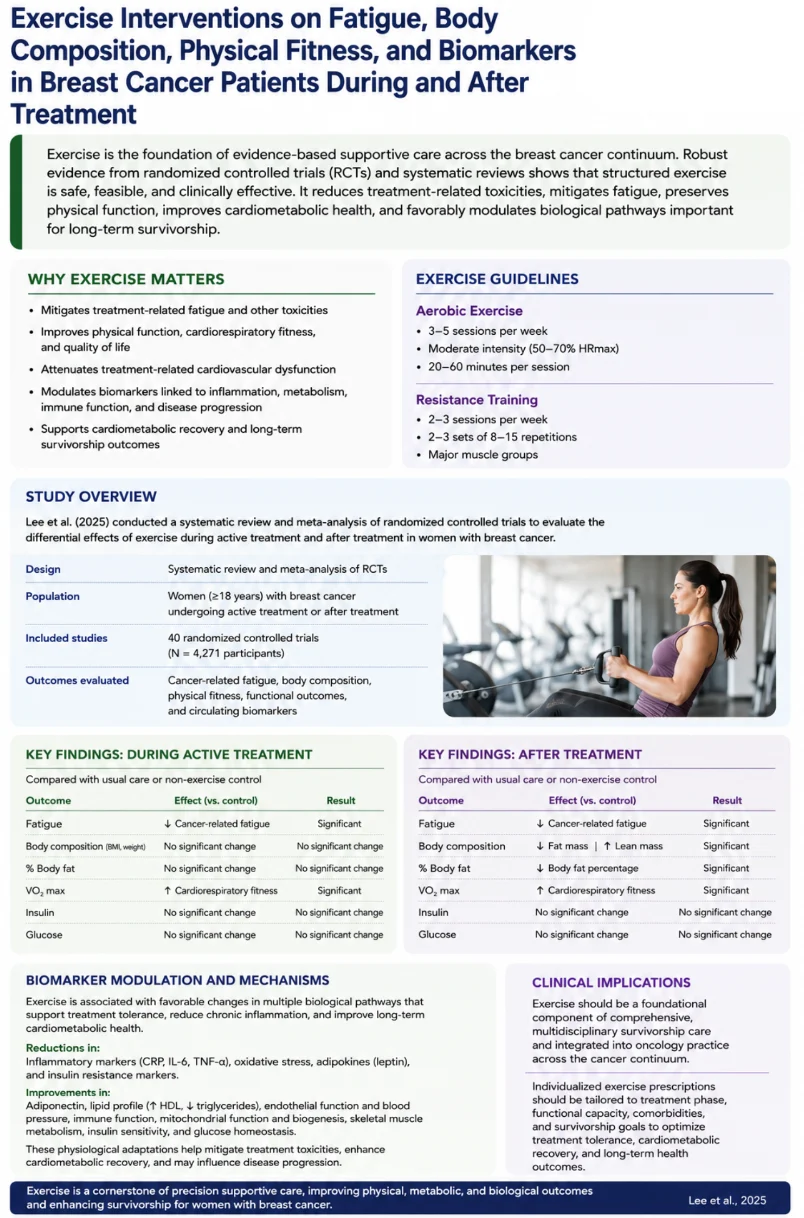
This article summarizes the systematic review and meta-analysis by Lee et al., which evaluated the effects of exercise interventions on fatigue, body composition, physical fitness, and circulating biomarkers in breast cancer patients during active treatment and after treatment completion.
The review synthesized evidence examining the impact of exercise on cancer-related fatigue, body composition, physical fitness, functional outcomes, and circulating biological biomarkers to characterize stage-specific responses to exercise.
Biological Mechanisms and Biomarker Modulation
Exercise has been associated with several important physiological benefits in breast cancer survivors, including:
- Reduced total and visceral fat and preservation of lean body mass
- Improved insulin resistance, glucose metabolism, and lipid profiles
- Favorable changes in inflammatory and metabolic biomarkers (e.g., CRP, IL-6, TNF-α, IGF-1, adiponectin, and leptin)
- Improved immune, endothelial, mitochondrial, and skeletal muscle function
- Enhanced cardiorespiratory fitness and overall metabolic health
Current Exercise Guidelines and Knowledge Gaps
| Current Exercise Guidelines | Evidence Gaps |
| Aerobic exercise: 3–5 sessions/week of moderate-intensity exercise (50–70% of maximum heart rate) for 20–60 minutes per session | Optimal timing of exercise across the breast cancer continuum |
| Resistance training: 2–3 sessions/week consisting of 2–3 sets of 8–15 repetitions targeting major muscle groups | Optimal modality, frequency, intensity, duration, and dose of exercise for different patient populations and treatment phases |
RESULTS
A total of 40 RCTs comprising 4,271 women with breast cancer were included in this systematic review and meta-analysis. Of these, 2,425 participants were undergoing active treatment, while 1,947 participants completed treatment.
Characteristics of Effective Exercise Programs
- Combined aerobic and resistance training with progressive overload
- Aerobic exercise: Walking, cycling, or treadmill exercise at 50–85% of maximum heart rate (HRmax)
- Resistance training: Approximately 60% of 1-RM for the upper body and 80% of 1-RM for the lower body
- During active treatment: Programs typically lasted 12 weeks
- After treatment: Longer-duration programs with 2–3 combined aerobic and resistance training sessions per week
During Active Treatment
- Reduced cancer-related fatigue
- Improved physical fitness (12-minute walk test performance)
- No significant changes in body weight or body mass index (BMI)
After Treatment
- Reduced cancer-related fatigue
- Improved body composition (increased lean body mass and reduced fat mass, body fat percentage, and waist circumference)
- Improved cardiometabolic and inflammatory biomarkers (reduced IL-6, LDL, fasting glucose, systolic and diastolic blood pressure, and increased HDL)
- No significant improvements in cardiorespiratory fitness (VO₂max), handgrip strength, or fasting insulin
These results support the implementation of stage-specific, individualized exercise prescriptions that prioritize symptom management and functional preservation during active treatment while emphasizing metabolic health, cardiovascular risk reduction, and long-term survivorship following treatment completion.
Toward Precision Exercise Oncology
- Exercise should be integrated as a foundational component of supportive care for individuals with breast cancer.
- Exercise prescriptions should be individualized based on treatment phase, treatment-related toxicities, functional capacity, comorbidities, and survivorship goals.
- During active treatment: Focus on symptom management, preserving physical function, maintaining treatment tolerance, and preventing functional decline. Low-to-moderate intensity combined aerobic and resistance exercise 1–2 times per week (20–40 minutes aerobic; 15–20 minutes resistance) is appropriate for most patients.
- After treatment completion: Emphasize rehabilitation, improving body composition, cardiometabolic health, and long-term survivorship. Moderate-to-vigorous intensity combined aerobic and resistance exercise 2–3 times per week (30–60 minutes aerobic; 20–30 minutes resistance) appears most effective.
The findings support the integration of exercise as a foundational component of evidence-based, precision supportive care across the breast cancer continuum while highlighting several priorities for future research and clinical implementation.
- Integrate exercise into routine care: Individualize exercise prescriptions based on treatment phase, functional status, and survivorship goals, and incorporate exercise into multidisciplinary breast cancer care pathways.
- Optimize exercise prescriptions: Conduct randomized trials to determine the optimal exercise type, intensity, frequency, duration, timing, and dose across the breast cancer continuum.
- Advance biomarker research: Investigate the biological mechanisms of exercise using comprehensive biomarker profiling, including inflammatory, metabolic, immune, and emerging molecular biomarkers.
- Evaluate long-term outcomes: Perform longitudinal studies assessing treatment toxicity, cardiovascular health, recurrence, survival, physical function, and quality of life using standardized exercise protocols and outcome measures.
Reference
Lee, J., Hwang, Y. The effects of exercise interventions on fatigue, body composition, physical fitness, and biomarkers in breast cancer patients during and after treatment: a systematic review and meta-analysis of randomized controlled trials. J Cancer Surviv 20, 1740–1768 (2025).
Table 1. Summary of pooled effect estimates for exercise interventions during active treatment and post-treatment survivorship in breast cancer.
| Outcome | During Active Treatment | Post-Treatment |
| Fatigue | Significant reduction (9 studies; d = −0.20, 95% CI: −0.32 to −0.08; p < 0.001) | Significant reduction (4 studies; d = −1.11, 95% CI: −1.36 to −0.85; p < 0.001) |
| Body mass index (BMI) | No significant change (3 studies; d = −0.17, 95% CI: −0.35 to 0.01; p = 0.07) | Not assessed |
| Body weight | No significant change (4 studies; d = −0.10, 95% CI: −0.27 to 0.06; p = 0.22) | Not assessed |
| Lean body mass | Not assessed | Significant increase (2 studies; d = 1.27, 95% CI: 0.96 to 1.59; p < 0.001) |
| Fat mass | Not assessed | Significant reduction (2 studies; d = −1.33, 95% CI: −1.67 to −0.99; p < 0.001) |
| Body fat (%) | Not assessed | Significant reduction (2 studies; d = −1.22, 95% CI: −1.57 to −0.88; p < 0.001) |
| Waist circumference | Not assessed | Significant reduction (4 studies; d = −0.69, 95% CI: −0.97 to −0.42; p < 0.001) |
| Physical fitness | Significant improvement in 12-minute walk test (3 studies; d = −0.29, 95% CI: −0.52 to −0.06; p = 0.01) | No significant effect on VO₂max (d = 0.25, 95% CI: −0.05 to 0.55; p = 0.10) or handgrip strength (d = −0.05, 95% CI: −0.28 to 0.18; p = 0.69) |
| Inflammatory biomarkers | Not assessed | Significant reduction in IL-6 (d = −0.95, 95% CI: −1.31 to −0.59; p < 0.001) |
| Lipid biomarkers | Not assessed | Significant increase in HDL (d = 2.16, 95% CI: 1.80 to 2.52; p < 0.001) and significant reduction in LDL (d = −1.49, 95% CI: −1.89 to −1.08; p < 0.001) |
| Metabolic biomarkers | Not assessed | Significant reduction in glucose (d = −0.66, 95% CI: −1.20 to −0.13; p < 0.001); no significant effect on insulin (d = 0.24, 95% CI: −0.04 to 0.52; p = 0.10) |
| Blood pressure | Not assessed | Significant reductions in systolic blood pressure (SBP; d = −1.23, 95% CI: −1.50 to −0.95; p < 0.001) and diastolic blood pressure (DBP; d = −0.87, 95% CI: −1.21 to −0.53; p < 0.001) |
You can also read: Muna Al-Khaifi: Lifestyle Programs and Cardiometabolic Health in Cancer Survivors