






Miguel Bronchud, Co-Founder and Advisory Board at Regenerative Medicine Solutions, shared a post on LinkedIn:
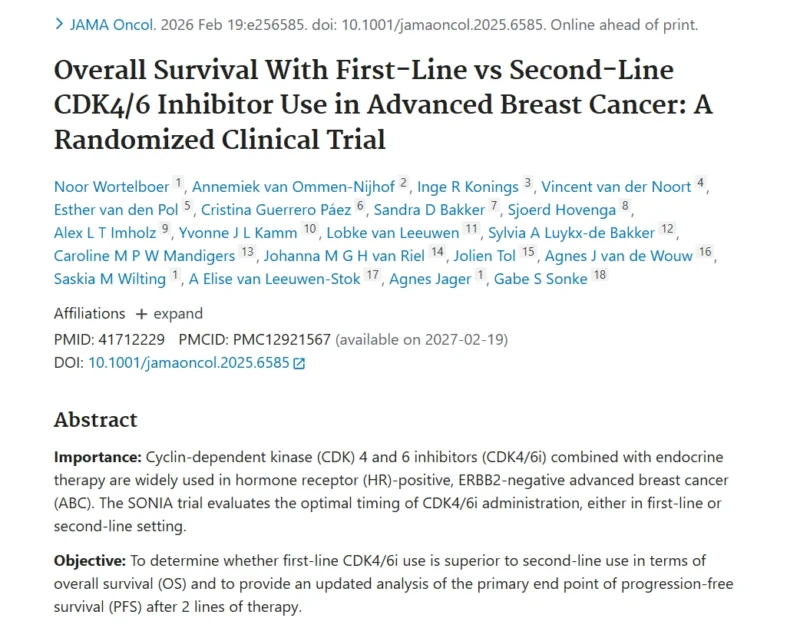
“In an open-label, investigator-initiated randomized phase III SONIA study, conducted in 74 Dutch hospitals, that compared the sequence of an aromatase inhibitor (AI) plus CDK4/6 inhibitor as first-line treatment followed by fulvestrant as second-line treatment (CDK4/6 inhibitor first-line group) versus the sequence of an AI as first-line treatment followed by fulvestrant plus CDK4/6 inhibitor as second-line treatment (CDK4/6 inhibitor second-line group), treatment with first-line CDK4/6 inhibitor use did not improve overall survival (OS) compared with second-line use, but did increase treatment-related and financial toxic effects in patients with hormone receptor (HR)-positive, HER2-negative advanced breast cancer (ABC).
In an accompanied editorial article, in JAMA Oncology 2026, Drs. Harold J. Burstein of the Dana-Farber Cancer Institute, Harvard Medical School in Boston, MA, US and Carmine Valenza of the European Institute of Oncology, IRCCS and Department of Oncology and Hemato-Oncology, University of Milan in Milan, Italy wrote that from a clinical point of view, the data from SONIA study suggest that a substantial percentage of patients with HR-positive ABC might be appropriately treated with endocrine therapy alone as initial treatment, reserving introduction of CDK4/6 inhibitor for later in the course of disease.
This cohort would include postmenopausal patients with either endocrine-naive or minimally treated cancers and modest tumor burden, where there is a high expectation of endocrine sensitivity and a high likelihood of being capable of receiving treatment at crossover.
Offering these individuals endocrine therapy alone with opportunity for CDK4/6 inhibitor at crossover is likely to be a well-tolerated and effective option. In patients with more extensive disease or prior endocrine therapy, tumors with PIK3CA variations, or premenopausal status, combination treatment with a CDK4/6 inhibitor looks more valuable.
There is a growing number of second-line targeted therapy options, including oral selective estrogen receptor degraders, use of CDK4/6 inhibitor beyond progression, and multiple new agents targeting the PIK3CA/AKT/PTEN pathway. Beyond the endocrine-targeted therapy axis, multiple antibody drug conjugates have been shown to have significant activity in HR-positive ABC.
Because of the availability of these treatments and widespread use of adjuvant endocrine treatments, which may now incorporate CDK4/6 inhibitors, there has been a marked escalation in the heterogeneity of treatment patterns offered to patients with breast cancer.
Owing to Dutch accrual, patients in the SONIA study had access to equivalent sets of therapy beyond initial progression.”
Title: Overall Survival With First-Line vs Second-Line CDK4/6 Inhibitor Use in Advanced Breast Cancer: A Randomized Clinical Trial
Authors: Noor Wortelboer, Annemiek van Ommen-Nijhof, Inge R Konings, Vincent van der Noort, Esther van den Pol, Cristina Guerrero Páez, Sandra D Bakker, Sjoerd Hovenga, Alex L T Imholz, Yvonne J L Kamm, Lobke van Leeuwen, Sylvia A Luykx-de Bakker, Caroline M P W Mandigers, Johanna M G H van Riel, Jolien Tol, Agnes J van de Wouw, Saskia M Wilting, A Elise van Leeuwen-Stok, Agnes Jager, Gabe S Sonke.
Other articles featuring Miguel Bronchud on OncoDaily.