






Olubukola Ayodele, Breast Cancer Lead at University Hospitals of Leicester NHS Trust, shared a post on LinkedIn:
“New patient clinics are usually the toughest in oncology.
You are meeting someone at one of the most vulnerable moments of their life. That first appointment is rarely routine. It carries urgency, uncertainty and weight because in that moment, patients are placing enormous trust in you.
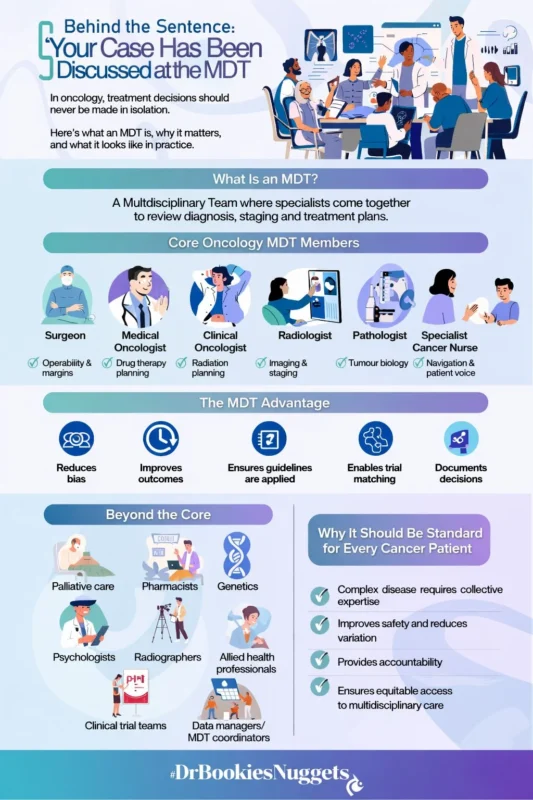
Knowing their treatment plan wasn’t made in isolation often helps. That is the power of the Multidisciplinary Team (MDT).
An MDT is where cancer specialists come together to review every new diagnosis before a plan is finalised. It is structured, documented and evidence-based. Not a corridor conversation. Not a quick second opinion. A formal meeting.
In oncology, complexity is the rule, not the exception.
- Scans need expert interpretation.
- Biopsies need precise pathological classification.
- Operability must be assessed.
- Sequencing of surgery, systemic therapy and radiotherapy must be carefully timed.
- Clinical trial eligibility must be considered.
No single clinician holds all of that safely alone.
At a minimum, a true cancer MDT should include:
- A site-specific surgeon.
- A medical oncologist.
- A clinical or radiation oncologist.
- A radiologist.
- A pathologist.
- A specialist cancer nurse.
- And critically, the MDT coordinator ensuring accuracy, completeness and governance.
Without radiology and pathology review, staging can be wrong.
Without surgical and oncology collaboration, sequencing can compromise outcomes.
Without specialist nursing input, the patient’s lived reality is underrepresented.
Stronger MDTs can include palliative care, pharmacists, geneticists, psychologists, allied health professionals and clinical trial teams.
What makes MDTs powerful is not just attendance. It is the challenge within the room.
The radiologist may question resectability.
The pathologist may redefine tumour subtype.
The surgeon may readdress margins.
The oncologist may highlight a trial option.
Plans are tested in real time. Variation reduces. Bias is checked. Decisions are strengthened.
In cancer care, MDT discussions should not be optional. Every newly diagnosed patient should be reviewed in this forum wherever possible. Where full teams are not available, services must link into regional networks. Equity in outcomes depends on equitable access to multidisciplinary decision-making.
But here is the nuance we do not always explain. MDT decisions are not law. The MDT reviews biology, data and guidelines, reaching a consensus based on evidence and expertise.
Then the clinician meets the person in front of them. Co-morbidities. Responsibilities. Values. Fears. Priorities. The MDT gives the safest, evidence-based foundation. The final plan is shaped through shared decision-making. That is patient-centred care.
The best cancer care happens when both are held with equal weight. How do you balance guideline-driven care with the reality of the person in front of you?
Let’s discuss.”
Other articles about MDT on OncoDaily.