






Kefah Mokbel, Chair of Breast Cancer Surgery at London Breast Institute and Honorary Professor of Medicine at Cardiff University School of Medicine, shared a post on LinkedIn:
“PIK3CA testing in HR+/HER2− metastatic breast cancer: what every oncologist needs to know.
A timely expert consensus published in npj Breast Cancer (Marchiò, Rojo, Copson et al., 2026) provides much-needed practical guidance on PIK3CA testing, which is becoming increasingly essential as PI3Kα inhibitors move into first-line clinical practice.
Key takeaways:
- Test early – at metastatic diagnosis rather than at progression. With inavolisib now EMA-approved in the first-line endocrine-resistant setting, delaying testing may result in missed therapeutic opportunities.
- A turnaround time of 2–3 weeks should be the benchmark. Reflex testing workflows and dual-sample strategies (tissue plus ctDNA simultaneously) can reduce delays and minimise sample failure rates.
- Targeted-panel NGS is the preferred platform, enabling simultaneous assessment of PIK3CA, ESR1, AKT1, PTEN, and BRCA1/2. qPCR remains an acceptable alternative where NGS access is limited.
- Pre-analytical handling is critical, particularly EDTA rather than acid decalcification for bone biopsies, adequate tumour cellularity (20–30%), and the use of stabilising tubes such as Streck for liquid biopsy.
- Reporting should align with ESMO ESCAT classification, clearly distinguishing actionable variants (ESCAT IA: H1047R, E545K, E542K, etc.) from variants of uncertain significance.
- Routine re-testing at progression is not recommended when high-quality baseline testing is negative for PIK3CA, AKT1, and PTEN alterations. This differs from ESR1, where serial ctDNA monitoring remains clinically relevant.
- Equity gaps remain a major challenge. Limited NGS access, inconsistent reimbursement, and variable genomic literacy across healthcare systems continue to leave many eligible patients untested. Education across the entire diagnostic pathway – oncologists, surgeons, radiologists, nurses, and laboratory teams – is essential.
The message is clear: PIK3CA testing is no longer optional. It is now a fundamental component of personalised care in HR+/HER2− metastatic breast cancer.”
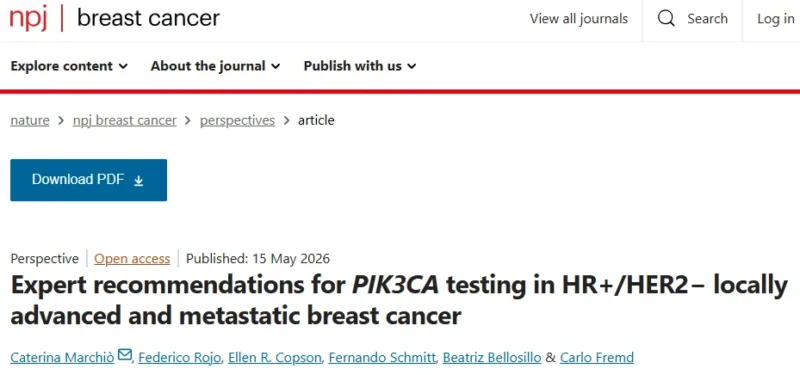
Title: Expert recommendations for PIK3CA testing in HR+/HER2− locally advanced and metastatic breast cancer
Authors: Caterina Marchiò, Federico Rojo, Ellen R. Copson, Fernando Schmitt, Beatriz Bellosillo, Carlo Fremd
Read the Full Article.
Other articles about breast cancer on OncoDaily.