





Justin Eyquem, Gene Editor and Synthetic Immunologist at UC San Francisco, shared a post on X:
“I am so excited to share our new paper in Nature the first programmable, site-specific integration of a large DNA payload into T cells in vivo.
A single IV injection results in therapeutic levels of TRAC-targeted CAR T cells in multiple models.
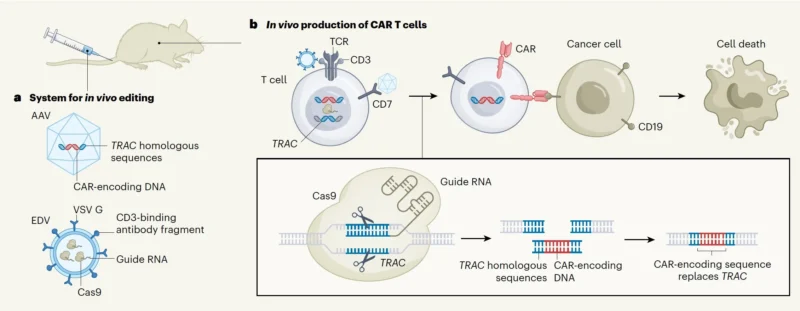
For the past decade, we’ve been optimizing site-specific CAR T cell engineering, convinced that precision matters, for safety, potency and durability. When we turned to in vivo CAR T cell generation, we refused to sacrifice that precision.
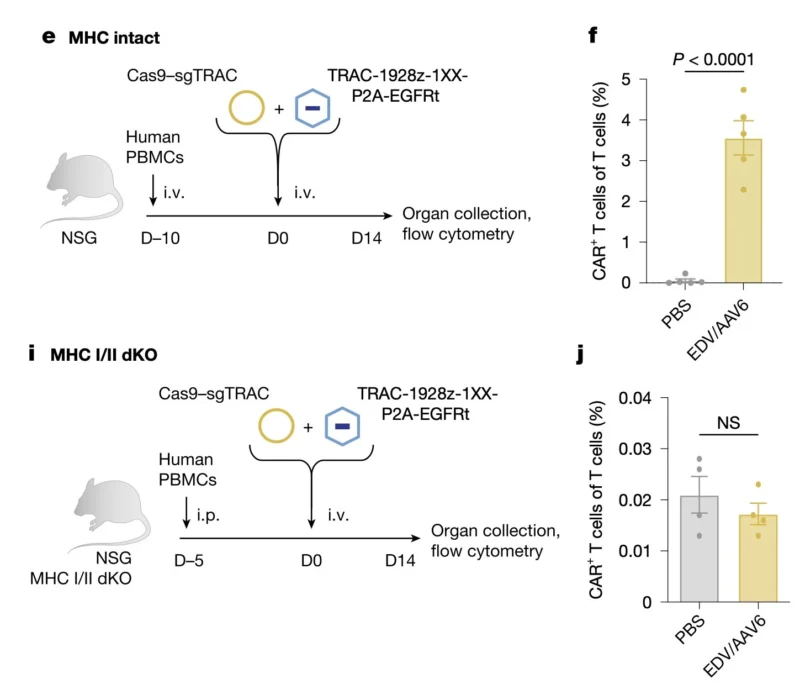
Using an EDV without CD3 targeting and AAV6 we were able to generate TRAC CAR T cells in a humanized NSG, but not an MHC I/II DKO. Note to the field, T cells activation by xeno-GVHD in a NSG mouse facilitate in vivo engineering. Easy to be fooled…
We needed better vectors.
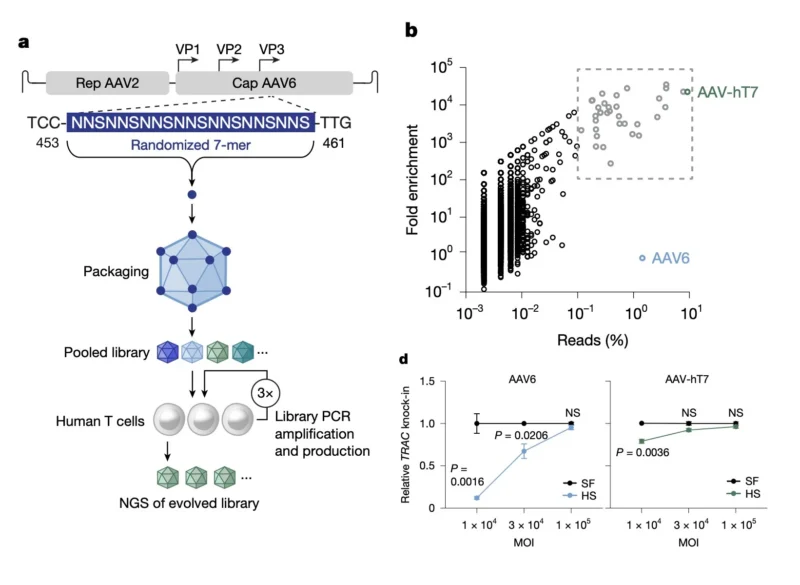
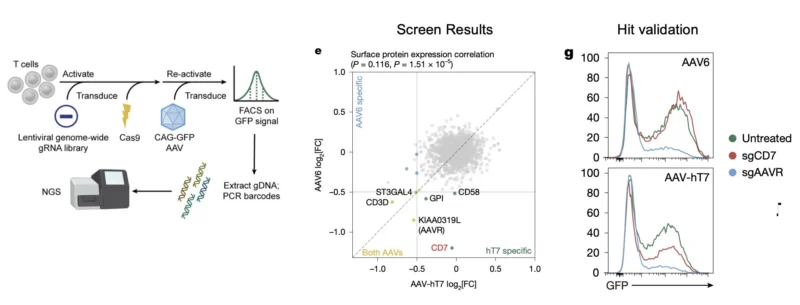
For the AAV, we evolved a capsid library from Aravind Asokan lab on human T cells with human serum and identified hT7-AAV, a novel capsid which transduced T cells efficiently in the presence of neutralizing antibodies.
To understand hT7-AAV tropism, we performed a genome wide CRISPR screen on human primary T cells and excitingly, identified CD7, a T/NK cell marker, as a critical transduction factor.
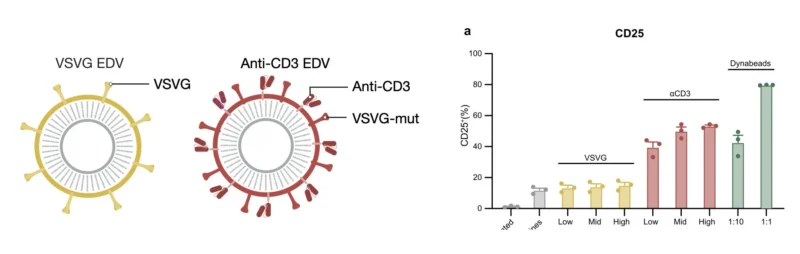
For the EDV, displaying CD3 provides T cell activation and greater specificity. Confirming Jenny Hamilton’s data in her Nature Biotech 2024 paper.
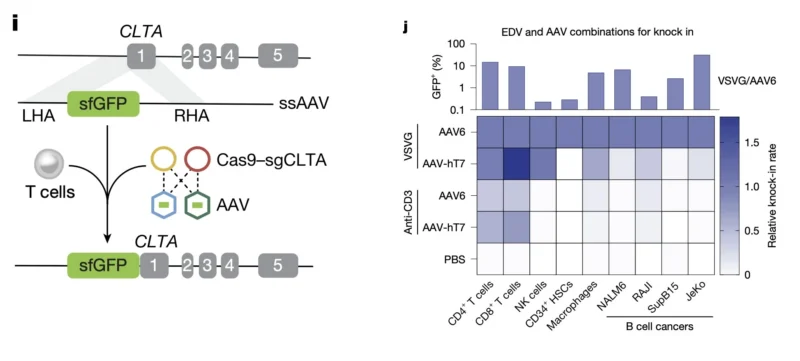
Both vectors are independently engineered for preferential T cell delivery. And by integrating a promoterless CAR cassette directly into the TRAC locus, a gene exclusively expressed in T cells, we restrict CAR expression to T cells. Together it’s 3 layers of specificity.
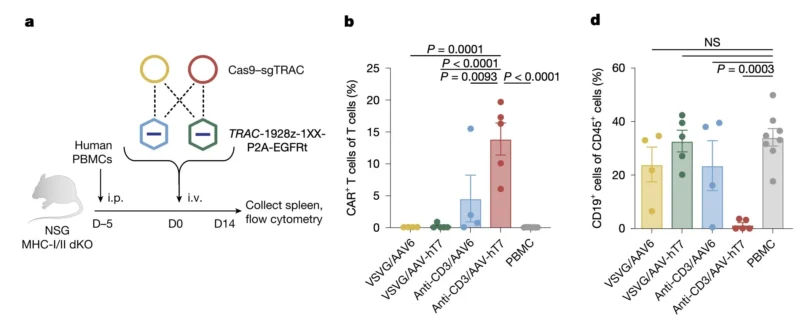
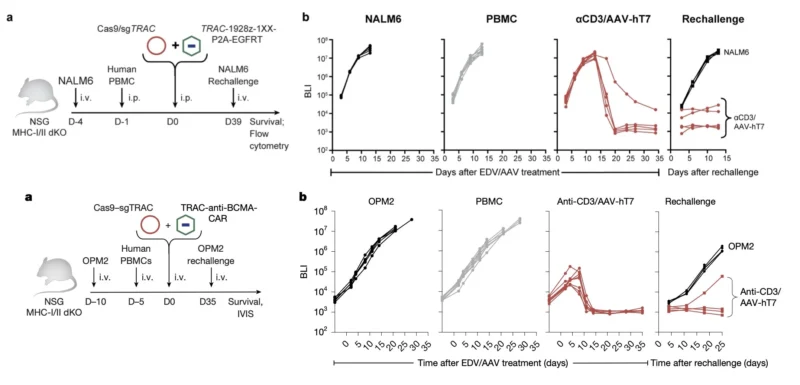
We first tested our vectors in a humanized B cell aplasia mouse model. A single injection of our engineered vectors achieved potent TRAC-CD19 CAR T cells generation and complete B cell aplasia, data relevant for a B cell reset in autoimmune disorders.
We next move to oncology and show that a single IV injection achieved therapeutic levels of TRAC-CAR T cells in models of aggressive leukemia and myeloma. We also confirmed their functional persistence with tumor rechallenge assays.
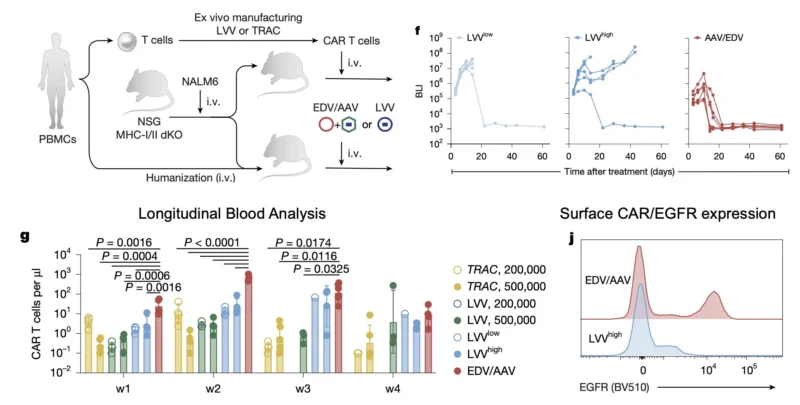
Remarkably, head-to-head, our in vivo TRAC-CAR T cells outperformed engineered lentiviral vectors delivering the same CAR at equivalent dose, which we believe reflects the fundamental advantage of site-specific over random integration.
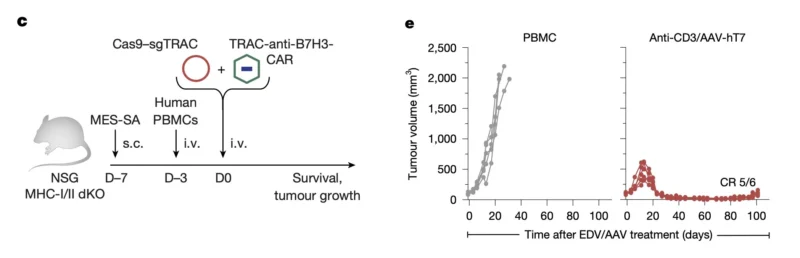
We have been asked many times: could in vivo generated CAR T cells work in solid tumors?
PL Bernard tested it and YES! In a uterine Sarcoma model, we show that a single injection of vectors delivering a TRAC-B7H3-CAR can achieve complete responses in our humanized mouse model.
Huge congrats to first authors William Nyberg and PL Bernard! Thank you to the many collaborators especially in the Doudna Jennifer and Aravind Asokan. This is what happens when genome editing, delivery science and synthetic immunology come together around a bold shared goal.
I am deeply grateful for UC San Francisco and Gladstone Institutes for creating a highly collaborative environment that supports team science to tackle big problems! I also want to thank all the funders who believed in this project especially Parker Institute for Cancer Immunotherapy, The Pew Trusts, Multiple Myeloma RF and Weill Cancer Hub.
The technology is now being further advanced both academically UC San Francisco and by Azalea Therapeutics, where the team led by Jenny Hamilton has already reproduced and extended these findings into non-human primates!”
Title: In vivo site-specific engineering to reprogram T cells
Authors: William A. Nyberg, Pierre-Louis Bernard, Wayne Ngo, Charlotte H. Wang, Jonathan Ark, Allison Rothrock, Gina M. Borgo, Gabriella R. Kimmerly, Jae Hyung Jung, Vincent Allain, Jennifer R. Hamilton, Alisha Baldwin, Robert Stickels, Sarah Wyman, Safwaan H. Khan, Shanshan Lang, Donna Marsh, Niran Almudhfar, Catherine Novick, Yasaman Mortazavi, Shimin Zhang, Mahmoud M. AbdElwakil, Luis R. Sandoval, Sidney Hwang, Simon N. Chu, Hyuncheol Jung, Chang Liu, Devesh Sharma, Travis McCreary, Zhongmei Li, Ansuman T. Satpathy, Julia Carnevale, Rachel L. Rutishauser, M. Kyle Cromer, Kole T. Roybal, Stacie E. Dodgson, Jennifer A. Doudna, Aravind Asokan, Justin Eyquem
Read The Full Article
Other articles about CAR T on OncoDaily.