






Harvard Medical School Master Of Medical Sciences In Global Health Health Delivery(MMSc-GHD) shared a post by Christian Ntizimira, Executive Director of ACREOL and Faculty member of the Palliative Care Centre for Excellence in Research and Education (PalC), Singapore on LinkedIn, adding:
“Alum Christian Ntizimira, MMSc ‘19 published his Harvard Medical School Master of Medical Sciences in Global Health Delivery (MMSc-GHD) thesis research in The Journal of Pain and Symptom Management with his thesis mentor Eric Krakauer as senior author.
Christian’s MMSc-GHD thesis expanded on his passion for palliative care, and since graduating, he has worked diligently to improve palliative care in Africa. He founded the nonprofit ACREOL and wrote an award-winning book, The Safari Concept:
An African Framework for End of Life Care. Congratulations to Christian and to the other authors on the article Deo Mbonyinkebe, Mary Dunne and Eric Krakauer.”
Quoting Christian Ntizimira‘s post:
“I am honored to announce the publication of my thesis project from Harvard Medical School, Global Health and Social Medicine, representing nearly four years of research, ethnographic fieldwork, and sustained scholarly engagement.
This study develops an anthropo-palliative framework for examining death and dying across pre-colonial and post-colonial periods, with particular emphasis on the relevance of traditional perspectives as a biosocial contribution to contemporary medicine.
By critically engaging African understandings of personhood, suffering, care, and mortality, the project argues for the importance of cultural relativism in the rethinking of end-of-life care. In the African context, I hope this research will contribute to the redesign of approaches to death and dying and support the rebuilding of culturally grounded, context-sensitive palliative care programs across the continent.
I wish to express my deepest gratitude to my thesis committee, Prof. Arthur Kleinman, Dr. Mary Dunne, and Prof. Mbonyinkebe Deo, and especially to Dr. Eric Krakauer, my thesis director, whose intellectual guidance, careful supervision, and support throughout the writing process were invaluable to this work.
I am equally indebted to the fieldwork supporters in Rwanda, without whom this ethnographic research would not have been possible. Their support ensured that this work remained attentive to lived experience, local knowledge, and the social realities that shape care at the end of life.
My sincere appreciation also goes to the Harvard Medical faculty who enriched my intellectual formation during my time in Boston: Dr. Joia Mukherjee , Dr. Christina Thompson Lively, Dr. Jason Silverstein, Prof. Byron Goods, and Dr. Hannah Gilbert. I remain deeply grateful for your mentorship, scholarship, and generosity.
Finally, I dedicate this publication to the memory of Dr. Paul Farmer, from whom I first encountered the anthropological perspective on end-of-life care. His intellectual legacy and moral commitment continue to shape and inspire this work.”
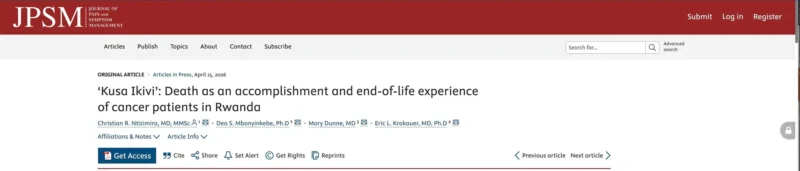
Title: ‘Kusa Ikivi’: Death as an accomplishment and end-of-life experience of cancer patients in Rwanda
Authors: Christian R. Ntizimira, Deo S. Mbonyinkebe, Mary Dunne, Eric L. Krakauer
Other Articles Featuring Christian Ntizimira on OncoDaily.