





Haitham Shaheen, Lecturer of Clinical Oncology at Suez Canal University Egypt, shared a apsot on LinkedIn:
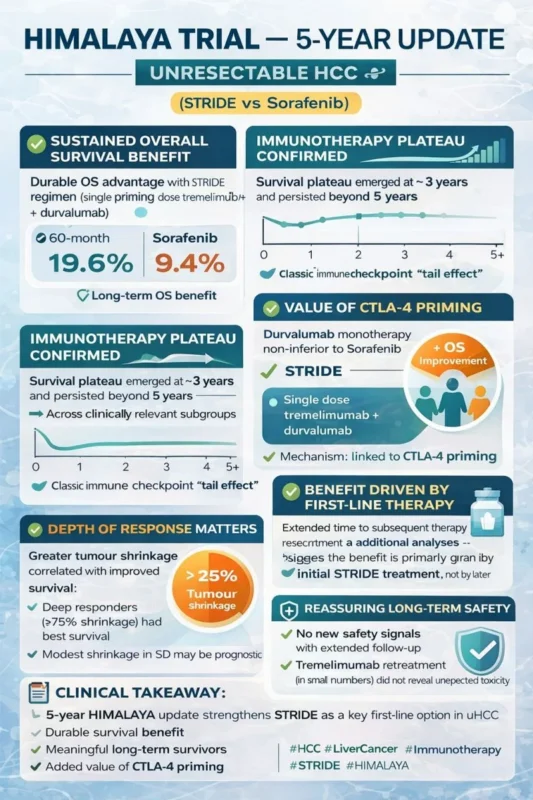
“HIMALAYA Trial – 5-Year Update in Unresectable HCC
(STRIDE vs Sorafenib)
The updated analysis of the phase III HIMALAYA study continues to reinforce the durable impact of immunotherapy in advanced hepatocellular carcinoma.
Key Highlights
Sustained Overall Survival Benefit
The STRIDE regimen (single priming dose tremelimumab + durvalumab) maintained a clinically meaningful OS advantage over sorafenib.
- 60-month OS:
- STRIDE: 19.6%
- Sorafenib: 9.4%
- Clear evidence of a long-term survival tail.
Immunotherapy Plateau Confirmed
A survival plateau emerged at ~3 years and persisted beyond 5 years – a hallmark of effective immune checkpoint therapy in uHCC.
Long-term survivors were observed across clinically relevant subgroups.
Value of CTLA-4 Priming
While durvalumab monotherapy remained non-inferior to sorafenib, the STRIDE regimen demonstrated greater OS improvement, highlighting the added value of a single tremelimumab priming dose.
Benefit Driven by First-Line Therapy
Extended time to subsequent therapy and additional analyses suggest the survival advantage is primarily driven by the initial STRIDE treatment, not by later lines.
Depth of Response Matters
Greater tumour shrinkage correlated with improved survival:
- Patients with >25% tumour reduction derived the greatest benefit.
- Deep responders (>75% shrinkage) showed the highest 5-year survival estimates.
- Even modest shrinkage within RECIST stable disease may carry prognostic value.
This challenges the traditional reliance on RECIST thresholds alone.
Reassuring Long-Term Safety
- No new safety signals with extended follow-up
- Tremelimumab retreatment (in small numbers) did not reveal unexpected toxicity
- Supports the long-term tolerability of the STRIDE approach
Clinical Takeaway
The 5-year HIMALAYA update strengthens STRIDE as a key first-line option in uHCC, demonstrating:
- Durable survival benefit
- Meaningful long-term survivor fraction
- Added value of CTLA-4 priming
- Potential importance of depth of response beyond conventional RECIST”
Other posts on OncoDaily.