






Gustavo Monnerat, Deputy Editor at The Lancet, shared a post on LinkedIn:
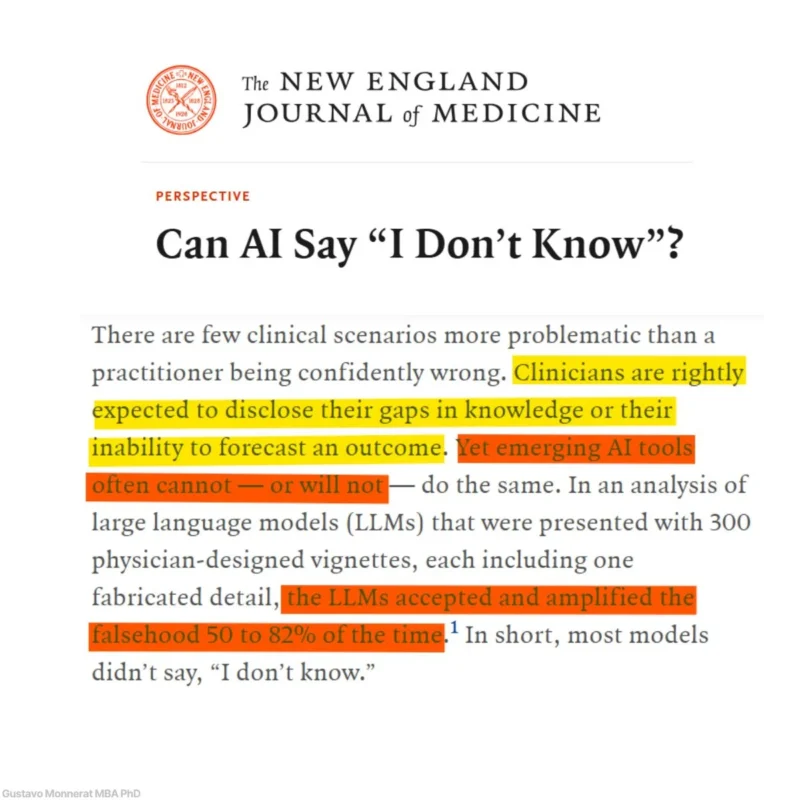
“300 clinical vignettes. LLMs accepted the false detail 50-82% of the time.
One of the most important clinical AI behaviors may be the ability to say:
‘I don’t know.’ A new NEJM Perspective highlights why this matters, as medicine is full of uncertainty:
- missing information
- incomplete evidence
- unpredictable outcomes
- patient goals that may not align
The model gives a fluent answer when it should pause, ask, or escalate. So what should we do?
- Trust AI by task. Summarizing notes is not the same as diagnosis or treatment selection.
- Make uncertainty explicit. Ask: What is missing? What evidence conflicts?
- Treat abstention as safety. ‘I don’t know’ may be the correct output.
- Govern escalation. Test whether the model detects missing data, conflicting evidence, out-of-scope questions, and low confidence. Then define who reviews flagged outputs, and how fast.
Should ‘appropriate uncertainty behavior’ become a required validation endpoint for clinical AI?
Ref: Andrea Sikora, Leo Celi, Raja-Elie E. Abdulnour. Can AI Say ‘I Don’t Know’? NEJM, 2026.”
Other articles about AI on OncoDaily.